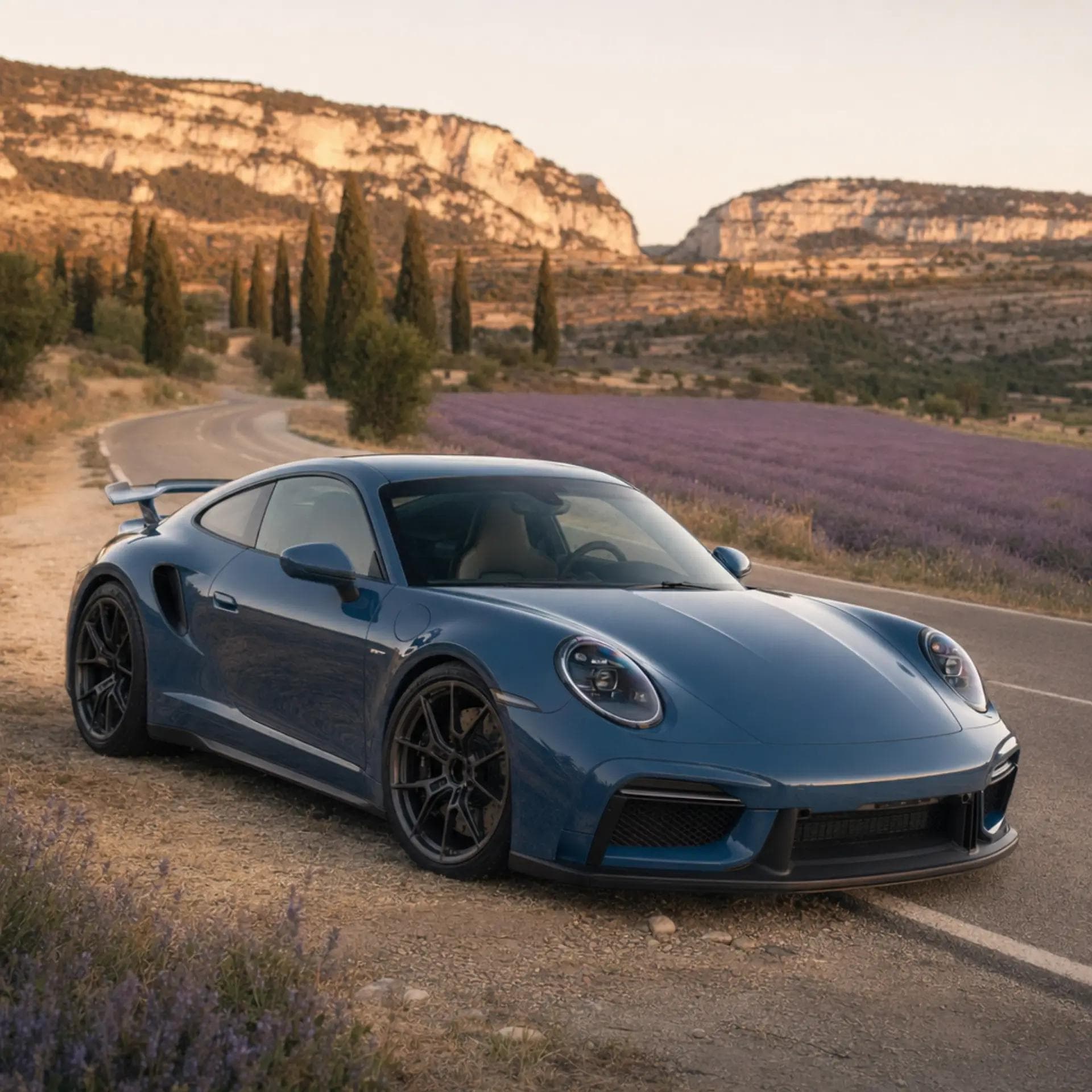
Porsche confirmed in late 2025 that the 992.2 GT3 will be the last GT3 with a naturally-aspirated flat-six and an optional manual gearbox. The next-generation 911 GT3, expected to enter production in 2027, will be a hybrid by regulation rather than choice. The 992.2 is therefore the last of a particular kind of car: a road-legal Porsche that drives the way the Porsche engineers have wanted Porsches to drive since 1973. We took one through three days of Provence in early September to understand what is being preserved and what is being lost.
The 992.2 GT3 was loaned by a private collector who has held three previous GT3 generations and who, after this loan, indicated he would not let it back out. The car has approximately 4,200 kilometers on the odometer and was specified with the manual gearbox, the lightweight Clubsport package, and the standard front-axle lift. We collected it in Marseille at the end of August and routed it inland through the Luberon for two days before climbing into the Verdon for the third. The trip was 1,180 kilometers total. None of those kilometers were at any speed that would have meaningfully approached the car's capability. The car did not require any of them to be.
The 992.2 is the last of a particular kind of car: a road-legal Porsche that drives the way the Porsche engineers have wanted Porsches to drive since 1973.
Three days, no track
We did not take the GT3 to a track. The decision was deliberate. The 992.2 GT3 is the most track-capable production Porsche the company has built, by every measurement Porsche publishes; the question we wanted to answer was whether the same car remained a road car, in any meaningful sense, when the surface beneath it was a closed two-lane backroad in late summer with the kind of granular asphalt the Mediterranean coast still uses. The answer, after three days, is yes, with caveats.
The Luberon roads are technical without being dangerous. The asphalt is good but not perfect. The corners are tight, often blind, and frequently change camber halfway through. The traffic is sparse outside the morning and evening windows. The GT3 in this environment is, in a way that is difficult to convey to anyone who has not driven a similar car on a similar road, in its element. The chassis settles into the surface with a kind of patient confidence that makes the car feel slower than it is. The throttle response is immediate and linear. The gearbox is the gearbox we have been driving in 911 GT3s since 1999, refined past the point where any further refinement would matter, and the brake response is the brake response of a car the company has built for road use first and track validation second, which is the priority order most owners actually need and almost no manufacturer still respects.
What the engineers protected
Three things, after three days. The first is the engine. The 4.0-liter naturally-aspirated flat-six is a development of the same architecture Porsche has run in GT3s since 2004. It produces 510 horsepower at 8,400 rpm and 470 newton-meters at 6,250 rpm. The numbers, on paper, are unremarkable against modern hybrid hypercars. The numbers, in the cabin, are the wrong measurement entirely. The engine's power delivery is linear from idle to redline, the rev-matching protocol on the manual is unobtrusive and excellent, and the noise that the engine makes between 5,500 and 8,000 rpm is the noise the Porsche engineers have been working on since the original 911 ST in 1971. That noise is what is being lost in 2027. No hybrid system replicates it. None of the marketing material around the next-generation GT3 will pretend otherwise.
The second is the gearbox. The manual on the 992.2 is, by every measurement the Porsche engineering team uses internally, the best manual transmission Porsche has ever built. The shifter throws are short, the gates are positive, the synchros engage with a precision that does not require concentration. After three days of varied driving the gearbox felt like an extension of the right hand, in the way the best mechanical interfaces always do. The PDK option, which is faster on every measurable axis, was not specified on this car and would have been a different car if it had been. The 992.2 GT3 with a manual is approximately seven percent of total GT3 production and substantially less than that internationally. The number is small and the reasons are commercial. It is also the number that defines the car for the people who actually drive these cars on roads.
The Provence reading
The point of the trip was the road, the noise, the gear changes, and the question of whether a car this far up the performance curve can still be a road car. The answer, on the third day, was clearer than it had been on the first. The asphalt wound endlessly higher through the Verdon valleys, twisting in a sequence that demanded complete attention, rewarding the driver with pure unfiltered mechanical music. We stopped twice in three days for fuel and water. We did not stop once for the car to do anything other than what it was doing. That is, in the context of modern performance cars, increasingly rare. Most modern hypercars require electronics-assisted intervention at some point in any extended drive. The GT3 did not. The GT3 stayed with the driver.
The closing climb out of Castellane toward the high points above the gorge produced the kind of late-afternoon light that Provence is famous for, and the car in that light, on that road, became the car the engineers had presumably been building from the start. There is no test on a closed circuit that captures what that drive felt like. There is also no test on a closed circuit that needs to. The car is, on its third day in the right environment, the answer to the question the engineers set themselves.
What 2027 looks like
Porsche has not released technical detail on the next-generation GT3. What is known publicly is that the platform will incorporate hybrid assistance to comply with the regulatory framework that Europe and California will impose on internal-combustion sports cars from 2027 forward. The hybrid system will, by every published technical hint, be a 48-volt mild-hybrid rather than a full-hybrid plug-in. The performance numbers, on paper, will likely be higher than the 992.2 GT3. The character will be different. The naturally-aspirated flat-six remains in the platform; the manual gearbox does not, except potentially in a limited Heritage-specification variant that Porsche has not committed to publicly.
Owners considering the 992.2 GT3 as a final-of-its-kind acquisition should consider the manual specification specifically. The manual gearbox in this generation is the artifact, more than any other component, that the next generation cannot replicate. Pricing in the secondary market on manual-spec 992.2 GT3s is already running ten to fifteen percent above PDK-spec equivalents and can be expected to widen further once the 2027 platform is announced. The Porsche Heritage program, which manages restoration and maintenance for older performance Porsches, will continue to support 992.2 GT3 ownership indefinitely. The cars will be drivable for as long as anyone wants to drive them.
Further reading: our coverage of G700 delivery slips and secondary-market repricing for clients pairing private flight with performance-car ownership, our Automotive vertical for ongoing performance-car intelligence, and our analysis of shoulder-season Cap Ferrat charter for the destination side of the trip. The Bryant editorial standards on automotive coverage are described on our About page; for daily allocation, road-test, and secondary-market intelligence, subscribe to Bryant Premium for The Bryant Memo.