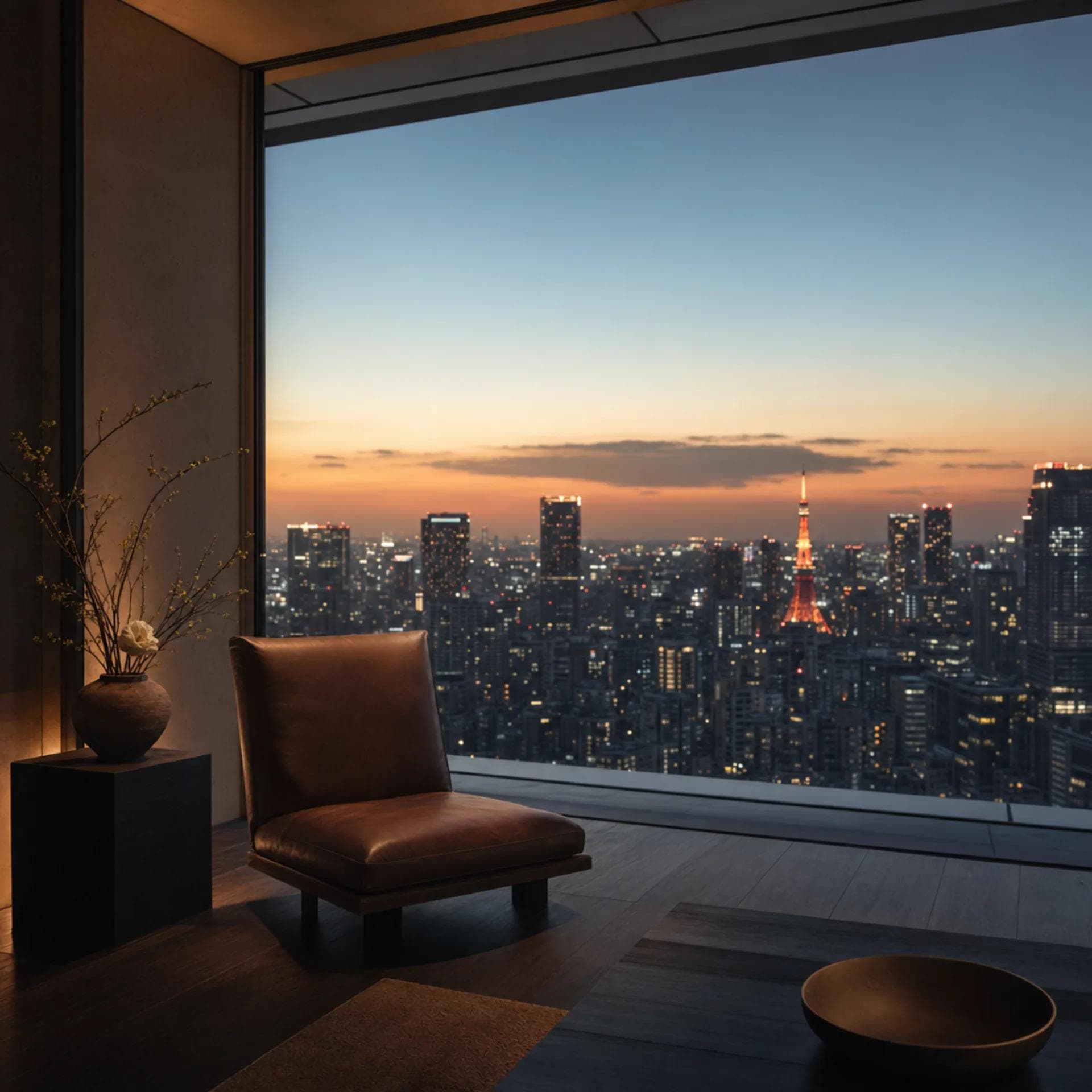
Aman Tokyo opens onto its 33rd-floor lobby through a corridor whose lighting takes the better part of a minute to read correctly. The corridor is dim. The lobby beyond is dim. The dimness is not a mistake. It is the architectural device that rewires the guest from the city below, Otemachi at evening, all glass and corporate-tower light, into the brand's quieter register. By the time a guest has crossed the lobby, taken the seat that the host directs them to, and accepted a cup of tea they did not ask for, they are in a building that has fundamentally negotiated with Tokyo for its right to be a different kind of room. A decade in, the negotiation has held.
We spent four nights at Aman Tokyo in September. The property opened in 2014 with 84 keys, the largest Aman by room count at the time, in the top six floors of the Otemachi Tower. The thesis at opening was that the Aman experience could survive vertical density, big-city noise, and corporate-tower architecture if the interior committed to the brand's silence and craft. The thesis was, at the time, contested. The brand's previous urban property, Aman Singapore, had not held; it closed within six years of opening, never reaching the rates the brand had projected. The Tokyo property was the bet that the Singapore problem was a Singapore problem and not a vertical-Aman problem. A decade later, the bet has paid out: rates have nearly doubled, occupancy has held above ninety percent through three economic cycles, and the lobby on the 33rd floor still operates on the same don't-perform-the-luxury rule that Adrian Zecha wrote into the brand book in 1988.
Don't perform the luxury. What you cannot have in Tokyo, you do not get. What you do get is delivered without any narrative around it.
What four nights confirmed
The original Aman Tokyo holds. Service ratios are the same as a desert Aman; we counted four staff in the corridors during a late-evening walk to the elevator, in a hotel with eighty-four occupied rooms, on a property that never feels staffed and never feels under-staffed. The spa runs on the same lap-and-onsen rhythm as Amankora and Aman-i-Khás, which is the rhythm Aman built its reputation on twenty years before the words wellness and longevity were in the brand decks of every other luxury group. The lobby on the 33rd floor still operates on the same rule that Adrian Zecha wrote into the original brand book: don't perform the luxury. What you cannot have in Tokyo, you do not get. What you do get is delivered without any narrative around it. A difference that, ten years in, Tokyo guests have learned to value above the usual hotel theater.
Three details from the four nights. The first: the room turn-down service does not include a card. There is no signature, no inspirational quote, no daily weather report on the pillow. The bed is turned down, the slippers are placed, the curtains are drawn to a specific angle that the housekeeper has been trained to identify. There is no theater. Second: the in-room dining menu is one page. There is no second page. There is no breakfast menu separate from the main menu. There are eleven dishes and they are eleven dishes that the kitchen will execute correctly at three in the afternoon and at three in the morning and the kitchen will not propose a substitution. Third: the swimming pool, which sits on a corner of the 34th floor with a view of the Imperial Palace gardens, has no music. There are no underwater speakers. There is no ambient soundtrack. The room is silent, and the silence is the feature.
These are not, individually, large things. They are the accumulated daily decisions of a property whose general manager has been in place for seven years and whose housekeeping director has been in place for nine. Aman Tokyo is staffed at a level that most luxury hotels in Tokyo cannot match because the property pays at a level the others will not match, and because Aman has always run the property to retain. The cost structure is high. The rate structure compensates for it. The math, after a decade, works.
Adrian Zecha's brand, after Adrian Zecha
Adrian Zecha founded Aman Resorts in 1988 and stepped away from the operating company in 2014, twenty-six years and twenty-eight properties later. The brand he built was, at his exit, a small portfolio of one-of-one resorts in remote locations that operated at occupancies most luxury operators considered impossible. Aman never advertised, never accepted travel-press junkets, never participated in the loyalty programs that defined the rest of the luxury hotel category. It ran on referrals from previous guests and on a service ratio of approximately four staff to one guest, which was not commercially defensible by any normal hotel-finance model and was in fact quietly subsidized for years by Zecha's own real estate development gains.
The current Aman, owned by the Russian-born investor Vladislav Doronin since 2014, operates on different financial mechanics. The brand portfolio has expanded from twenty-eight properties to thirty-two and is committed to growth toward fifty by 2030. The growth has been almost entirely in residences rather than hotel keys; Aman New York opened in 2022 with twenty-two suites and forty-two residences, and the residences sold at rates that the New York real estate market did not believe were possible until they did. Aman Bangkok and Aman Beverly Hills will follow the same model. The economics work because the residences pay for the hotel and the hotel maintains the brand value that the residences are pricing against. It is a financial structure that Adrian Zecha never used and that, by some accounts, he is uncomfortable with. It is also the structure that has tripled the brand's enterprise value in eight years.
The Roppongi project
The 2027 property is a different bet. It will operate eighteen hotel keys against approximately one hundred and ten residences, in a tower in Roppongi that is currently under construction by the same developer group that built Aman Tokyo. The economics work if Aman can sell the residences at the rate Aman New York sold them. That rate is one the Manhattan market did not believe was possible and now defines the comp set. In Tokyo the math has not been tested. The property's developer is confident; the property's general manager, who was promoted internally and will move from the Otemachi tower to the Roppongi tower at opening, is confident; the brand's leadership is confident; the residences have been quietly pre-marketed since spring 2025 to existing Aman members and to a list of approximately four hundred Hong Kong, Singapore, and mainland Chinese family offices, and the response has been strong enough that the developer has stopped accepting expressions of interest from outside that list.
We left the conversations less confident than the people we spoke with, but for an interesting reason. The brand's defining quality has always been silence. Aman Tokyo is a small hotel of eighty-four keys with a single shared lobby that operates as the social heart of the property; the silence holds because the population is small and the staff-to-guest ratio is high. A residential building with one hundred and ten owners is not an environment that produces silence reliably. Owners in luxury residential buildings host parties, host children, host renovations, host the kind of late-evening hallway conversations that small hotels are explicitly designed to prevent. The architects on the Roppongi project have done what they can; the residences are in a separate vertical core from the eighteen hotel keys, with separate elevators, separate amenities, and a service-corridor design that means a guest in the hotel will essentially never encounter a resident. But the brand identity of Aman has been built on a silence that is reliable. A residence-and-hotel hybrid is a building whose silence is conditional on the behavior of the owners, and that is a different proposition than a hotel whose silence is an operating decision the GM makes every morning.
What Aman New York did and didn't prove
Aman New York opened in 2022 in the Crown Building on 57th and Fifth, in twenty-two suites and forty-two residences. The residences sold out at $7,000 per square foot, which was, at the time, the highest residential rate in Manhattan. The hotel rate ran at $4,000 per night against a forty-five percent ADR premium to the previous high-end Manhattan benchmark. Three years in, the property is profitable, the residences are appreciating against the broader Manhattan market, and the residence owners report a level of satisfaction with the building's services that real-estate analysts at Jones Lang LaSalle have called the highest they have measured in a New York condo project since records began.
What Aman New York did not prove is that the model works at the residence-to-hotel ratio Roppongi is attempting. New York is twenty-two hotel keys against forty-two residences. Roppongi is eighteen against a hundred and ten. The hotel-key count in Roppongi is essentially symbolic; the property is, in effect, a luxury residential tower with a brand-anchor hotel attached. That is a different economic structure and, more importantly, a different operating structure. The hotel brand is being asked to validate the residences. Whether the residences can sustain the brand identity that the validation depends on is the open question, and it is not a question that the New York project has answered.
The hotel brand is being asked to validate the residences. Whether the residences can sustain the brand identity that the validation depends on is the open question.
What's at stake
Aman has a quality that no other hotel brand in the world has. That quality is silence, and it is harder to maintain at scale than the brand's marketing material acknowledges. Aman Singapore failed because the silence did not survive in the Singapore service culture. Aman Tokyo succeeded because the building was tightly controlled and the staff was tightly retained. Aman Roppongi will succeed or fail on whether the residential population that is paying for the building turns out to be a population that values silence as much as it values the brand name.
We will know in 2028. The first residents move in late 2027. The general manager who is moving with the property has approximately twelve months of operating runway between hotel opening and residence move-in to set the brand template; what happens in that twelve months will determine the property for the next twenty years. We will be back, and we will tell you what we find.
Further reading: our analysis of the world's most expensive zip code at Cap Ferrat for the residential parallel; our broker-side coverage of shoulder-season charter on the Côte d'Azur; the Bryant Destinations vertical for ongoing hospitality coverage; the Bryant Real Estate vertical for residential analysis. The Bryant editorial firewall is described in full on our About page; for daily intelligence dispatches, subscribe to Premium.