
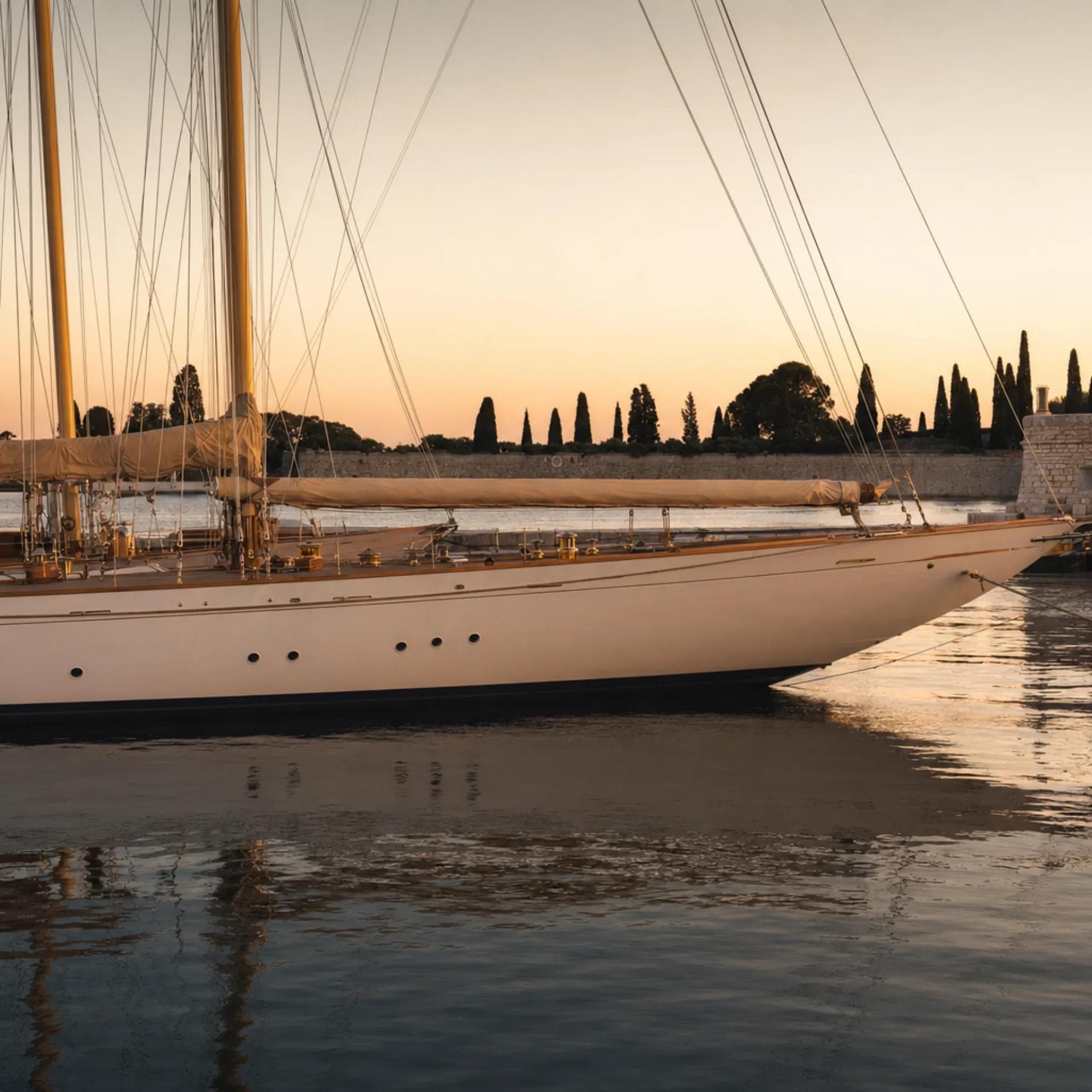
Shoulder season at Cap Ferrat is what brokers will not tell you about until you ask correctly. The boats are the same boats. The crews are the same crews. The water, in the second week of September, is warmer than it was through most of August, the breeze is steadier, and the marinas have begun to thin. What changes is the math, and the math changes more than most charter clients realize.
We spent the first ten days of September on the peninsula. Not on a charter, but in conversations across three independent broker desks, two fleet management offices, and the bar at the Royal Riviera at hours when the bar was the desk. The picture that emerged is the picture every broker who works the cap already knows, and the picture no broker will volunteer to a client who calls the office in August asking whether anything is available.
The boats are the same boats. The crews are the same crews. What changes is the math, and the math changes more than most charter clients realize.
What actually moves in September
From the first Tuesday of September the high-summer cancellation queue becomes negotiable. A 50-meter motor yacht that listed at €420,000 a week through August moves to €295,000 with a captain happy to throw in two extra days at the dock at Beaulieu. A 38-meter Sunseeker that was unavailable through August at €165,000 a week is suddenly placeable at €115,000 with a captain who had eight days unbooked between charters and would rather burn fuel than burn the calendar. The clients who paid August prices are not lining up to defend them, and the brokers who placed them are no longer being asked to.
The catch is that the boats worth chartering are not on the public broker boards in shoulder season. They are placed by the same five fleet managers who placed them in July, and the inventory is shown only to clients those managers have already routed business to. New money does not see the list. The client who shows up at a broker office in mid-September with a budget and a date range is shown the boats the manager could not place in August at any price, the boats whose captains are difficult, the boats whose owners are renovating after the summer and need the rate to keep the books closed. The client who has chartered with the same desk three times before is shown a different list.
This is the structural feature of the market that makes Cap Ferrat charter a relationship business and not a transactional one. The boats are placed through a small network of placement agents who know the captains, know the owners, and know which clients hold up to a difficult week and which do not. A broker who places a difficult client on a captain's first charter of the season is a broker who does not get the captain's call the following spring.
The three boats that just opened up
Two motor yachts and one classic sailing yacht came back to the broker network the second week of September after late cancellations. We watched the calendar movements through three independent broker desks. The first is a 47-meter Feadship currently moored in Antibes; she is owned by a Northern European industrial family who will not put her on a public broker board under any circumstance, and she is placed only through one fleet manager based in Monaco. The second is a 38-meter Sunseeker working out of Saint-Jean-Cap-Ferrat with a French captain who is selective about routing and has, in the last three years, declined three charters that were placed and confirmed because the client list did not match the boat. The third is a 60-meter classic sailing yacht with a French captain who runs the boat as a one-man editorial empire of who-can-and-cannot-board, with a service standard that we have not seen on any motor yacht of any size in the Mediterranean in a decade.
We are not naming the boats. We are naming the broker who placed each of them. If you are a Society member and one of these routes matters to you, the concierge will route you to the right desk and the desk will route you to the boat that fits the trip. If you are not a Society member, the right move is to call any of the five major Mediterranean charter desks and ask, by name, for the placement agent who handles the third-party-managed Feadship inventory in the Western Mediterranean. There are five of them. They know each other. They will not give you a name on the first call.
The five fleet managers who matter
Charter on Cap Ferrat in shoulder season runs through five fleet management offices, two of them in Monaco, two in Antibes, one in Cannes. Between them they place approximately seventy-five percent of the third-party-managed yachts on the western Côte d'Azur. The rest is direct-from-owner, which sounds appealing on paper but is in practice only available to clients whose name the owner already recognizes and whose lawyer the owner's lawyer knows from a previous transaction.
The five offices do not advertise. None of them have a website worth the visit. Three of them are second-generation businesses, two of them third. Their entire client development function is referrals from the previous client, conversations at the same six restaurants in Monte Carlo and Saint-Jean during August, and the standing relationships with the captains who decide which charter weeks they will accept and which they will pass. A client who can land an introduction to one of the five offices has a different charter market in front of them than a client who cannot.
There are arguments to be made about whether this is healthy for the market. We are not making them. We are describing how the market actually works, because the gap between how it works and how it is described in the public charter literature is one of the reasons the public charter literature is mostly useless to the people who actually charter at this level.
What to ask the broker before you call
Three questions. First, ask what the boat's last charter looked like. Not what was paid. Where the boat went, how long the crew had off afterward, and whether the boat is being placed by the captain directly or by the management company. A boat with a long August run and a short turnaround is a tired boat in shoulder season; the crew is not at their best, and you will pay full price for half-attention. A boat with a four-day turnaround between charters has a chef who has had time to write a menu, a stewardess who has had time to redo the linens, and an engineer who has had time to address the small mechanical issues that accumulate over a high-season run.
Second, ask whether the boat is being placed by the captain or by the management company. Captain placements are negotiable on extras, terms, and routing. The captain owns his calendar; he chose to take the charter; he can throw in an extra day, throw in a tender transfer, throw in a chef's tasting at anchor in Villefranche. Management company placements are placed against a corporate calendar with a corporate margin, and the captain will not deviate from the agreed routing without authorization. There is no judgment here; both kinds of charter exist for a reason. The kind you want depends on what you are after.
Third, ask which port the boat clears from. The Italian Riviera is back-channel routing for boats avoiding French clearance windows in late September; you will pay less but you will work harder. A boat clearing from Sanremo and joining you at Cap Ferrat the following morning has paperwork costs that have been worked into the price. A boat clearing from Antibes and meeting you at the dock at Beaulieu has a different operating cost structure. The broker should be able to tell you which without hesitation. If the broker cannot, the broker is not actually placing the boat.
A broker who places a difficult client on a captain's first charter of the season is a broker who does not get the captain's call the following spring.
a Monaco placement agent
The routes worth doing
Cap Ferrat to Portofino on a 60-meter motor yacht is six hours at twelve knots, less if the captain is willing to push, more if the swell on the Ligurian crossing is doing what the swell does in late September. The boat clears Italian customs at Sanremo or Imperia, which is a forty-minute detour from the rhumb line, and most captains will tell you they prefer Imperia because the harbormaster's office runs on a schedule that does not assume you are running an emergency. From Portofino you can route up the coast to the Cinque Terre or south toward the Tuscan archipelago; either is a different trip than the Cap Ferrat charter most clients have in mind, and either is the trip a captain will tell you, on background, is the trip he would take if it were his charter.
Cap Ferrat to Saint-Tropez is two hours west and a different country in every dimension that matters. Saint-Tropez in mid-September is recovering from August in the way Manhattan recovers from a Friday night. The town is not at its best. The anchorages around the Hyères islands, four hours further west, are the answer; they were too crowded in August and they are perfect in September, and most clients leave them off the itinerary because they have heard the word Saint-Tropez for thirty years and they have not heard the word Porquerolles.
What the captains tell you
The captains we spoke with in early September said three things consistently. The first is that the September window is the most beautiful charter window of the year and the least promoted. The second is that the clients who book in September are, almost without exception, the clients who have been chartering for a decade or more; first-time charterers do not know the calendar yet, and the clients who book first-time charters in late August do not understand the gap between August at full rate and September at the same boat. The third is that the brokers who place the September inventory are the brokers worth knowing for the year ahead. A broker who can place you on a difficult boat in shoulder season is a broker who can place you on the same boat in July eleven months later, which is a relationship that compounds.
All three of those things are knowable from the inside and almost impossible to learn from the outside. Which is, perhaps, the most useful thing we can tell you.
Further reading: our analysis of why Saint-Jean-Cap-Ferrat is still the world's most expensive zip code, our coverage of the second-hand Gulfstream G700 market for clients pairing a charter with a private flight, and the Bryant Yachts vertical for ongoing market intelligence. The Bryant Memo, our daily intelligence dispatch, runs broker-side updates on charter inventory six mornings a week. Subscribe to Premium for daily delivery.