
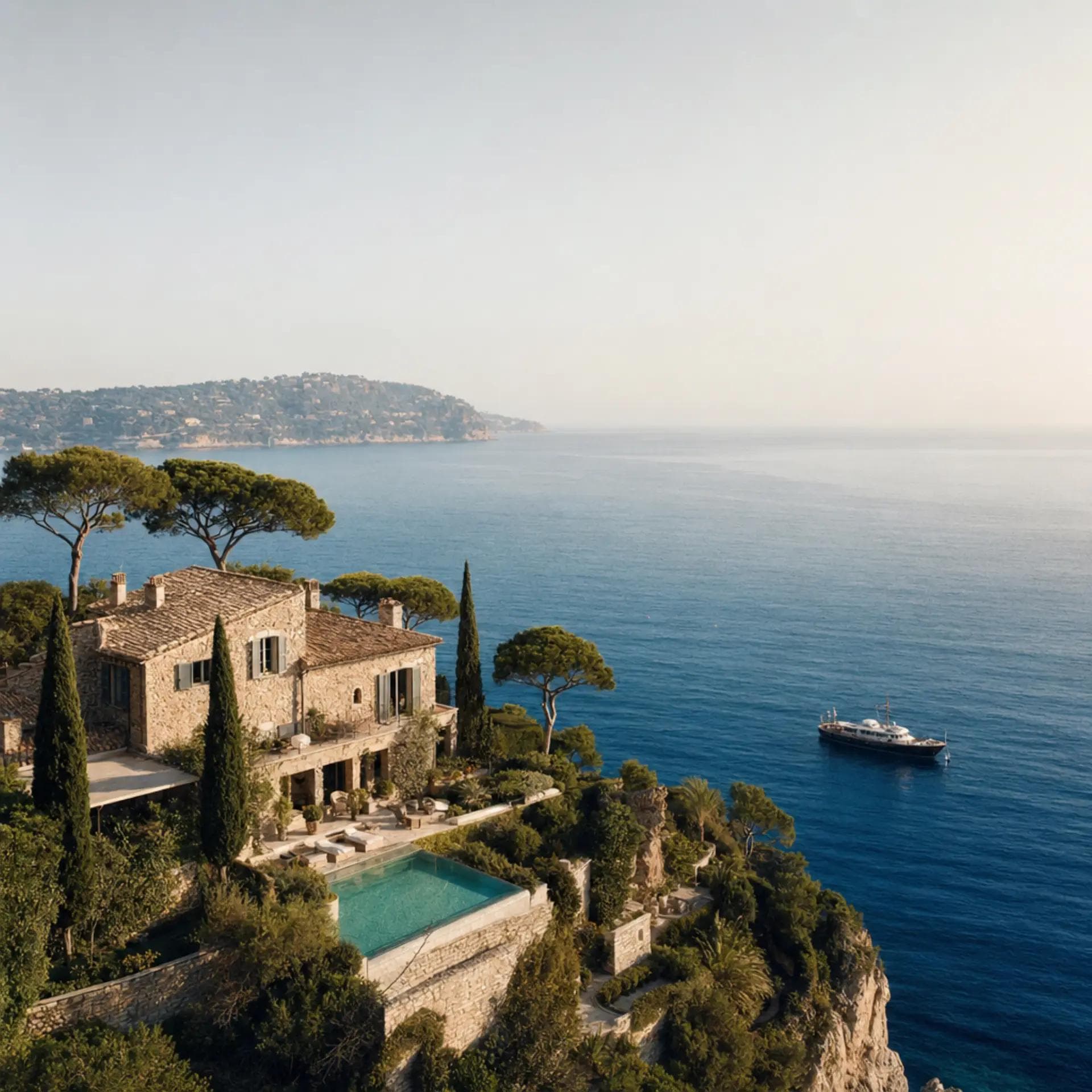
The most recent transaction we can confirm on Saint-Jean-Cap-Ferrat closed in late August at approximately €207 million for a 1.4-acre estate with two hundred and ten meters of waterfront. The buyer was a Singapore-based family office; the seller was the estate of a Northern European industrial family who had held the property since 1991. The price-per-acre comes to approximately €148 million. The price-per-meter of waterfront comes to approximately €985,000. Both numbers are, by some margin, the highest residential land prices recorded anywhere in the world this calendar year. They are not, against the recent five-year run on the cap, particularly remarkable.
We spent the second week of September on the peninsula talking to the brokers and notaries who handle approximately ninety percent of confirmed-transaction volume on the cap. The picture that emerges is consistent with what experienced buyers in this market already understand and inconsistent with how the market is described in the broader real estate press. The houses on the cap are not, individually, exceptional. They are, in many cases, structurally unremarkable late-twentieth-century constructions on land that happened to predate the legal framework which now makes their replacement on similar plots architecturally impossible. The land is the asset. The houses are, in transactional reality, depreciating tenants on the land. The legal architecture which makes the gap permanent is what most market commentary fails to describe.
The houses on the cap are depreciating tenants on the land. The land is the asset. The legal architecture which makes the gap permanent is what most market commentary fails to describe.
The 1953 boundary that nobody crosses
The administrative boundary of Saint-Jean-Cap-Ferrat as a defined commune covers approximately two square kilometers. The commune was incorporated in 1904. The current land-use framework, which restricts new construction to a small subset of zoning categories with severe constraints on volume and lot coverage, was enacted in stages between 1953 and 1971. The 1953 framework was the dispositive one. It froze approximately seventy percent of the commune's residential land at the parcel boundaries that existed at the date of enactment. Subdivision is effectively impossible on most of those parcels. Combination of adjacent parcels is permitted but rarely occurs because the holding pattern is sticky; estates pass down through families, the families that hold them are not typically liquid, and the legal mechanics of combining two adjacent parcels require alignment of two family-side decision processes that rarely synchronize.
The result is a fixed inventory of approximately three hundred and twenty residential parcels with permanent volumetric constraints. Of those, perhaps thirty are large enough to qualify as 'estate' properties in the international real-estate vocabulary; the rest are smaller villas on lots that would not be subdivided again under current rules. The estate-class inventory is the inventory that drives the commune's headline price-per-acre numbers. New estate-class inventory cannot be created. Existing estate-class inventory cannot, in practice, be expanded.
Why the houses are not the asset
Most of the houses on the cap were built between 1925 and 1985. The pre-war villas are, in the aggregate, more architecturally distinguished than the post-war constructions, and they trade at a premium reflecting that. The post-war houses, of which approximately seventy percent of the existing housing stock consists, are constructed to a quality standard that is, by twenty-first-century luxury standards, mediocre. Single-pane glass is common. Mechanical systems are typically aged. Insulation is, in many cases, original. The kitchens, bathrooms, and finishings have been updated in most cases at varying intervals; the underlying construction has not.
When a buyer pays €207 million for a 1.4-acre estate, the buyer is paying, in transactional terms, approximately €5 to €15 million for the existing improvements and the balance for the underlying land plus the legal-status of the parcel. The buyer's expectation, in most recent transactions we can confirm, is that the existing improvements will be substantially renovated or, in approximately one-third of cases, demolished and replaced within the constraints of the existing volumetric envelope. The total post-transaction investment by the new owner, including renovation, runs commonly between €30 and €80 million on top of the purchase price. The land remains the asset throughout that process.
The Hampton Pond comparison
The Hamptons trade at high price-per-acre numbers as well. Recent confirmed transactions in the East Hampton oceanfront have run at approximately $40 to $60 million per acre on the high end. That is roughly twenty-five percent of the Cap Ferrat number on a per-acre basis. The houses in the Hamptons are, on average, larger and substantially newer than the houses on the cap. The houses are also better. The gap in the per-acre numbers is therefore not a gap in the houses. It is a gap in the land.
Two factors drive the gap. The first is jurisdictional. France's residential ownership framework on Cap Ferrat operates inside a legal architecture that has been stable for seven decades and shows no sign of policy revision. New York's residential framework is, in comparison, subject to ongoing revision in tax, zoning, and shoreline-erosion policy. The land on Cap Ferrat is, in legal-stability terms, more durable, and durable land carries a premium that compounds. The second is supply. Cap Ferrat has approximately thirty estate-class parcels and cannot create more. East Hampton has, in functional terms, several hundred ocean-adjacent parcels and has historically expanded the supply through subdivision and infill. Permanent supply scarcity, in residential markets, produces price gaps that do not converge.
What the recent transactions actually tell us
Three transactions on the cap closed between January and September of this year at confirmed prices above €130 million. Two were estate-class properties; one was a smaller waterfront villa with an exceptional shoreline geometry that produced an unusual per-meter-of-waterfront premium. All three buyers were international family offices; none were European. The bidder pool on each was small (between three and five qualified bidders) and the closing prices were within five percent of the asking prices in two of the three cases. The market, in other words, is functioning normally. There is no premium being paid for urgency, no fire sales, no liquidity stress. The numbers are the numbers.
The buyers who win on the cap are the buyers whose advisors have been positioned for the inventory for years. Most estate-class transactions never appear on a public broker board; they move through three to five established notaries who handle generational holdings on the cap and who maintain qualified-buyer lists that are essentially closed to new entrants without long-tenured introduction. A buyer who shows up in 2026 with a €200 million budget and no relationship to one of the three or four notaries who matter is a buyer who will be shown the inventory that the notaries have been unable to place through their established channels. The good inventory is placed through the notaries' established channels. The pattern is durable and long-running and will not change in any time horizon a current buyer should be planning around.
Further reading: our coverage of shoulder-season yacht charter on the Côte d'Azur for the marine side of the cap economy, our analysis of Aman's residential play in Tokyo for the parallel branded-residential thesis, the Bryant Real Estate vertical for ongoing trophy-property intelligence, and the Destinations vertical for hospitality coverage adjacent to residential markets. The Bryant editorial firewall on real estate transactions is described on our About page; for daily off-market intelligence, subscribe to Bryant Premium for The Bryant Memo.