
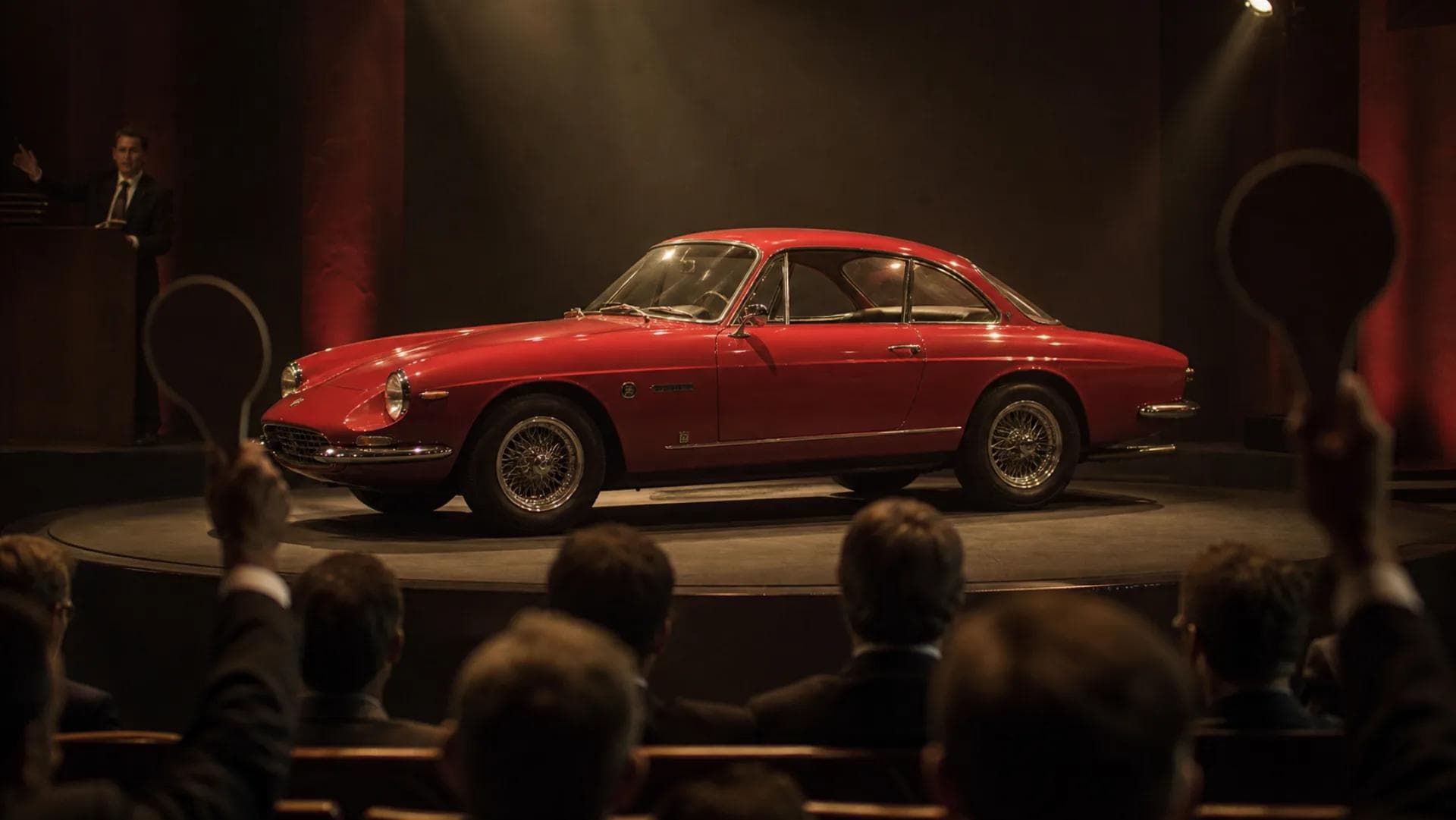
The Hagerty Market Rating closed Q1 2026 down approximately four points from peak 2023 levels. RM Sotheby's Monaco sold through at strong rates on the top-five lots but softened materially on the mid-market. The classic car investment thesis that worked from 2020 to 2023 is being re-priced in real time.
The question principal-collectors are asking now is whether this is a soft cycle to buy through, or the start of a structural reset. The more pointed question is where family office capital is actually deploying in 2026. The answer is increasingly auction houses, not dealers.
We spent the last month talking to two London-based brokers adjacent to Fiskens and Girardo, one Monaco placement agent who placed three of the RM Monaco lots, and one US-side Family Office automotive advisor. The picture they describe is consistent and the divergence inside it is the story.
What the 2026 data shows
The single most important market observation in 2026 is divergence. Seven-figure trophy lots cleared at RM Monaco at strong levels. A 1965 Ferrari 275 GTB/C hammered above the high estimate. A Mercedes-Benz 300SL Gullwing in the top decile of condition cleared retail-equivalent. The mid-market, a 1968 Porsche 911S, a 1970 Daytona in good rather than excellent condition, saw multiple lots passed or sold materially below low estimates.
The principal collector with capital deploying at the top is not feeling the cycle. The mid-tier collector with $200K to $500K to deploy is.
Segment performance in Q1 2026
Pre-war classics (Bugatti, pre-war Bentley, Mercedes SSK): holding. 1950s and 1960s American sports (Corvette C1/C2, Cobra): softening 10 to 15 percent. 1960s and 1970s European sports (air-cooled Porsche 911, Ferrari Daytona, 246 Dino): softening 8 to 12 percent.
Modern collectibles (Carrera GT, Enzo, F50): holding firm on top-condition, softening on second-tier examples. 1980s and 1990s emerging classics (993 Turbo, F40, 288 GTO): mixed, market-specific. Restomods and continuation cars: weakening, segment over-supplied.
Why auction houses are beating dealers in 2026
Family office general counsel teams have tightened due diligence requirements on seven-figure asset purchases. Auction provenance with documented hammer price is more defensible to a GC than a dealer-curated story with a private negotiated price. That structural change is reshaping where capital flows.
The institutional argument for buying through auction in 2026:
Provenance documentation. Auction catalogs publish ownership chain, restoration history, and expertise reports. Dealer narratives often condense or selectively present this.
Title clarity. Post-sale, the buyer receives clear title from the auction house's escrow process. Private dealer sales increasingly require additional title insurance and forensic VIN work.
Price defensibility. A documented hammer price is comparable. A negotiated private dealer price is not. For Family Office buyers, comparability matters at insurance renewal and at eventual exit. Bonhams Bond Street's June 6 sale is the next stress test on this dynamic.
Buyer's premium cost. Auction buyer's premium runs 10 to 15 percent. Many dealers operate on similar effective margin but with less transparency. The all-in cost gap has narrowed.
Which does not mean dealers are obsolete. Fiskens, Girardo, Tom Hartley Jr., and the top private brokers still command authority on rare lots that never reach public auction. The market is bifurcating. Auction for documented buys, top-tier private dealers for confidential or off-market acquisitions. The middle-tier dealer with no marquee lots and no privileged access is the segment under pressure.
Which classic car segments are still worth capital in 2026

Pre-war classics: the defensive hold
Bugatti, pre-war Bentley, Mercedes SSK, Alfa Romeo 8C, Talbot-Lago. Top condition examples are not in the cycle in the same way. The buyer pool is smaller and price-insensitive. The risk profile favors capital preservation over appreciation. For Family Office capital looking for a defensive collectible position with established comps, pre-war remains the defensive hold. The caveat is liquidity. Exit horizon should be five years minimum.
Air-cooled Porsche 911: the cycle-tested compounder
The air-cooled 911 (1965 to 1998) softened 8 to 12 percent through 2024 and 2025, but the long-term curve is the longest-running positive comp in the market. The 1973 Carrera RS, 964 Carrera RS, 993 Turbo, and GT3 RS variants are the defensible references. Buy condition over rarity at this point in the cycle. The modified-Porsche segment (Singer, RUF, theon) is a different position entirely. The factory references hold. The modified market is overbuilt. See our 992.2 GT3 review for the road-going-Porsche read.
Modern hypercars in single-digit production: the trophy play
Carrera GT, Enzo, F40, F50, McLaren F1, more recently the LaFerrari and 918 Spyder. Top-condition examples with full documentation, factory tools, books, and delivery mileage are holding firm. Mid-condition examples (60K+ miles, modified, restored) are softening. The trophy play in 2026 is buying single-digit production (Veneno, Speciale, Stradale) with documented provenance, not buying scale-production hypercars with story-condition.
The Bryant Family Office read on classic cars in 2026
Classic cars work as an asset class if you treat them as one. Hagerty's Q1 softness is consistent with a 12 to 18-month normalization cycle, not a structural break. The pieces that survive normalization are the same pieces that have always survived. Top condition. Documented provenance. Segment-defining models. The pieces that get hurt are the ones that rode the 2020 to 2023 lift without underlying scarcity to support it.
New entrants in 2026 should buy at auction, buy fewer cars at higher quality, and accept a five to ten-year exit horizon. Existing collectors should consider rebalancing. The mid-market softness is a window to upgrade quality within the same capital budget. A $400K position in a good 1970 911 can become a $400K position in an excellent 1973 911 if the seller side of the trade has shifted, which our sources confirm it has at the mid-market level. The current cycle is a quality-trade window, not an exit window.
How to approach classic car investment in 2026
Buy through auction unless you have a privileged off-market relationship. The auction channel is currently the dominant defensible channel for Family Office buyers.
Buy quality over rarity at this point in the cycle. A documented excellent-condition car will hold through normalization. A good-condition example of a rarer reference will not.
Plan for the carry cost. Insurance (1.5 to 3 percent of value annually), storage (climate-controlled, $400 to $1,200 per month), maintenance reserve (set aside 2 to 4 percent of value annually). Annual carry runs 3 to 7 percent of asset value. Build it into your expected return assumption.
Match horizon to liquidity. Auction-channel resale is 12 to 18 months from listing decision to closed transaction. Private dealer resale is 6 to 18 months depending on lot. Plan exits with that runway.
The Bryant read on classic cars in 2026
The classic car investment case in 2026 is narrower than it was in 2022 but still real for buyers operating at scale, with discipline on quality, and with the right channel choice. Auction houses are currently the dominant channel for Family Office buyers because of provenance, title clarity, and price defensibility. The market is bifurcating between top-of-market (holding) and mid-market (softening), and capital should follow the data, not the dealer pitch. Read more from our automotive desk or the cross-vertical Lange Datograph allocation analysis for related collector dynamics.