
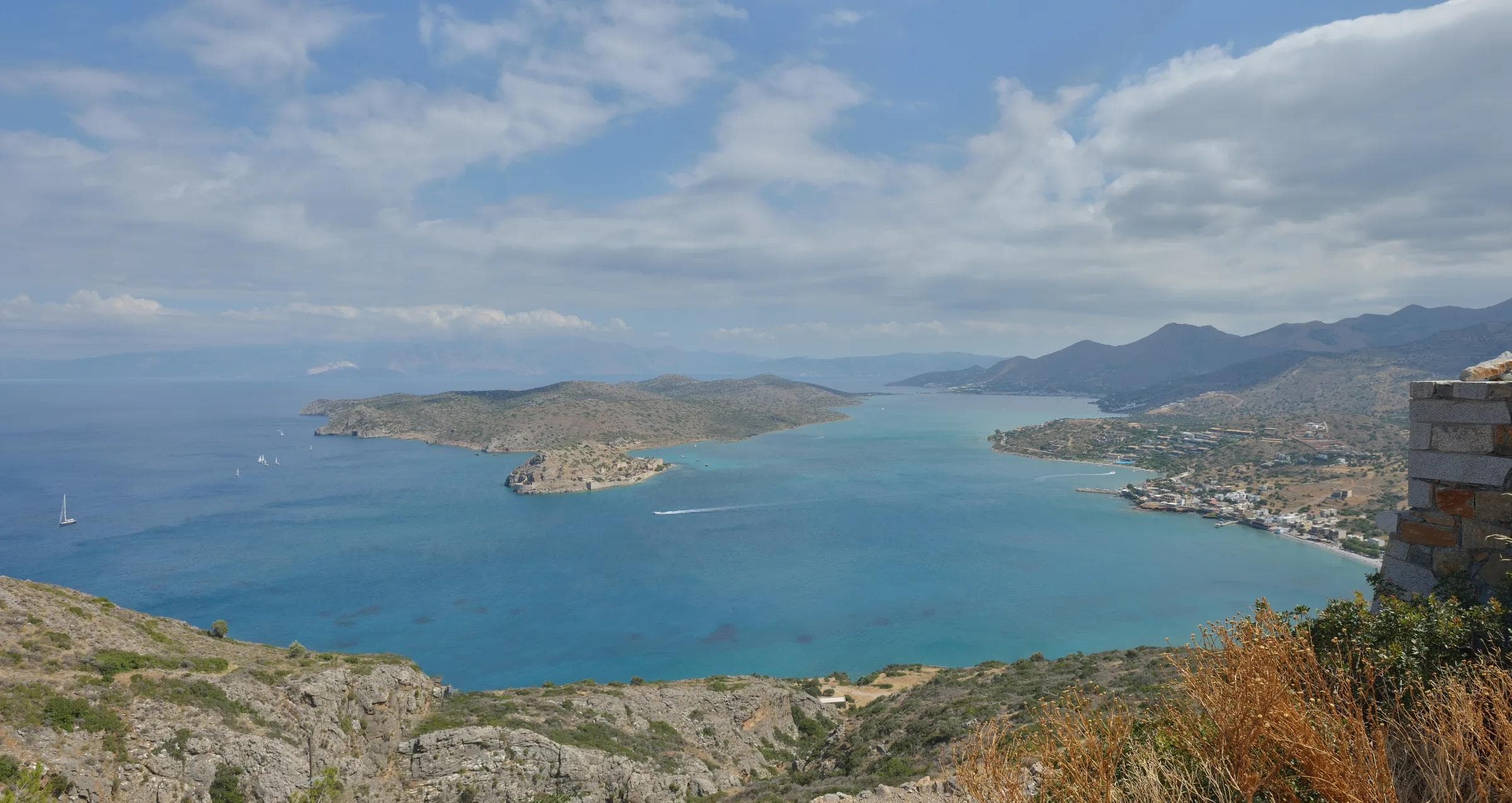
Rosewood Hotels and Resorts announced in late 2023 that it would reopen the Blue Palace on Crete's north-east coast as its first Greek property. The property sits between the fishing village of Plaka and the port of Elounda, on a hillside above one of the most established ultra-luxury bays in the Mediterranean, with views across the Gulf of Elounda toward Spinalonga Island's Venetian fortress. Rosewood's official property page now lists the reopening for 2027, a comprehensive reimagination by Athens-based K-Studio, the same firm behind the Dexamenes Seaside Hotel and parts of the Four Seasons Astir Palace and One and Only Aesthesis on the Athens Riviera. The original Blue Palace marked its twentieth anniversary around 2023, per NUVO Magazine, which means Rosewood is arriving at an address with two decades of UHNW recognition, not a greenfield play.
The booking community in Mediterranean luxury travel noticed the announcement for reasons that had little to do with the property's room count. The Aegean already has a functioning luxury circuit, anchored by Cycladic island hotels where peak-summer rates run among the highest in the Mediterranean and where brand investment has been flowing heavily since 2019. Adding Rosewood to Crete rather than to Mykonos or Santorini was a deliberate choice, and it is being read as a statement: that the next leg of ultra-luxury expansion in Greece runs through cultural depth and year-round positioning rather than through peak-season spectacle.
The reflex read is that Rosewood simply found a quality asset, acquired the management flag, and will run the Mediterranean summer circuit like every other luxury brand operating in Greece. That read misses the mechanism. Rosewood's operator pitch for the property centers on its A Sense of Place philosophy, placing Cretan tradition as the design brief rather than as a backdrop. The owner, Phaea, a female-led Greek hospitality group run by the Sbokou family, has retained K-Studio precisely because the studio has a demonstrable record of embedding local identity in architecture rather than applying a generic five-star vocabulary. The result, when it opens in 2027, will be the strongest test yet of whether the UHNW Mediterranean traveler will pay for depth and intentionality over island spectacle, and whether Elounda Bay's longstanding position as Greece's densest ultra-luxury cluster can absorb a Rosewood flagship without cannibalizing the established set.
Rosewood chose Crete over Mykonos. That is the thesis, not the amenity list.
The Elounda Bay position: Greece's most concentrated luxury bay
Elounda Bay has hosted Greece's highest-end resort cluster for the better part of three decades. The Elounda Beach Hotel and Villas, the Elounda Bay Palace, and Porto Elounda Golf and Spa Resort collectively define a competitive set that operates at a consistently higher occupancy and average rate than the Cycladic peak-season market, partly because the geography works year-round and partly because the bay's calm water and hillside topography support a style of stay that is more villa and wellness than party and spectacle. The Aman Beverly Hills financing round of 2026 showed how much institutional appetite exists for branded ultra-luxury addresses with genuine scarcity. Elounda has the same structural characteristic: a contained bay, a fixed footprint, and an established ultra-luxury buyer profile that has been landing at Heraklion and transferring east for two decades.
The Blue Palace's specific position is the hillside that separates Plaka from the Elounda waterfront, with a private beach accessible from the property and sightlines toward Spinalonga Island that no development on the bay can replicate or obstruct. Spinalonga carries a layered cultural history, including centuries as a Venetian fortress and a twentieth-century designation as a leper colony, which made it the subject of Victoria Hislop's novel The Island and a subsequent Greek television series. That combination of visual anchor and cultural narrative is, in destination travel terms, a differentiator that neither Mykonos nor Santorini can match. Rosewood is positioning the property as a gateway to Crete's history and landscape, not simply as a beach resort with a global brand attached.
154 keys, 85 private pools, and what the ratio signals
Rosewood's official property page states that Rosewood Blue Palace will open with 154 rooms and suites, of which 85 will be accentuated with private pools. That private-pool ratio, above 55 percent of the total inventory, is meaningfully higher than the typical luxury resort configuration and directly comparable to the best-performing pool-villa destinations in the Indian Ocean. For the UHNW segment where a private pool is a prerequisite rather than an upgrade, a ratio that high effectively reclassifies most of the property as villa-tier accommodation with the operating platform of a full-service hotel attached.
The comparison that matters is not Elounda Beach or Porto Elounda. It is the small-count, high-pool-ratio properties that have defined the top end of the Mediterranean market. Rosewood's Four Seasons Red Sea opening established 149 keys as a ceiling reference for ultra-luxury exclusivity in a new-geography play. Blue Palace at 154 keys sits just above that ceiling, but with a pool-suite ratio that softens the absolute count: a guest staying in one of the 85 pool suites is not in a 154-key hotel in any experiential sense. They are in a private pool suite at a small-count boutique with full hotel services behind it. That is the experience the pricing will reflect.

K-Studio and the Cretan design brief
The choice of K-Studio is not a branding decision. It is a thesis in the architecture. K-Studio is the Athens firm whose Dexamenes Seaside Hotel converted a historic Peloponnesian wine factory into a design-led property that became one of the most architecturally cited Greek hotels of the past decade. The firm has also worked on parts of the Four Seasons Astir Palace and the One and Only Aesthesis on the Athens Riviera and on Costa Navarino in the Peloponnese, which means most major international luxury operators entering the Greek market in the last ten years have at some point reached the same firm. Their design language is characterized by a refusal to genericize: the Dexamenes looks like nothing else in the Mediterranean because it reads entirely as a Peloponnesian industrial building.
For Rosewood Blue Palace, K-Studio's brief is described as a design informed by Cretan tradition and identity. That phrase is doing real work. The Blue Palace in its prior form was a high-quality Mediterranean resort. The Rosewood version, as Phaea and Rosewood have described it, is intended to read as a property that could only exist on Crete, with materials, forms, and landscaping that reference the island's vernacular. Whether that ambition survives a full renovation at 154-key scale is the executional test, but the studio has the record to attempt it at that scale, which most firms engaged in five-star repositioning do not.
Phaea and the ownership structure
The property is owned by Phaea, formally Golf Residences S.A., a Greek hospitality company led by the Sbokou family. Travel Weekly reported that Phaea is positioning the Blue Palace reopening as a Rosewood management agreement rather than a brand acquisition, meaning the Sbokou family retains ownership and Rosewood manages the operation and supplies the brand. That structure is meaningful for the UHNW traveler because owner-managed assets at this tier tend to maintain physical standards differently than asset-light brands that manage-but-do-not-own. The hotel-club hybrid model that has gained traction across the Aman ecosystem and its offshoots depends in part on this same owner-operator alignment: when the owner is not a REIT looking at quarterly returns, the maintenance cycle and the guest-experience investment stay longer. Phaea's architecture at Elounda, which has operated ultra-luxury product in the bay for decades through the Blue Palace's prior iteration, has that track record.

The Asaya wellness platform and what it means for programming
Rosewood has confirmed that Rosewood Blue Palace will include an Asaya spa, the company's integrated wellness brand. Asaya sits across a growing subset of the Rosewood portfolio, most prominently at Rosewood Hong Kong, and is characterized by an integrated approach to physical and behavioral wellness rather than the treatment-menu model most resort spas operate on. For a Cretan property in a bay that competes partly on length of stay, a credible wellness anchor matters. The profile of the buyer who selects Elounda over Mykonos is often specifically not looking for peak-season density or nightlife adjacency, and a serious Asaya program is a direct answer to that preference. Whether the full Asaya offering lands at the same depth as the flagship Hong Kong location, or in a lighter resort format, will be visible only at opening. The real estate branded residence model has shown consistently that buyers at this tier pay a material premium for access to exactly this kind of managed wellness infrastructure, which they use as a reason to stay longer rather than as an occasional amenity.
What this signals for the Greek ultra-luxury map
Greece's luxury hospitality geography has been dominated by the Cycladic circuit for most of the past fifteen years. Mykonos and Santorini captured the marketing attention, the fashion-week adjacency, and the rate compression that comes when demand concentrates into a short season and a small island. The result is a market where the best Cycladic properties command their highest rates in a narrow peak window, where occupancy drops sharply outside of June through September, and where the UHNW guest who wants cultural immersion, not Instagram architecture, has had limited options.
Rosewood Blue Palace is not the only signal that this is changing, but it is the clearest branded signal. Crete's season runs meaningfully longer than the Cycladic average because the island's eastern end, where Elounda sits, is sheltered and warm into October. The island's cultural inventory, including Minoan archaeological sites, the old city of Chania, and Spinalonga, gives the extended-stay guest reasons to remain that Mykonos and Santorini, however beautiful, cannot manufacture. Rosewood entering through the eastern bay rather than the established Cycladic circuit is a read on where the next tranche of ultra-luxury Mediterranean travel investment is going to concentrate.
The question for the UHNW traveler making a Greece decision in 2027 and beyond is not whether to go to Crete. It is whether the Rosewood Blue Palace, once open, will have solved the delivery gap that has kept the bay from competing with the Cycladic circuit's best product at the absolute top of the rate stack. The property numbers say it should: 154 keys, 85 private pools, K-Studio's hand, Rosewood's management platform, and an owner who has operated in the bay for two decades. The Aman Tokyo second-act lesson applies here: flagships matter most when they arrive in a market that already has a defined buyer profile and a shortage of product that meets the buyer's standard. Elounda Bay has the buyer profile. After 2027, it will have the product.
The bottom line for travelers
Rosewood Blue Palace is set to open in 2027 as Rosewood's first Greek property, with 154 rooms and suites, 85 of which include private pools, designed by K-Studio and positioned by owner Phaea against the deepest cultural geography in the Aegean. Rosewood's official property page lists the year as 2027 and has not published a month or season. For the UHNW traveler deciding between a Cycladic peak-season booking and a Cretan stay that runs longer and reads differently, this is the first Rosewood-level answer Elounda Bay has had. The Bryant Destinations desk tracks the ultra-luxury hospitality map continuously. The full Destinations coverage holds the current state.