
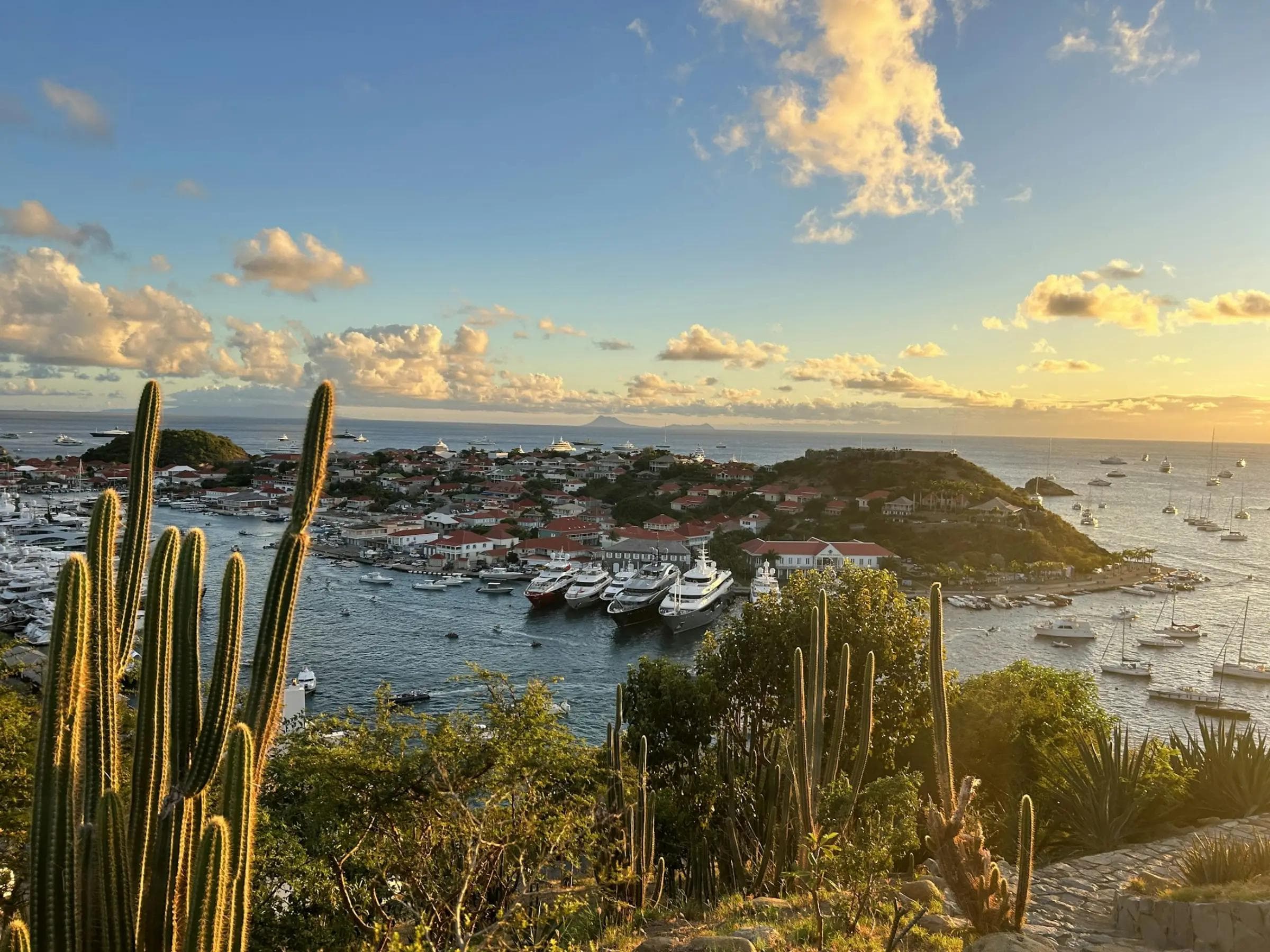
St Barths drew a record 226 superyachts over 24 metres into the waters around Gustavia for New Year's Eve 2025, a third more than the 170 that gathered a year earlier, with 155 of them available for charter, according to YachtCharterFleet's fleet count. The gathering included Flying Fox, the 136 metre Lürssen that is the largest charter yacht in the world. Most of the fleet did not originate in the Caribbean. It crossed the Atlantic from the Mediterranean in November and December, chasing the northeasterly trade winds that have routed the winter charter trade for a century.
The reflex read is that a record fleet means a roaring charter market with pricing to match. The published rates say something more divided. A 40 metre Sunseeker named TC spent the season offering Caribbean and Bahamas weeks at 149,900 dollars, a cut of more than 15,000 dollars off its standard rate. At the top of the same fleet, the 95 metre Whisper carried a from-rate of 1,137,000 dollars a week. The gathering is real. The idea that it lifted all rates is not.
The winter Caribbean season runs opposite to the Mediterranean. Where the Med peaks July through August, the Caribbean window opens with the Antigua Charter Yacht Show in early December, concentrates over the St Barths New Year, and runs through the St Barths Bucket regatta in mid-March before the fleet turns back east. Inside that window the value and the availability do not sit where the New Year photographs suggest, and the tax map that governs Caribbean charter economics looks nothing like Europe's.
The gathering is real. The idea that it lifted every rate with it is not.
Why does the fleet cross the Atlantic at all?
The Caribbean charter fleet is, in large part, the Mediterranean charter fleet on its winter rotation. Yachts depart Europe at the end of November to catch the northeasterly trade winds that strengthen through December and January, a crossing of at least 3,400 nautical miles routed through Gibraltar, the Canaries, and often the Azores on the return leg. The same hulls that worked Monaco and Sardinia in August are the hulls clearing Gustavia in January.
That migration is why the two seasons are best read as one market in two hemispheres. A yacht that commanded a peak August rate in the Mediterranean does not automatically command the equivalent over Caribbean New Year, because the cost base, the demand calendar, and the tax exposure all change when it crosses. The Mediterranean charter market we mapped for summer 2026 is the same fleet under a different set of rules, and the rules are what move the number.
The crossing also compresses the booking calendar. The Caribbean season is short, roughly December to April, against the Mediterranean's May to October. Broker guidance on the listing aggregators is to book Caribbean weeks at least three months out, because a fleet that is physically smaller on station than the summer Med fleet sells its prime weeks first. This is the same relationship-placement dynamic visible in the Cap Ferrat shoulder-season market, where the best boats move through fleet-management offices before they ever reach a public board.
Caribbean charter weeks, by the from-rate
Published from-rates give a clean read on the top of the market, with the caveat that a from-rate is a starting weekly base, not an all-in price, and not necessarily the rate a given week clears at. On YachtCharterFleet's St Barts listings, the named superyacht fleet ranges from the 70 metre Joy at a from-rate of 650,000 dollars and the 73 metre Laurel at 525,000 dollars, up through the 90 metre Nero at 497,000 dollars, the 88 metre Maltese Falcon at 571,000 dollars, the 105 metre Black Pearl at 989,000 dollars, and the 95 metre Whisper at 1,137,000 dollars a week.
Below the superyacht tier the entry point is materially lower, and that is where the winter value sits. The Caribbean motor-yacht range opens around 39,000 dollars a week plus expenses, and the sailing-yacht range opens near 29,855 dollars. Boatbookings and other guides put a 30 to 45 metre motor yacht of recent build at roughly 50,000 to 120,000 dollars a week, with older hulls in the 30,000 to 80,000 range. The crewed catamaran, the workhorse of the Caribbean charter trade, sits lower still. The result is a market with a far longer tail of accessible inventory than the New Year megayacht photographs imply.
None of those numbers is the price the charterer pays. Every Caribbean charter above roughly 30 metres runs on a base-plus-expenses structure, and the expenses are not a rounding error.

How much does the all-in number add to the base?
The base rate covers the yacht, the crew salaries, and the basic equipment. On top of that sits the Advance Provisioning Allowance, the float the captain draws against for fuel, food, dockage, and port fees under the standard MYBA charter agreement. On motor yachts the allowance commonly runs 30 to 40 percent of the base fee, with unused funds refunded after the charter, and a crew gratuity of 15 to 20 percent sits on top of that.
The arithmetic compounds quickly. Take a 100,000 dollar base, add an advance provisioning allowance near 40 percent and a gratuity of 15 to 20 percent, and the all-in budget lands closer to 155,000 to 160,000 dollars. Apply the same structure to the 497,000 dollar from-rate on a 90 metre and the realistic all-in week clears past 700,000 dollars before a single optional extra. The from-rate is the headline. The advance provisioning allowance is the bill.
Why does the same yacht cost more in the Bahamas than the BVI?
The single largest variable the Mediterranean does not have is the Caribbean tax map, and it is sharp enough to redraw an itinerary. The Bahamas levies a 14 percent charter tax, four percent government plus a ten percent VAT, per Vital Charters' destination breakdown. The British Virgin Islands carry no equivalent charter tax; the model there is permits and crew gratuity, and St Martin and St Barths sit outside the Bahamas levy as well. On the same benchmark week, a 46 foot crewed catamaran for six runs about 18,263 dollars all-in in the Grenadines, 24,287 dollars in the BVI, and 40,700 dollars in the Bahamas, with roughly 4,200 dollars of the Bahamas figure being tax alone.
That differential reframes the standard read on the BVI as the budget option. The BVI is not cheaper because the boats are lesser. It is cheaper because there is no charter tax and the inter-island passages are short, which holds fuel and dockage down. A charterer optimizing for cost per quality week is choosing the tax regime as much as the yacht. A charterer optimizing for the New Year scene is paying the St Barths premium for the anchorage, not the hull. The two decisions point at different islands.

Is St Barths actually displacing the Mediterranean?
The structural question under the record fleet is whether the Caribbean winter now rivals the Mediterranean summer for the top of the market, and the directional data leans that way. Elite Traveler, citing SuperYacht Times data, reports a 22 percent year-on-year increase in Caribbean yacht charters, with St Barths leading and Anguilla and Turks and Caicos behind it, and first-quarter 2026 St Barths bookings running ahead of the prior year's pace. The New Year gathering assembled the largest single concentration of 100 metre plus yachts on record, exceeding what Monaco's headline summer events draw.
That convergence is not confined to yachts. The same buyer pool driving the Caribbean winter is the pool reshaping how trophy assets clear across categories, the younger, increasingly American fractional buyer remaking the yacht order book, and the same demand signal is visible in destination hospitality. The Caribbean winter pull is part of a broader migration of the trophy calendar toward curated, low-density destinations, the same logic driving sovereign-backed openings like the Four Seasons Red Sea resort that compete for the same weeks of the year and the same passport-agnostic clientele.
The season also has a tail the New Year fleet obscures. The Antigua Charter Yacht Show, in its 64th edition over December 4 to 9, 2025, drew about 60 yachts and functions as the brokers' opening of the winter calendar. The St Barths Bucket regatta, set for March 12 to 15, 2026, closes it. Between those bookends, January and February hold the season's quietest weeks and its most negotiable rates, which is precisely why a 40 metre Sunseeker was discounting into the spring rather than holding firm at a New Year number.
Where does the winter value actually sit?
Read against the record, the value is in the off-peak weeks and the no-tax islands, not the New Year anchorage. The St Barths New Year is the season's single most expensive week to charter and its least available, because demand and supply peak in the same five days. A charterer indifferent to the scene buys more boat per dollar in January, in the BVI, on a yacht that crossed the Atlantic for a short season and would rather sail at a discount than sit at the dock.
The from-rate is the wrong number to anchor on. The advance provisioning allowance, the tax regime, and the week of the calendar move the all-in figure further than the choice of hull does. The Bahamas adds 14 percent the BVI does not. The allowance adds 30 to 40 percent everywhere. New Year adds a premium that January removes. A buyer who prices on the headline gathering pays for the photograph. A buyer who prices on the structure, an off-peak week, a no-tax island, a fleet motivated to fill a short season, charters the same standard of yacht for materially less.
The Bryant Yachts desk tracks the charter market across both hemispheres, season by season. The full Yachts coverage holds the running read on where the fleet is and what it costs.