
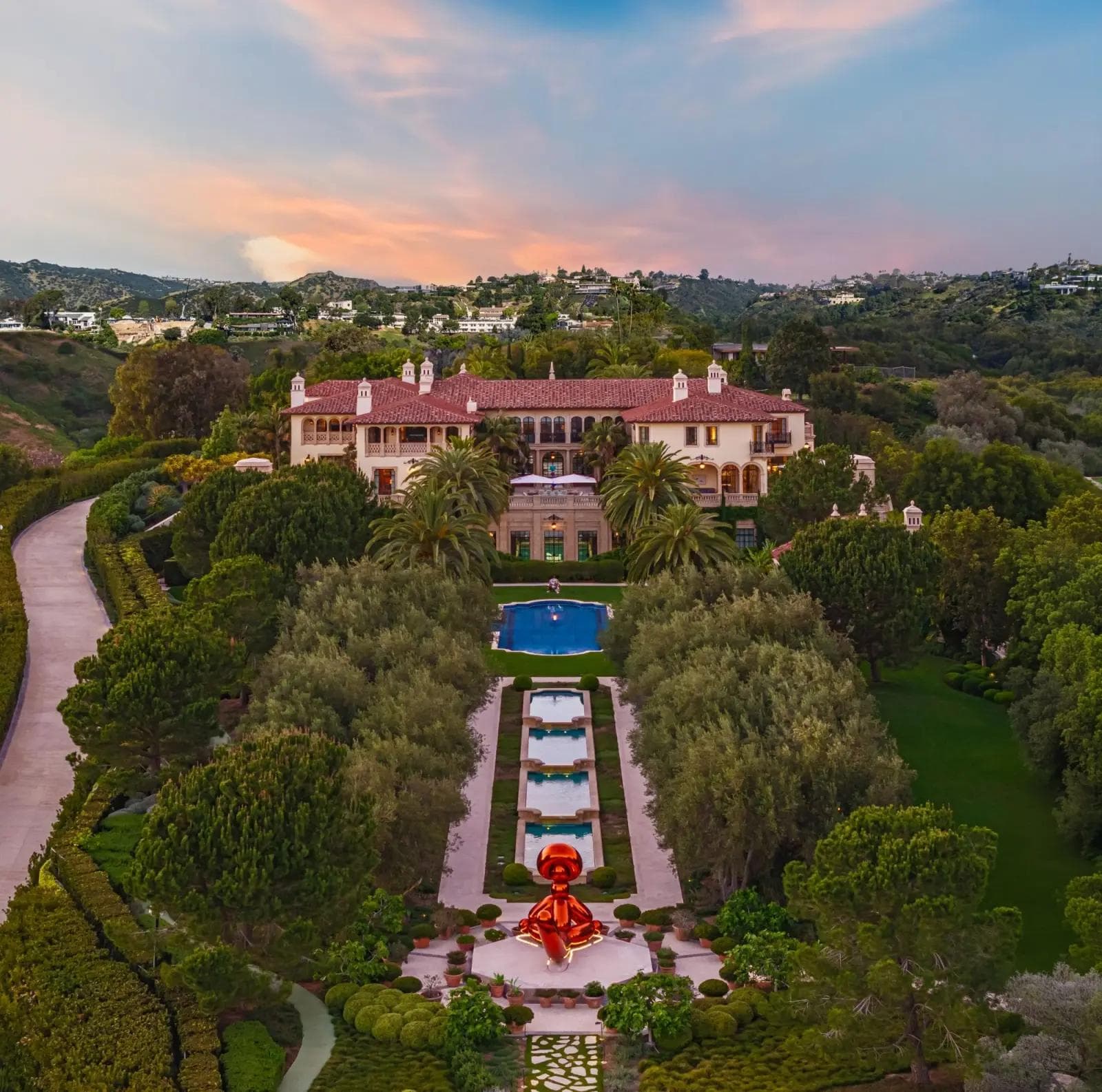
Qatar's Al Thani royal family listed its 8-acre Bel Air estate at 11201 Chalon Road for $400 million on April 29, 2026, instantly making the property the most expensive home for sale in the United States. The number is $162 million above the prior US single-family record, hedge fund founder Ken Griffin's $238 million Central Park penthouse from 2019. The 70,000-square-foot Italian Renaissance-style estate, designed by Peter Marino and completed in 2018 after roughly eight years of construction, contains 39 bedrooms, 50 full bathrooms, an indoor pool clad in Moorish tile, a hammam, separate men's and women's spas, a movie theater, and views from downtown Los Angeles to the Pacific Ocean.
Bloomberg led its April 29 story with the asking price. The family's framing on the listing was different, and more useful for principals reading the market: explicit cost-recovery rather than profit.
The Al Thani listing is not a price discovery. It is a ceiling test, designed to anchor the rest of the US trophy real-estate catalog while the family runs an orderly cost-recovery exit. The realistic clear price is well below the $400 million headline, and the more interesting question is what the ask does to the rest of the $100M+ inventory while the listing sits.
What the Bel Air listing actually is
Headline numbers: $400 million ask price. 8 acres of land on a Bel Air hilltop. 70,000 square feet of built area. 39 bedrooms. 50 full bathrooms plus 9 powder rooms. Peter Marino as architect. Peter McCoy / McCoy Construction as builder. Completed 2018 after approximately eight years of construction. Views from downtown Los Angeles to the Pacific Ocean. Featured amenities listed by LuxuryHomes.com: indoor pool, hammam, spa (separate men's and women's), cold/hot plunges, massage suites, gym, Pilates studio, beauty salon, movie theater.

Peter Marino built the estate as a private commission, not a spec build. The Al Thani family has used it intermittently since 2018. The decision to list now (rather than continuing to hold) reflects the family's read that the 2026 ultra-prime market clears at a ceiling number, with the residual ceiling discovery to be done by the buyer rather than the seller.
Why the ask is the ceiling, not the price
Bloomberg's April 29 framing of the listing was explicit: the Al Thani family is seeking to recoup costs, not to set a record. That language tells you the realistic clear price is well below the $400M ask, with the $400M ask functioning as a high-anchor for negotiation rather than a true ask-side price discovery.
Three structural facts in the ultra-prime catalog confirm this read. One: no US single-family home has cleared above the Griffin 2019 ceiling at $238M in any verifiable transaction. Spelling Manor cleared at $119.75M in 2019 after a $200M initial ask and a long marketing window. The Mountain of Beverly Hills was foreclosed at $100,000 (no genuine buyer) after a $1B fantasy ask. Trophy real estate above $200M has a consistent and meaningful gap between initial ask and ultimate clear price.
Two: the transactable buyer pool at this price tier is small enough that Knight Frank's PIRI 100 wealth-distribution data implies a global cohort of fewer than a hundred individuals with the liquid-asset position to acquire a $300M+ residential property. Of those, the trade-press-discoverable share is a fraction of the total. The discoverable buyer pool for an Al Thani listing is meaningfully narrower than the listing's headline visibility suggests.
Three: the Al Thani family's framing as cost-recovery rather than profit signals to the discoverable buyer pool that the family will engage meaningfully below the ask. That framing increases the probability of a transaction within an extended window at a clear price well below the $400M headline, while keeping the headline ask high enough to support comparable-trade pricing for the rest of the Marino-designed trophy catalog.
What this does to the $50M-plus listing market
The $400M ask resets the comp set for everything below it.
The $100M-plus US listing tier was already a structurally narrow market with a small number of active listings at any given time (Douglas Elliman and Knight Frank quarterly tracking publish ranges in the dozens). The Bel Air listing gives every $100M+ ask broker an anchor to point to in seller conversations. Expect some upward ask-revision pressure in that tier as a function of the new ceiling reference. The same dynamic Bryant has tracked in the Hamptons split: trophy listings reset comp pricing for the rest of the catalog.
The $50M to $100M tier is the deepest ultra-prime band in the US market. The Bel Air listing is too far out of band to directly anchor pricing in this tier. The buyer pool is broader, the carry math is materially different, and the comp set for clears is anchored on actual transactions rather than headline asks. The Bel Air listing's direct effect on this tier is limited.
The sub-$50M ultra-luxury tier is genuinely a different market. The buyer pool is much larger, financing-driven, and clears against actual trade comps not headline asks. The Bel Air listing has essentially zero effect there.
Who actually buys a $300M-plus US house
The discoverable buyer pool for an Al Thani listing is meaningfully narrower than the listing's headline visibility suggests.
The disclosed comparable trades over the last seven years and the public-record buyer profiles point at a small set of structurally-distinct buyer cohorts. Sovereign-adjacent wealth from Gulf states (Qatar, UAE, Saudi Arabia), typically royal-family-direct or sovereign-fund-adjacent and frequently using opaque LLCs delivered through London or Geneva fiduciaries. Post-2022 Russian-departure wealth that exited Russia post-sanctions and is deploying liquid wealth into trophy real estate as an inflation hedge. American tech founders post-IPO liquidity events. Existing US trophy collectors (Griffin, the Adelson estate, Larry Ellison, Jeff Bezos) who add selectively to multi-property portfolios.

For the Al Thani listing to clear, one of these cohorts has to be in active acquisition mode for a Los Angeles property at this price tier in the next 24 months. The probability is non-trivial but is not high. Comparable Bel Air trophy listings have historically taken multi-year marketing windows to clear at significant discounts to original ask.
What changes on the desks
For principals positioning in US ultra-prime real estate over the next 24 months, three things to track.
The Al Thani days-on-market clock. Trophy listings above $200M have historically required multi-year marketing windows. If the Bel Air listing clears inside 24 months at any price above $250M, that is a positive ceiling-confirmation signal. If it sits without offers, the ceiling is lower than current ask implies.
The $100M-plus listing inventory count. Douglas Elliman publishes quarterly. If inventory grows materially without a single clear, the ceiling-support thesis is failing and the broader trophy catalog will retest lower.
The IPO sequencing. Each major IPO adds a small number of newly-liquid principals to the discoverable ultra-prime pool. SpaceX's June 12 listing is the first inflection. Post-lockup (December 9, 2026) is the realistic deployment window. Watch for $100M-plus LA, Palm Beach, and Aspen listings between Q1 and Q3 2027 as IPO-lockup liquidity hits the property market. Bryant has tracked the parallel dynamic in the hospitality-as-asset class, where branded residences and destination-tied real-estate plays like Four Seasons Red Sea attract the same buyer cohort as $400M Bel Air. The Cannes Film Festival villa market is the European cousin of the same dynamic.
The ceiling has moved. The buyer pool to test it has not grown commensurately. The two-year-out read is that the Bel Air listing eventually settles well below the $400M ask, becomes the new comparable, and the $100M tier drifts upward as a function of the new ceiling reference. More in Real Estate.