
In December 2025, a penthouse at Bugatti Residences by Binghatti in Business Bay sold for AED 550 million, roughly 150 million dollars at the UAE dirham's fixed peg to the US dollar, the highest price ever recorded for a residence in the Middle East. The unit spans 47,200 square feet and achieved AED 11,650 per square foot, a Business Bay record. That transaction closed in the same calendar year Dubai completed 500 sales of homes priced above ten million dollars, the most of any city on earth, with a combined value of 9.05 billion dollars, according to Knight Frank.
The headline number is not what makes the data remarkable. London, one of the world's oldest super-prime markets, logged 161 transactions above ten million dollars in 2025 and slipped to fifth in Knight Frank's global super-prime ranking, having led that table as recently as 2022. Dubai's volume now runs more than triple London's. The gap is widening, not narrowing. Knight Frank's Prime International Residential Index for 2026 placed Dubai's prime residential price growth at 25.1 percent for 2025, second globally only to Tokyo's new-build surge of 58.5 percent, and roughly eight times the global luxury average of 3.2 percent.
The consensus read on Dubai luxury real estate is still anchored in the boom narrative: everything is up, everything is selling, the city has no ceiling. That framing is accurate for the top of the market and misleading for everything below it. Dubai in 2026 is not one market. At the ultra-prime tier, the ten-million-dollar-plus segment is operating on structural drivers that have almost nothing to do with Dubai's residential price cycle. At the mid-market level, roughly 66 percent of the under-construction pipeline consists of studios and one-bedroom apartments concentrated in five high-density districts, where units compete directly with the tower next door. The UHNW read is not that Dubai is booming uniformly. It is that the super-prime tier has decoupled from the market beneath it, and the two are now priced on entirely different equations.
Dubai in 2026 is not one market. The ten-million-dollar-plus tier has decoupled from the market beneath it, and the two are now priced on entirely different equations.
How the ten-million-dollar-plus tier separated from the market
Knight Frank's Q4 2025 Dubai Residential Market Review uses a phrase worth noting: the growth gap between luxury and mainstream markets widened in a record year. Prime residential capital values rose 12 percent year-on-year in Q4 2025 specifically, on top of the full-year 25.1 percent gain. Prime values have surpassed AED 4,300 per square foot at the top end. The overall market, which recorded a record 205,400 total transactions in 2025, grew by 18 percent in deal count and 25 percent in total sales value to AED 544.2 billion. Those are strong numbers, but they are being driven by high volume in mid-market units, not by pricing momentum in the mainstream.
The ultra-luxury segment tells a different story. Sales above 25 million dollars reached 68 transactions for the full year, a 48 percent increase year-on-year. For the full year, Knight Frank counted 500 sales above ten million dollars, a 15 percent increase in volume year-on-year, at a total value that was up 27.7 percent. The ultra-prime segment is not only growing faster in price, it is growing faster in absolute transaction count, which means demand at the top is not thinning even as the market overall normalizes its pace.
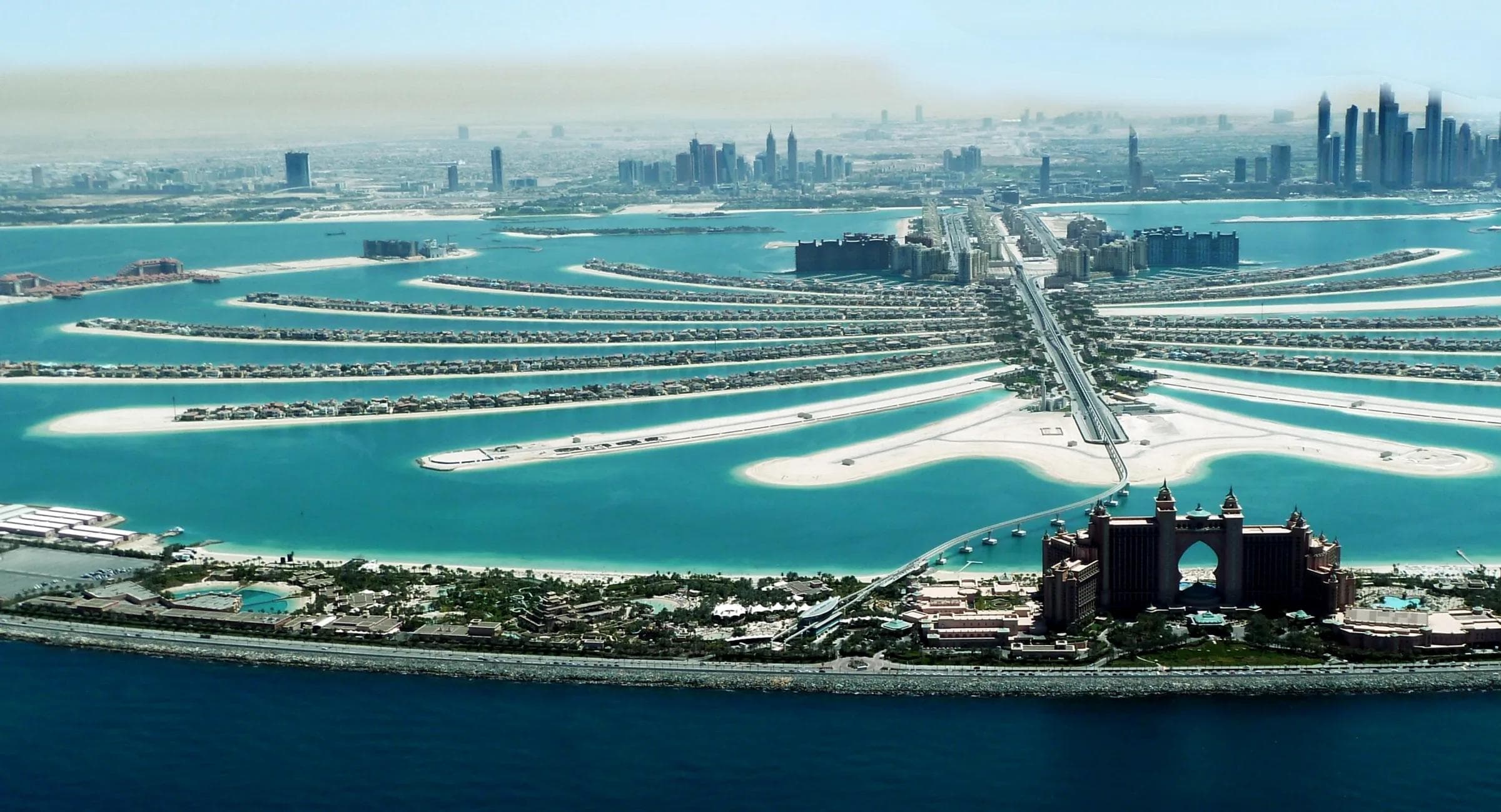
The structural explanation is straightforward. Trophy stock is genuinely scarce in Dubai. Palm Jumeirah, Jumeirah Bay Island, and the top floors of true branded towers have fixed supply. When the denominator does not move, sustained demand compresses into the same pool of units. The Bugatti Residences penthouse, the Palm Jumeirah signature villa resale that cleared AED 161 million (about 43.8 million dollars) at AED 14,679 per square foot in 2025, the Jumeirah Bay Island villa listed at 114 million dollars in 2026: these are not the same market as a one-bedroom in Dubai South, any more than a Central Park penthouse is the same market as a Queens studio.
The structural case: what is pricing the trophy tier
Four factors are doing the pricing, and they compound rather than average. First, the UAE levies no personal income tax, no capital gains tax, no inheritance tax, and no wealth tax. For a family office allocating across jurisdictions, those zeros are not an incentive: they are the default expectation for a domicile. Second, the UAE dirham is pegged to the US dollar at a fixed rate of 3.6725, which means AED-denominated asset purchases carry no currency risk for dollar-denominated wealth. Third, the UAE Golden Visa provides a ten-year residency for investments of at least AED two million (roughly 545,000 dollars) in qualifying UAE property, giving the UHNW buyer an entry cost for residency rights that is materially lower than most comparable Western investor visa programs. Fourth, the UAE attracted a net inflow of 6,700 millionaires in 2024, the highest of any country on earth for the third consecutive year, and that population creates its own demand: UHNW residents refer UHNW capital.
The combination of those four factors means Dubai's super-prime tier is absorbing capital from a global pool that is not sensitive to Dubai's own economic cycle. A buyer parking 150 million dollars in a Business Bay penthouse is not making a bet on Dubai's GDP. They are making a bet on political stability, dollar linkage, tax permanence, and the optionality that a ten-year residency provides if conditions deteriorate in their primary jurisdiction. The property is incidental to the jurisdiction case; it is simply the vehicle.

The branded residence premium in Dubai is running well above global norms
Globally, branded residences command a premium over comparable non-branded stock. Knight Frank's figure for that premium is 20 to 35 percent. Savills puts the worldwide average at 33 percent, rising toward 39 percent in resort markets. CBRE's UAE Branded Residences Report 2025 puts the Dubai-specific figure at 64 percent above comparable non-branded properties in the same location, roughly double the global norm. That figure reflects a market where the branded label carries unusually strong information value: buyers are far from home, transacting in a market they may know less well than their primary residence markets, and a recognized hotel or luxury house operating the building is a shorthand for quality, management standards, and resale liquidity.
The volume numbers behind that premium are significant. Dubai recorded a 26 percent year-on-year increase in branded residence transaction volumes in the first nine months of 2025, with more than 7,700 branded units sold, and total branded sales value rose 51 percent to nearly AED 50 billion (approximately 13.6 billion dollars). The city's pipeline through 2030 holds more than 31,000 additional branded units, representing about eight percent of total new residential supply, per CBRE.
The Bugatti Residences result is the apex of that market, and it illustrates the dynamic precisely. The Bugatti name on the building does not add square footage. It adds access to a brand ecosystem that the buyer's counterparts globally recognize, it adds a community of other UHNW buyers within the same development, and it adds resale liquidity in a market where the branded label functions as a signal of quality that transcends local market knowledge. That is the same argument underpinning the 6,300-dollars-per-square-foot Mandarin Oriental result on Brickell Key: at the top of the branded hierarchy, the name is the product, and the building is secondary.
Where the risk actually sits
The nuanced read on Dubai in 2026 requires distinguishing between the trophy tier and the broader off-plan market, because the risk profiles are almost inverse. Trophy waterfront stock on Palm Jumeirah and Jumeirah Bay Island, and the top floors of the handful of genuine branded towers, are structurally undersupplied relative to the demand pool targeting them. Prime villas and branded waterfront assets are likely to see continued price support as long as the jurisdictional pull on global UHNW capital remains intact.
The risk is concentrated elsewhere. Industry analysis of the under-construction pipeline, including reporting from Khaleej Times and property data firm analyses, shows that nearly 45 percent of under-construction stock sits across five high-density districts: Jumeirah Village Circle and Triangle, Dubai South, Mohammed Bin Rashid City, Business Bay, and Dubailand Residence Complex. Around 66 percent of upcoming inventory is studios and one-bedroom apartments, where a new unit competes with every other new unit within walking distance. Fitch has signaled a moderate correction risk for mainstream Dubai residential prices in 2026. Knight Frank's own 2026 forecast for the prime segment is around three percent, a significant moderation from 25.1 percent.
For UHNW buyers and family offices, that distinction carries weight. An off-plan position in a mid-market corridor in Dubai South is a different underwrite from a beachfront villa on the Palm or a penthouse in a genuine branded tower. The first is an exposure to Dubai's supply cycle. The second is an exposure to global UHNW demand for a fixed-supply jurisdiction play. Both are real estate. They are not the same asset.

The off-plan question and how to read the pipeline
Off-plan sales accounted for roughly 65 percent of total Dubai residential transactions in 2025, rising above 75 percent in the strongest quarters, driven by flexible payment structures and a wide pricing spectrum relative to ready properties. For UHNW buyers, off-plan at the trophy tier carries a specific logic: the best units in the best towers are reserved at launch, before ground is broken. A buyer acquiring on plan in a genuine branded tower is not speculating on Dubai's price cycle. They are securing allocation in a supply-constrained product class, the same logic that applies to collector car auction positions and other fixed-production luxury assets. The delivery risk is real but manageable: Dubai's branded tower developers have largely delivered on their pipelines, unlike some markets where off-plan is synonymous with speculative non-delivery.
The off-plan risk that matters is in the mid-market: a buyer who acquired a one-bedroom in a non-branded tower in a high-density corridor in 2022 or 2023 may find that by 2027, when that unit delivers, the building next door has also delivered, and the one beyond that, and asking prices have compressed. That is a legitimate exposure and a different question from whether to acquire a branded waterfront penthouse.
The separation between the two is becoming legible in the data. The same pattern of a resilient trophy tier sitting above a normalizing or correcting mid-market is playing out across global luxury real estate in 2026. The Hamptons two-market split shows the same structure: above twenty million dollars the market remains active; below it, buyers have leverage and inventory is rising. Dubai's version runs at different absolute price points but the mechanism is identical. Global UHNW capital is selective, and it is concentrating into a narrower set of markets and asset types within those markets.
Bottom line for buyers
Dubai's ultra-prime tier, the ten-million-dollar-plus segment, is operating on a different set of drivers from the city's residential market as a whole: zero-tax jurisdiction, dollar-pegged currency, fixed supply of true trophy stock, and a global UHNW demand pool that is large enough to absorb 500 nine-figure-market transactions in a single year. Knight Frank's PIRI 2026 data puts the full-year prime price growth at 25.1 percent, the Q4 prime growth at 12 percent on a year-on-year basis, and the 2026 prime forecast at three percent: a market that has priced the structural case and is now consolidating around it. The risk for family offices considering Dubai is not in the branded waterfront tier. It is in confusing the trophy tier's resilience with a broad-market green light, and buying off-plan mid-market exposure under the assumption that the whole city moves together. It does not. The Bryant Real Estate desk tracks the super-prime tier transaction by transaction. For the branded trophy cohort globally, from Brickell Key to Business Bay, the thesis is the same: scarcity and brand do the pricing, and the broad market is no longer the reference.