
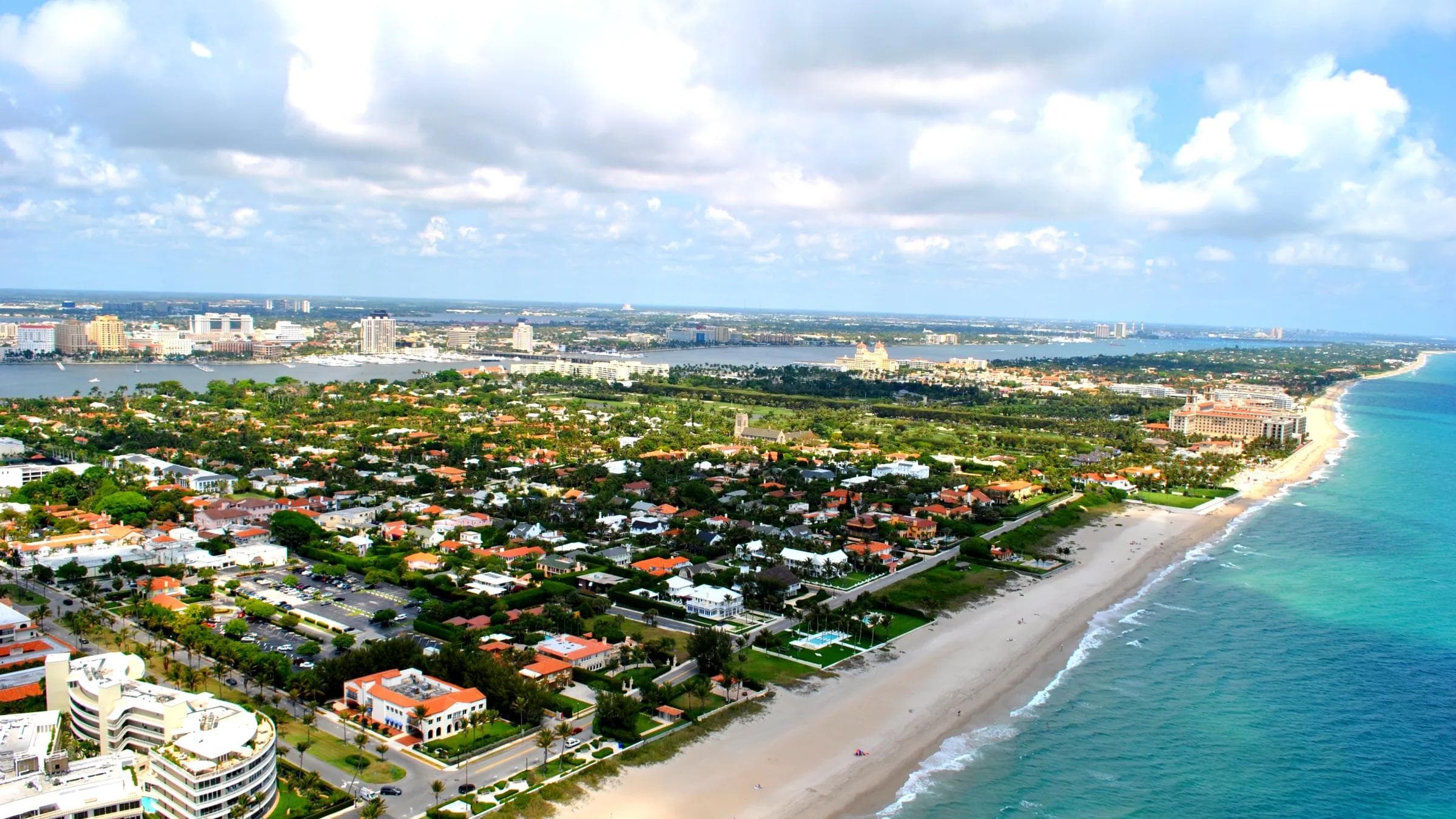
Wells Fargo announced in January 2026 that it is relocating its wealth management headquarters to One Flagler in downtown West Palm Beach, leasing 50,000 square feet and moving roughly 100 senior executives to Florida. The bank is the first major US financial institution to run its wealth operations from the Palm Beaches. It is not the first to show up. Elliott Management moved its forty-one billion dollar hedge fund headquarters to 360 Rosemary in West Palm Beach in 2020. Point72, Goldman Sachs, and Millennium Management followed into the same building. Over 300 hedge funds and financial firms have now planted offices in Palm Beach County, per the Palm Beach County Business Development Board.
That concentration of capital is not abstract. It is expressing itself in the residential market one mile east across the Intracoastal Waterway, on the barrier island where the average single-family price rose 18 percent year over year in Q1 2026 and where Corcoran reported sales over twenty million dollars doubling and sales over fifty million dollars tripling. Ken Griffin, who built Citadel into a roughly sixty-five billion dollar multi-strategy fund, has assembled more than 27 oceanfront acres along Palm Beach's South Ocean Boulevard, the stretch known as Billionaires' Row just south of Mar-a-Lago, over roughly the past decade, spending a reported total above four hundred million dollars in what has been described as a one billion dollar private estate vision. When the capital moves, it does not rent.
The standard read on Palm Beach trophy real estate is that it benefits from Florida's income and estate tax advantages, a warm climate, and a cultural shift toward work-from-anywhere. All three are real. None of them is the structural force that sets Palm Beach apart from other Sun Belt markets that also benefit from migration. The structural force is the island itself: 16 miles long, four square miles of land, at no point wider than three-quarters of a mile, with a fixed number of oceanfront and Intracoastal lots that cannot be increased by rezoning or new construction. Supply is not just constrained. It is geologically capped. The finance industry's migration has placed permanent, end-user demand against a fixed footprint, and that combination is what has caused the island market to decouple from the cooling broad US luxury residential cycle.
Supply is not just constrained. It is geologically capped.
The finance cluster that built the demand base
The migration began as tax arbitrage and matured into something more durable: a genuine financial district. The Related Companies' 360 Rosemary tower in downtown West Palm Beach became the anchor, leasing floors to Elliott Management, Goldman Sachs, and Point72 in the early 2020s. Millennium Management took 40,000 square feet at CityPlace Tower in 2021, housing 150 employees for the hedge fund and its quantitative subsidiary WorldQuant. The result is a functioning cluster: trade execution, risk management, and compliance operations that require proximity to one another are all now present within the same few blocks of downtown West Palm Beach.
Wells Fargo's January 2026 announcement made the cluster institutional. The bank's decision to move its wealth management headquarters to One Flagler was framed internally as a strategic bet on the highest concentration of high-net-worth and ultra-high-net-worth clients in the country outside of New York. That framing tracks the resident-wealth count: the island of Palm Beach is home to 58 resident billionaires, and the median single-family sale price on the island itself reached 12.9 million dollars in the first half of 2025, a figure that puts it in a category occupied by very few US residential markets.
The practical consequence of the financial cluster is a demand base that does not behave like vacation-home demand. Hedge fund principals who have relocated their headquarters are not buying Palm Beach estates as a second home held for three weeks of winter. They are buying as primary residences or as homes for senior staff who have permanently relocated. That distinction matters to the pricing structure of the market. Vacation demand softens when markets correct and principals pull back on discretionary spending. End-user principal demand does not.
A 16-mile island with no new oceanfront
The supply side of the Palm Beach equation is where the market logic separates from other trophy US residential markets. Palm Beach is a barrier island with 4.20 square miles of land and, at no point, more than three-quarters of a mile of width. The ocean-to-Intracoastal distance on the narrowest stretches is roughly 500 feet. There are no undeveloped oceanfront lots available for new construction in a meaningful sense. The island is fully built out. What trades is existing footprint: the lot, its entitlements, and whatever structure is on it.

The practical expression of that reality is what brokers in the market call tear-down economics: a buyer acquires an existing home not for the structure but for the site and its entitlements. Corcoran's Q1 2026 Coastal Palm Beaches and Barrier Islands report documented that single-family sales over twenty million dollars in the Town of Palm Beach doubled year over year and sales over fifty million dollars tripled, even as the average single-family price rose 18 percent. Town of Palm Beach single-family inventory sat at 111 active listings, while inventory across the adjacent barrier island submarkets ran down by double digits, falling 14 percent in the Hypoluxo Island to Highland Beach corridor and 21 percent in Delray Beach. The high end is not thin because buyers left. It is thin because sellers who do not have to sell are not listing into a market where there is nothing comparable to buy.
The 2023 island record illustrates the dynamic. Michael Cantanucci paid 170 million dollars for an oceanfront estate at 589 North County Road in an all-cash transaction in April 2023. The figure was a Palm Beach island record at the time. The estate had sold for 25 million dollars in 2014. The appreciation is not a function of capital improvements to the structure. It is a function of what that site represents: irreplaceable oceanfront acreage on an island where no new oceanfront is created.
The active trophy ceiling and what it signals
The most closely watched Palm Beach listing as of June 2026 is 1491 North Ocean Boulevard, the former Aldo Gucci estate on 4.8 oceanfront acres, listed at 205 million dollars in November 2025 by Christian Angle Real Estate. The compound runs to a 14,500-square-foot main house with six bedrooms plus a two-bedroom guest house on the grounds, and it is the island's most expensive active listing. It has not sold. That fact is as informative as any sale: at 205 million dollars, the listing is testing whether the trophy ceiling will hold above 170 million dollars, and the market has not yet answered. A sale at or near ask would reset the island record. A sale at a meaningful discount would define the ceiling more precisely.
The question of where the trophy ceiling sits is not idle. The highest recorded island transaction in 2025 was a South Lake Trail estate at 86.5 million dollars. The gap between that figure and the 205 million dollar ask is the range the market is negotiating, and the negotiation is ongoing. What is not in question is the direction of the floor. Average single-family prices on the island have moved up materially over the past five years, by one of the highest five-year rates of any major Florida market, and the average single-family sale now clears at a level that would have been considered extraordinary half a decade ago.

How Palm Beach compares to Bel Air and the Hamptons
The relevant comparison set for the Palm Beach trophy tier is not the broad Florida residential market. It is the other US markets competing for the same pool of UHNW buyers. The most prominent competitor right now is Bel Air, where the Qatari royal family listed a 70,000-square-foot compound at 400 million dollars in April 2026, the highest residential asking price in US history. The Bel Air listing is testing a ceiling in the most literal sense: no US home has ever sold at anywhere near that figure, and the property has been on the market without a buyer. The distinction from Palm Beach is structural. Bel Air is a hillside neighborhood in a large city with no fixed boundary on buildable land. The four hundred million dollar ask is priced on construction cost and aspiration, not on a scarcity of sites.
The Hamptons comparison is closer in geography and character. The Hamptons trophy tier in 2026 is running on its own separated track, with Q1 2026 brokerage reports showing sharp year-over-year gains in transactions above ten million dollars and above twenty million dollars, even as overall sales counts softened. That is a market performing well at the top. But the Hamptons is a seasonal market in its bones: the demand base is second-home and summer-house buyers, and the trophy tier does not have the financial-industry end-user cluster that anchors Palm Beach year-round. The Hamptons has a trophy premium. Palm Beach has a trophy premium plus a structural supply constraint plus a permanently relocated demand base. Those three factors compound.
The practical difference shows in transaction velocity. Palm Beach island single-family volume rose 36 percent in Q1 2026. The market is not thin. It is moving. In a broad US luxury residential environment where many markets saw either flat or declining activity in the same period, the Palm Beach figure is an outlier that requires a structural explanation, not a seasonal one.
What the market cannot price in and what buyers should underwrite
Two forces complicate a straightforward bull case on Palm Beach island, and both are worth underwriting before any acquisition. The first is climate exposure. The island is a barrier island on the Atlantic coast of Florida. It has survived major storms and it benefits from robust construction standards and seawall infrastructure, but sea level projections over a 30-plus year hold are not zero risk and are not zero cost. Institutional insurance markets are already repricing coastal Florida exposure, and that repricing will work its way into carrying costs on oceanfront estates over the next decade. The asset may appreciate and the cost of owning it may simultaneously increase.
The second complication is the concentration of the demand base itself. Palm Beach's trophy market repriced materially because a specific cohort of finance principals relocated from New York and Connecticut between 2020 and 2024. If that cohort's fortunes cycle down together, a meaningful share of the demand base is correlated in a way that geographically diversified demand bases are not. The island's fixed supply means prices do not collapse on typical demand softening. But the correlation risk is worth naming before assuming the trajectory is one-directional.
The structural case for the island's trophy tier is real, verifiable, and does not require extrapolation. A fixed land footprint, a relocated permanent demand base, and a five-year appreciation rate that has compressed the gap between what was and what is are three co-present conditions that do not disappear with a rate cycle or a broader housing correction. The reading for a family office weighing trophy property as a hard asset position is that Palm Beach island is not speculative. It is end-user demand against fixed supply, which is the most defensible pricing mechanism in residential real estate.
The same supply-scarcity logic that applies to oceanfront land on a barrier island applies in different forms to other trophy hard assets. The branded residence sector is pricing on a similar dynamic: a fixed number of keys at a specific location with a specific brand attached, where the scarcity is manufactured rather than geological but the premium structure is analogous. Both markets price on what cannot be replicated. On Palm Beach island, the constraint is the island itself.
The bottom line for buyers
Town of Palm Beach single-family sales over twenty million dollars doubled in Q1 2026 and sales over fifty million dollars tripled, with the average single-family price up 18 percent, even as inventory across the adjacent barrier island submarkets fell by double digits. Wells Fargo's January 2026 move of its wealth management headquarters to West Palm Beach marks the institutional arrival of the finance cluster that has been building since Elliott Management moved in 2020. The island is 16 miles long and four square miles of land. No new oceanfront is being created. The 205 million dollar North Ocean listing is testing the ceiling. The floor has moved decisively higher. The Bryant Real Estate desk tracks the US ultra-prime market transaction by transaction. The full Real Estate coverage holds the running record.