
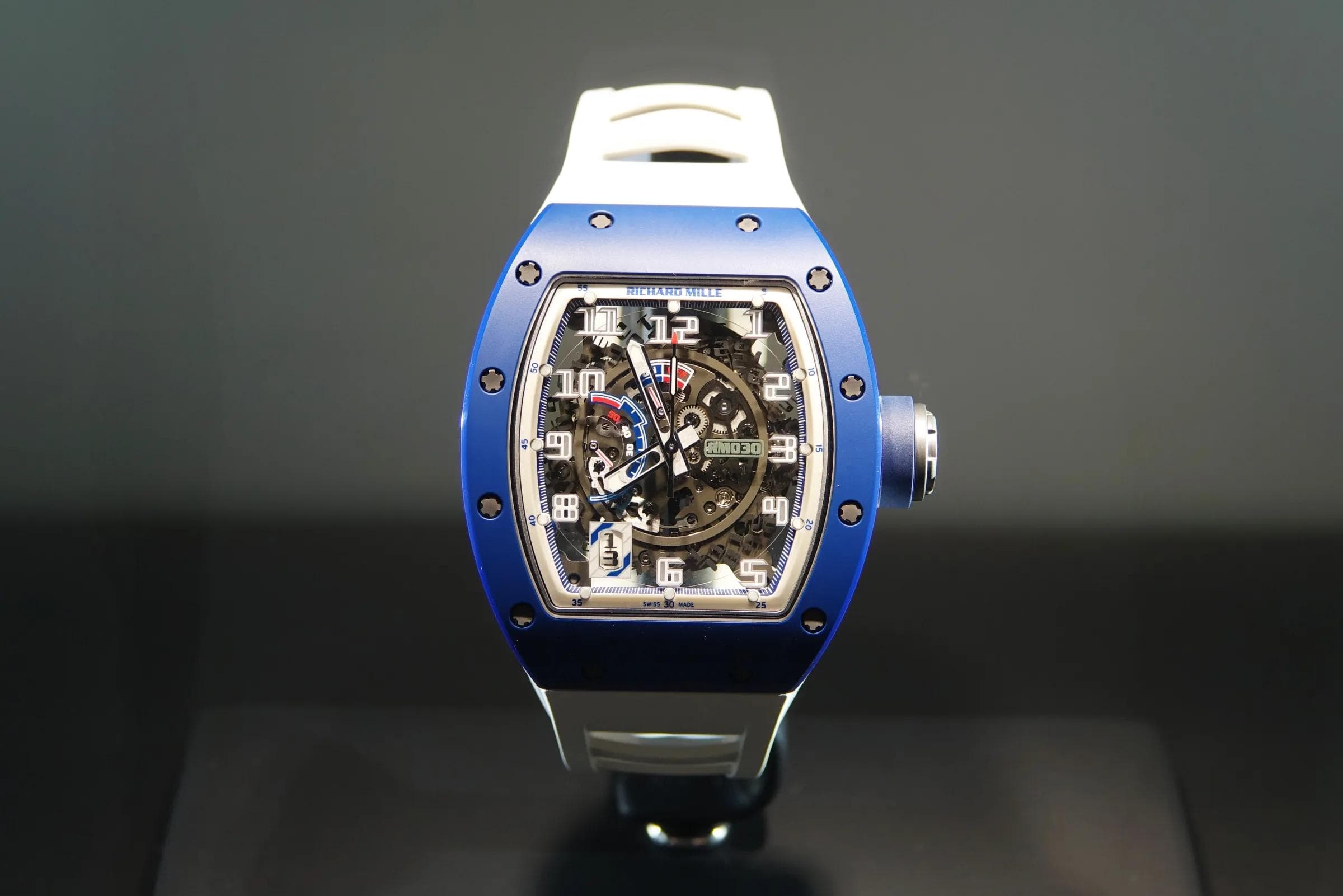
Richard Mille unveiled the RM 55-01 in April 2026, a manual-winding skeleton watch built around a new Caliber RMUL4 that weighs under five grams on its own, roughly the weight of a single sheet of paper. The retail price is reported at 212,000 dollars; Richard Mille lists the watch on request and does not publish a figure. The case pairs a grade 5 titanium middle with Carbon TPT or Quartz TPT, proprietary composites formed by layering ultra-thin fibers at varying angles. Richard Mille has been releasing watches at this price point and technical register since the brand was founded in 2001, and the formula has not changed: radical materials, limited production, no discounting, and distribution gated at the boutique level.
Swiss watch exports fell again in 2025, down 1.7 percent overall to roughly CHF 25.6 billion and a second consecutive annual decline, with the high-end segment above CHF 3,000 contracting 1.9 percent, according to Federation of the Swiss Watch Industry data. Vontobel's 2026 industry overview frames the period as a market where only a small group of structural leaders held growth while the rest adjusted. Richard Mille's estimated global turnover reached CHF 1.55 billion in 2024, per Morgan Stanley and LuxeConsult, the highest revenue per watch of any brand in their rankings. In a market normalizing after a speculative peak, holding that line is not a trivial result.
The reflex read is that Richard Mille is untouchable, a brand so scarce and so technically distinctive that normal market gravity does not apply. The secondary market data complicates that story. The RM 11-03 Automatic Flyback Chronograph, one of the brand's highest-volume references, is down roughly 15.6 percent on the secondary market over the past year per WatchCharts, underperforming the overall WatchCharts market index by about 24.5 percentage points. The RM 55-01 and the Nadal tourbillons trade far above retail. The RM 11-03 is trading below its original sticker price. Richard Mille is not one market. It is two, and the line between them is the one a buyer at 212,000 dollars needs to understand before committing.
Richard Mille is not one market. It is two, and the line between them is the one a buyer needs to understand before committing.
How five thousand pieces a year becomes a pricing instrument
Richard Mille's total annual output sits near 5,300 pieces, an industry estimate cited consistently by Morgan Stanley and LuxeConsult and widely referenced in the watch press. Rolex produces roughly one million watches annually. Patek Philippe produces around 65,000. Richard Mille produces fewer than almost any brand in its price tier, and the gap is not accidental.
The scarcity is structural. Richard Mille does not use distributors, does not offer discounts at its authorized boutiques, and has been systematically consolidating its retail presence into a direct boutique network. The Chronohunter waitlist guide notes that multi-year waits are common on sought-after references, with some collectors waiting three to four years and needing documented purchase history to access certain collaborative pieces. For most buyers, the secondary market is the only realistic route to ownership on the references they actually want. Sotheby's frames the acquisition this way explicitly: build a relationship with a boutique, and if that fails, go to auction.
That supply constraint has direct secondary market consequences. The EveryWatch 2025 secondary market report, published in February 2026, measured total pre-owned luxury watch sales at 16.73 billion dollars, up roughly 36 percent year over year. As WatchPro reported from the data, Richard Mille ranked fifth by value among tracked brands at 672 million dollars, behind Rolex at 5.7 billion, Patek Philippe at 2.2 billion, Audemars Piguet at 1.6 billion, and Omega at 697 million. Richard Mille's 672 million represents 6.74 percent of the top-brand total. Counting only the privately held names, the four largest, Rolex, Patek Philippe, Audemars Piguet, and Richard Mille, captured 49.1 percent of secondary market value combined. At under 6,000 units a year, Richard Mille's claim on nearly seven percent of secondary value by dollar is the clearest single expression of how its pricing model works.
Where the premium holds and where it does not
The secondary market data splits the Richard Mille catalogue into two distinct tiers, and the split is legible if you know what to look for.
At the top, the Nadal tourbillon series anchors the high-water mark. The RM 27-04, a fifty-piece limited edition released in 2020, sold at Phillips Geneva Watch Auction XIV for CHF 1.66 million in November 2021, against a retail price of roughly one million dollars. The RM 27-05, released in 2024 in a run of 80 pieces with a retail price near CHF 980,000, or about 1.1 million dollars, lists on the secondary market at 2.7 million dollars on dealer platforms including Chrono24. These are not volume references. They are, for practical purposes, collectible artworks with complications.
The RM 55-01 launched in April 2026 sits below that tier but above the volume end of the catalogue. At 212,000 dollars retail, with a Caliber RMUL4 that is a genuine engineering milestone, it enters the catalogue as a specialist piece. Richard Mille has not announced a production cap for the RM 55-01, so the secondary market premium, if any, will depend on how many units clear boutiques and how quickly.
The volume risk sits with the RM 11-03 Automatic Flyback Chronograph, the brand's most actively traded reference and one of its most recognizable. WatchCharts data for the RM 11-03 as of May 2026 shows the reference down roughly 15.6 percent over the prior year, underperforming the overall WatchCharts market index by around 24.5 percentage points, with the average trading around 283,000 dollars. The RM 11-03 now trades near or below its retail sticker on the secondary market, depending on execution. That is not a catastrophic result for a six-figure watch, but it is the data point that breaks the narrative of universal Richard Mille premium retention.
The same pattern, premium references holding while volume references soften, is the central finding of the 2026 Vontobel industry overview on the broader watch market. Vontobel analyst Jean-Philippe Bertschy labeled it 'selective normalisation,' a market environment where structural leaders maintain pricing power and everything else adjusts. Richard Mille's catalogue is a clean illustration of that dynamic within a single brand.

The boutique network and the CPO programme
Richard Mille controls more of the resale ecosystem than most buyers realize. The brand launched a certified pre-owned programme in 2015, one of the first among ultra-luxury watchmakers. The current network runs four affiliated partners: NX-One in Tokyo, The Value of Time in Singapore, Westime in Los Angeles, and Ninety at Mount Street in Mayfair, London. Ninety opened in 2021 as the only official Richard Mille CPO boutique across Europe and the Middle East.
Each CPO partner houses a watchmaker fully trained by Richard Mille, issues brand-authenticated documentation, and carries a two-year warranty on certified pieces. The network gives Richard Mille a stake in secondary market transactions that most watch brands cede entirely to grey dealers and auction houses. WatchPro's coverage of the Ninety launch framed the programme as a deliberate effort to maintain brand standards on the resale side, not merely to capture additional revenue.
The CPO network also reinforces the allocation model. A buyer who goes through an authorized boutique for a new piece, then sells through a CPO partner, stays inside the Richard Mille ecosystem. The brand retains visibility on transaction history and client behavior. That data has obvious value for allocation decisions on future releases.

What the 2026 releases signal about brand direction
The RM 07-01 Colored Ceramics III, released at Watches and Wonders 2026, is a different kind of statement. The collection closes a five-year ceramic arc that began in 2021. Each of the three new variants is limited to 50 pieces in TZP ceramic, offered in blush pink, lavender pink, and powder blue, with bezels set with diamonds, sapphires, rubies, and tsavorites. The RM 07-01 targets a different buyer profile from the Nadal tourbillons: smaller case, gem-set, clearly positioned toward a collector who wants the Richard Mille brand expression in a wearable format. The 50-piece cap applies the same scarcity logic at a different price point.
The two 2026 launches, the RM 55-01 Manual Winding and the RM 07-01 Colored Ceramics III, reinforce the pattern the brand has followed for over two decades. Engineer something technically distinctive, produce a small number, distribute through a controlled network, and hold the retail price firm. The formula has not required revision.
The structural question heading into the second half of 2026 is whether the softening in volume references like the RM 11-03 accelerates or stabilizes. The Rolex secondary market parallel is instructive: Rolex raised retail prices in 2026 while secondary market premiums on steel sports models compressed. The most actively traded references at both brands are adjusting toward fair value after the speculative run-up of 2021 to 2023. The halo references, the pieces with hard production caps and genuine technical distinction, have not moved.
The allocation game: what it takes to get in
Richard Mille allocations work on purchase history, not on walking into a boutique with a deposit. The model mirrors, and in some respects exceeds, the Patek Philippe and AP allocation systems that generate so much friction at the top of the market. Chronohunter's waitlist guide documents waits of one to four years on standard references, with certain collaborative pieces requiring demonstrated purchase history before a buyer is even considered.
The effect is that a first-time buyer at any Richard Mille boutique has no realistic path to the references that actually hold secondary market premiums. Those pieces go to established clients. The grey market and auction houses capture the secondary demand from buyers who were not in the allocation queue when the piece shipped.
That allocation structure is also what makes the CPO network strategically important. A buyer who cannot clear the primary allocation can, in principle, acquire through Ninety or Westime with brand authentication and warranty coverage. The price will be secondary market, not retail, but the documentation and service access are equivalent to a boutique purchase. For collectors treating the watch as a financial asset rather than purely a wearable, that distinction matters: the provenance chain is clean, and the resale path is already established.
The bottom line for buyers
Richard Mille's scarcity model is working at the top of its own catalogue and facing ordinary market pressure in the middle. The RM 27-05 and the Nadal tourbillons trade at multiples of retail on the secondary market. The RM 11-03 no longer does. The 2026 novelties, the RM 55-01 and the RM 07-01 Colored Ceramics III, are both positioned in the specialist tier rather than the volume tier, which is a reasonable read of where the brand's pricing power resides. For a buyer entering at the 212,000 dollar level, the question is not whether Richard Mille holds value as a category. It is whether this specific reference has a production cap that creates secondary market scarcity, or whether it is effectively a volume piece priced like a limited one. The Bryant watches desk tracks the secondary market reference by reference.