
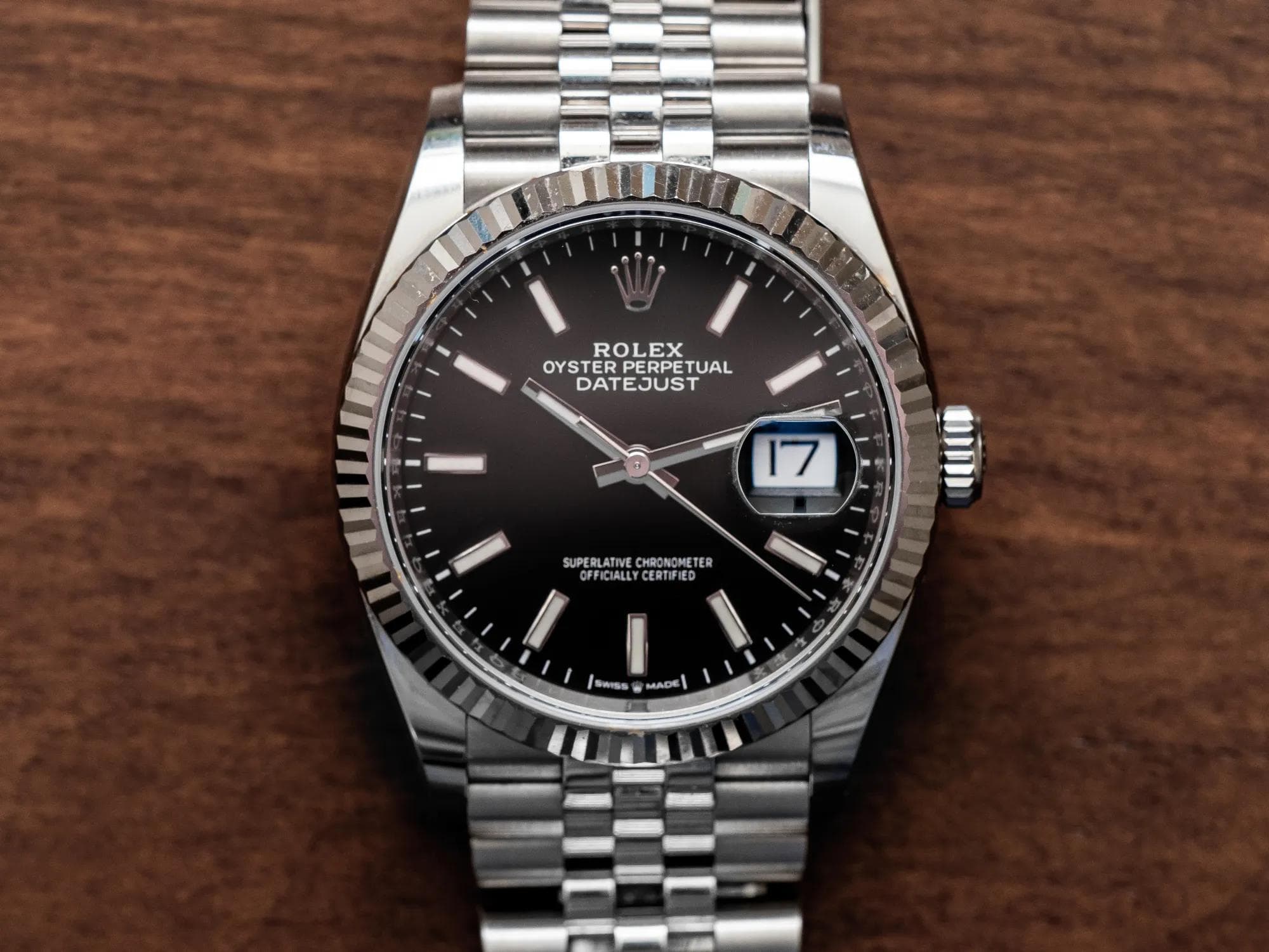
In March 2026, Morgan Stanley and LuxeConsult published their ninth annual Swiss watch report and confirmed what the trade had assumed but not seen quantified: Rolex sold roughly CHF 11 billion of watches at wholesale in 2025, an implied CHF 16 billion at retail, on production of about one million units. That is close to 14 billion dollars at retail and 32.9 percent of the entire Swiss watch industry by value, a gain of 90 basis points in a single year. No watchmaker has ever held a share that large. The crown now captures a third of every franc spent on Swiss watches while making 2 percent fewer of them than the year before, the second consecutive annual cut in volume.
Three weeks earlier, on January 1, Rolex had raised retail prices for the fourth year running. The increases were modest on steel, between 1 and 3.5 percent across the core Oyster Professional range, and sharp on gold, 5 to 6 percent, with the white-gold Daytona moving from 51,800 to 56,400 dollars in the United States before tariffs. Then the report landed, and the secondary market did something it had not done in three months. It stopped following Rolex up.
Rolex is the only major brand whose resale index is now lagging the recovery it personally started. That is not weakness. It is the plan working.
WatchCharts, whose Overall Market Index tracks live transaction data across 27 brands, recorded Rolex down 0.3 percent in March 2026, snapping a three-month winning streak, while Patek Philippe led every brand at plus 1.2 percent and Cartier's Panthère posted one of the month's strongest collection gains at plus 1.5 percent. Rolex's most-traded references all slipped: the Daytona off 0.7 percent, the Datejust and Submariner each off 0.6 percent, the Sky-Dweller worst at minus 1.5 percent. The brand that led the entire market out of its 2022 collapse is now the laggard in its own recovery. The reflex read is that demand is cooling. The sharper read is that Rolex has spent two years engineering exactly this outcome, and the 2026 price list is the clearest evidence yet of where the company thinks its real customer sits.
Why did Rolex raise prices into a softening resale market?
Because the resale market is not where Rolex makes money, and the company has been working to make that fact structurally true rather than merely accounting-true. Every watch that trades on the secondary market traded at retail exactly once, and Rolex captured its margin on that single transaction. The flips, the grey-market premiums, the waitlist arbitrage that defined 2021 and 2022, none of it accrued to Geneva. It accrued to dealers, speculators, and the lucky allocation holders who sold. For a brand that produces a million watches a year, a frothy secondary market is not a revenue stream. It is a reputational liability and a pricing distortion the company does not control.
So Rolex did two things. It tightened supply discipline, cutting unit production 2 percent for the second straight year even as demand and pricing power held, and it acquired its largest retail partner. The 2023 agreement to buy Bucherer, which together with Tourneau operates more than 100 points of sale and is the single biggest Rolex retailer in the United States, signals the direction unmistakably. Rolex wants to own more of the path between the manufacture and the wrist. A company moving to internalize distribution is a company that has decided the resale market is a problem to be managed, not a barometer to be celebrated.
The price architecture confirms the priority. Near-flat steel keeps the entry Oyster Professional references, the Submariner and GMT-Master II among them, within reach of the aspirational buyer who sustains brand demand and waitlist length. Aggressive gold pricing, up to 6 percent before tariffs and as much as 15 percent in the tariff-exposed US market, tracks a precious-metals shock that genuinely reshaped the cost base: gold rose roughly 46 percent in euros and 65 percent in dollars year over year and broke 4,500 dollars an ounce in early 2026, while platinum surged past 100 percent in euros. Rolex is not gouging on gold. It is passing through a real input cost to the buyer who can absorb it, and protecting the steel tier that does the brand-building.
Who actually buys watches now, according to the Morgan Stanley data
The polarization is the story the headline market-share number obscures. Watches priced above CHF 50,000 now account for 37.3 percent of Swiss export value and delivered 89 percent of the entire industry's growth in 2025, despite representing just 1.4 percent of unit volume. The money is at the top, and it is concentrating fast. Switzerland's four largest privately held watchmakers, Rolex, Patek Philippe, Audemars Piguet, and Richard Mille, lifted their combined share by 2.2 percentage points to 49.1 percent. Four houses now command half the industry by value.
The revenue ladder underneath that statistic is steep. Richard Mille books roughly 4.1 billion dollars on fewer than 6,000 watches, which works out to an average selling price near 689,000 dollars, an order of magnitude above Rolex's roughly 14,000 dollar implied average. Audemars Piguet clears about 3.3 billion dollars on roughly 53,000 units, an average near 62,000 dollars, and Patek Philippe about 3.2 billion dollars on roughly 72,000 units, an average near 44,000 dollars. Those average selling prices are Bryant derivations, calculated from the disclosed revenue and unit figures where both exist; Morgan Stanley publishes the totals, not the per-watch averages. The revenue bases also mix wholesale and retail framings across brands per the underlying report, so they are directional rather than strictly comparable on a like-for-like basis.
Cartier is the genuine mover beneath Rolex. The maison reached roughly CHF 3.5 billion, around 4.5 billion dollars, to hold second place by value, ahead of Omega at roughly 2.8 billion dollars, and its resale performance has outpaced Rolex's for over a year. That is not coincidence. Cartier sells design and heritage at price points that have not been distorted by speculation, which is precisely the position Rolex is trying to engineer for its steel range: desirable, available enough to avoid grey-market frenzy, and priced by the manufacture rather than the flipper.

Is the secondary-market dip a warning or a feature?
It is directionally consistent with a healthy market, not a breaking one, which is the opposite of how a single down month gets read on watch forums. The broader recovery remains intact: the WatchCharts Overall Market Index rose 8.2 percent over the trailing year and was essentially flat at plus 0.1 percent in March, with 20 of 27 tracked brands in positive territory against just 8 a year earlier. By the first quarter of 2026, more than 70 percent of tracked brands posted positive quarter-on-quarter performance, versus 3 percent, Rolex alone, in the year-ago quarter. The Bloomberg Subdial index, which weights the 50 most-traded references by transaction value, gained 8 percent across 2025 on the same recovery. The market is not rolling over. It is normalizing, and Rolex sitting out a single month while Patek and the dress-watch segment lead is what a normal market looks like after a speculative cycle resolves.
The Subdial data sharpens the point. Across 2025, the pre-owned Patek index gained roughly 18 percent against a 10 percent rise for Rolex, and Cartier was the standout in the mid-tier. Rolex underperforming its peers on the resale tape is not a demand failure. It is the predictable result of a brand whose primary-market pricing has been deliberately closing the gap that speculation once opened. When the retail price rises 7 percent a year and the secondary premium compresses, the arbitrage that made Rolex flipping profitable simply disappears. That is the entire point of the exercise. A buyer who wants a steel Submariner in 2026 increasingly has one rational path, the authorized retailer, at the price Rolex sets.
What this means for collectors and the resale trade
The era of buying a Rolex as a liquid, appreciating asset is closing, and the brand is closing it on purpose. For the serious collector, the implication is a return to first principles: buy the watch to own it, not to flip it, and concentrate capital in the references where scarcity is structural rather than manufactured, the precious-metal and complicated pieces that the Morgan Stanley polarization data shows are absorbing nearly all the industry's value creation. For the dealer and the platform, the squeeze is real. A compressing spread between retail and resale is a compressing margin, and Rolex's move to internalize distribution through Bucherer narrows the independent trade's lane further.

For the aspirational buyer, paradoxically, the news is better than the headlines suggest. A normalized secondary market and a manufacture determined to protect its steel tier means the dream references are becoming buyable again at something closer to list, which is exactly the outcome the speculative era denied. The watch that was impossible to get at retail in 2022 and absurd to buy at resale is, in 2026, increasingly just a watch an ordinary buyer can order. The Rolex markup has not vanished. The crown has simply reclaimed the right to set it.
The bottom line for collectors
The Bryant Watches desk tracks allocation, secondary-market direction, and the structural shifts reshaping how the major houses price scarcity. For the parallel dynamics in the asset markets the same buyers are weighing, The Bryant's analysis of why collectors are buying at auction in 2026 maps the same speculation-to-ownership transition playing out in cars. Read the resale tape as Rolex now wants it read: not as a quote on a liquid asset, but as the receding shadow of a speculative cycle the manufacture has spent two years winding down.