
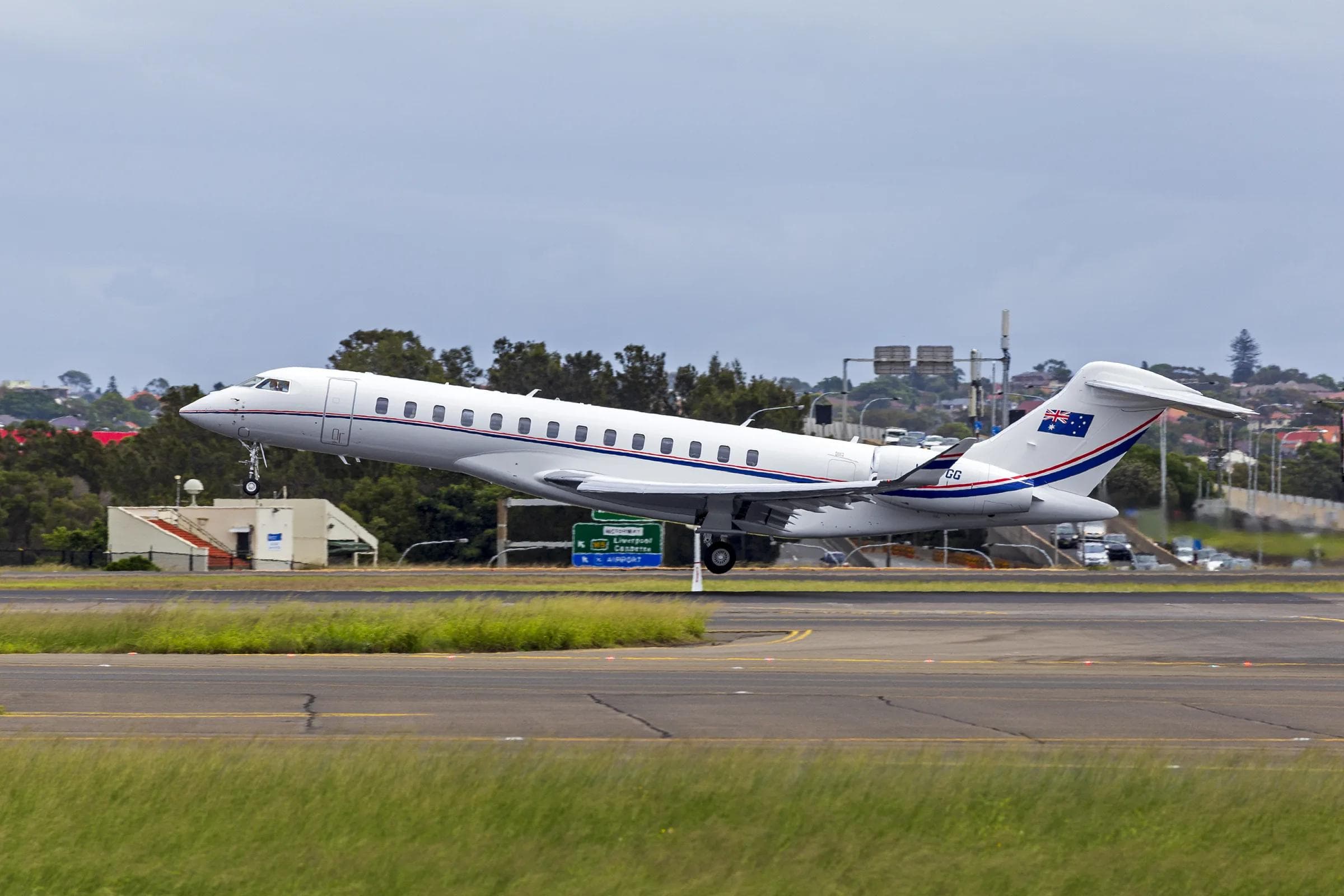
Bombardier unveiled the Global 8000 in Mississauga in December 2025 as the fastest civil aircraft to enter service since the Concorde retired in 2003. The aircraft carries a certified top speed of Mach 0.95, a range of 8,000 nautical miles, and a cabin altitude of 2,691 feet at 41,000 feet, the lowest of any business jet in production. Twelve weeks later, on March 26, 2026, NetJets took delivery of the first of 24 firm-ordered aircraft, becoming the Global 8000's fleet launch customer and signaling that the fractional market had already decided which instrument sits at the top of the ultra-long-range stack.
The business aviation market did not wait for the delivery ramp to form a view. Bombardier's order backlog reached 20.3 billion dollars at the end of March 2026, a 43 percent increase year-over-year, with Q1 book-to-bill running at 3.6 times, well above the 1.0 mark that signals stable demand. The Global 8000 and fleet operators were cited by Bombardier as the primary backlog drivers. Speed, presented for years as a secondary attribute in ultra-long-range competition, is now a lead argument.
The reflex read across aviation press has been that the Global 8000 and the Gulfstream G800 are converging products competing on the same mission. That framing misreads both aircraft. The G800, certified by the FAA and EASA in April 2025, is a range maximizer: it posts 8,200 nautical miles at Mach 0.85 cruise, the longest certified range of any in-service business jet. The Global 8000 is a time-arbitrage instrument. Its certified Mach 0.95 maximum operating speed, raised from a previously planned Mach 0.94 after Bombardier's flight test team found handling capacity better than the original target, positions it on a different axis from the G800. The buyer choosing between them is not choosing between good and better. They are choosing between two different performance theories.
Speed, presented for years as a secondary attribute in ultra-long-range competition, is now a lead argument.
What Mach 0.95 actually means on a transoceanic leg
Mach is the ratio of an aircraft's speed to the speed of sound, so Mach 0.95 is 95 percent of that speed. The Concorde cruised at Mach 2.04, twice the speed of sound. The Global 8000 is not competing with that; it is competing with the Mach 0.85 to Mach 0.90 high-speed cruise profile that most ultra-long-range jets operate. At Mach 0.92 high-speed cruise (the Global 8000's operational high-speed setting, per Bombardier's product specification), the time saving on a New York to Dubai leg, roughly 5,950 nautical miles nonstop (a nautical mile is about 1.15 ordinary miles, so the leg runs near 6,850 statute miles), against a Mach 0.85 competitor works out to approximately one hour by our calculation, not a figure Bombardier publishes. On New York to Singapore, which at approximately 8,300 nautical miles requires a fuel stop regardless of aircraft, the speed advantage concentrates on the legs that can be flown direct. For a principal whose board meeting or site visit cannot move, that hour is not comfort. It is deal availability.
The Mach 0.95 number also carries a certification meaning that the marketing framing obscures. The maximum operating Mach number is a structural and handling limit, not a routine operating speed. Bombardier originally planned Mach 0.94 for the Global 8000, which itself matched the Global 7500's limit, but the flight test program demonstrated handling characteristics beyond that threshold. Bombardier announced the Mach 0.95 certification on October 13, 2025 at the NBAA business aviation show in Las Vegas. FlightGlobal noted it would be the highest Mmo ever approved for a subsonic civil aircraft. The certification was Transport Canada on November 5, 2025, followed by FAA on December 19, 2025.
The G800 range argument and where it holds
Gulfstream's G800 is the stronger aircraft on pure range at slower cruise. Certified to 8,200 nautical miles at Mach 0.85, it edges the Global 8000's published 8,000 nautical miles by 200 nautical miles on paper, though the G800 posts 7,000 nautical miles at the faster Mach 0.90 cruise profile. The G800 received FAA and EASA certification in April 2025, entering service ahead of the Global 8000 and giving Gulfstream a meaningful head start on fleet building. The General Dynamics aerospace unit ended Q1 2026 with 22.27 billion dollars in backlog, and the G800 was named among the three highest-demand aircraft in the line.
The range crown matters on specific routes. City pairs beyond 8,000 nautical miles nonstop, a set that includes Singapore-New York and Sydney-Dallas, require either a fuel stop or a range-maximized aircraft flying at slower cruise. On those missions the G800 at long-range cruise covers ground the Global 8000 cannot reach without a stop. For a buyer whose primary mission is that transpacific leg, the G800's range headroom is the decision. The Bryant analysis of the G800's 2026 delivery ramp and fleet positioning covers that aircraft's backlog and operator profile in full.

NetJets and the fractional read on the fleet tier
NetJets is the world's largest private jet operator and its fleet choices function as a market signal. The firm's 24-aircraft firm order for the Global 8000, with an option structure for additional aircraft beyond that initial tranche, converts the fleet launch customer designation into a practical statement about what the highest-volume fractional operator believes its clientele will pay for. NetJets confirmed it will also work with Bombardier to upgrade its in-service Global 7500 fleet to Global 8000 aircraft, a conversion program that reinforces how closely the two platforms are positioned. Per the Bombardier delivery announcement on March 26, 2026, Patrick Gallagher, NetJets Aviation President, framed the partnership around a shared vision of performance and innovation, not around price competition. That is the language a buyer uses when the product justifies the premium, not when the buyer is selecting on cost.
The 24-aircraft order also implies a view on demand depth. NetJets does not add 24 units of a new type to serve one or two clients. The fractional model requires enough demand to fill flying hours across the fleet. The Global 8000 order tells the market that NetJets expects sufficient demand for Mach 0.95 capability across a fleet, not merely from the handful of buyers who write checks for whole aircraft.
The Global 7500 as the speed step-down
The Global 8000 is a direct derivative of the Global 7500, built on the same airframe with enhanced wing aerodynamics and the Mach 0.95 certification that the 7500 stops short of at Mach 0.94. That proximity matters in the pre-owned market. The Global 7500 pre-owned stack is already the tightest in its class: as the Bryant read on Global 7500 parity pricing documents, average asking prices for low-time examples sit within roughly five percent of new-build list, the cleanest single data point in the ultra-long-range pre-owned market. The Global 8000's entry into service at approximately 81 million dollars list will apply additional pressure to that spread. A buyer who wants the Global 7500's cabin and range profile now has a clear step-up argument available from the same manufacturer, and the pre-owned 7500 market will price that pressure in.
The conversion program NetJets structured, upgrading its in-service 7500 fleet to 8000 specification, is the manufacturer-endorsed version of that same logic. Bombardier is treating the two platforms as a continuum rather than as separate product lines, and the certification pathway for that upgrade will be a data point the broader pre-owned 7500 market watches closely.

The ownership read: who pays for the fastest jet
The 81 million dollar list price positions the Global 8000 roughly at parity with a new Global 7500 and within a few million dollars of the Gulfstream G800 range. The differentiation is not primarily financial at that tier. The buyer choosing the Global 8000 over the G800 at comparable price points is choosing a performance theory: speed and cabin altitude as the product, versus range ceiling and route flexibility as the product. Both theories are defensible at the principal level. The deciding variable is the buyer's actual route profile and how they price time.
The cabin altitude specification adds a dimension that pure speed and range comparisons miss. The Global 8000's 2,691 feet at 41,000 feet is the lowest of any business jet currently in production, per Bombardier's November 2025 announcement and AINonline's coverage of the record. On a 16-hour transatlantic or transpacific leg, the difference between a 2,691-foot and a 6,000-foot effective cabin altitude is a material fatigue variable. A principal who steps off a 16-hour flight at Mach 0.92 in a 2,691-foot effective environment is not carrying the same physiological debt as one flying the same mission at a conventional cabin altitude. For buyers whose competitive edge is decision-making capacity at destination, that is not a comfort specification. It is a performance specification.
The secondary question is whether speed leadership is defensible. Gulfstream's G800 maximum operating speed is Mach 0.935, 0.015 below the Global 8000's Mach 0.95. Gulfstream could raise its own Mmo on the G800 or the G900 generation if market demand justifies the certification investment. The Global 8000's speed lead is real and certified, but the moat is not particularly wide. What Bombardier has done is establish speed as a primary marketing axis in the ultra-long-range category and occupy that position first, at the moment when the fractional market, through NetJets' 24-aircraft commitment, is signaling that the position has commercial traction. That is different from having an uncopyable technical advantage. For the buyer evaluating the category today, the fractional ownership economics and the specific mission profile matter more than the Mach 0.015 edge at the margin.
The bottom line for buyers
The Global 8000 is the fastest civil aircraft since Concorde, it is certified and in service, and NetJets has committed 24 aircraft to the platform. Those three facts are load-bearing. The speed advantage over the Gulfstream G800 is real but narrower than the headline framing suggests: Mach 0.95 vs Mach 0.935 at the top-speed limit, Mach 0.92 vs Mach 0.90 at high-speed cruise. The G800 holds the range ceiling at slower cruise. The choice between them is a mission-profile decision, not a quality decision. For buyers on the Global 7500 pre-owned market, the 8000's entry positions the 7500 as the value expression of the same Bombardier long-range thesis, with the conversion upgrade path confirmed. The Bryant Aviation desk tracks the ultra-long-range tier transaction by transaction. The full Aviation coverage holds the running record.