
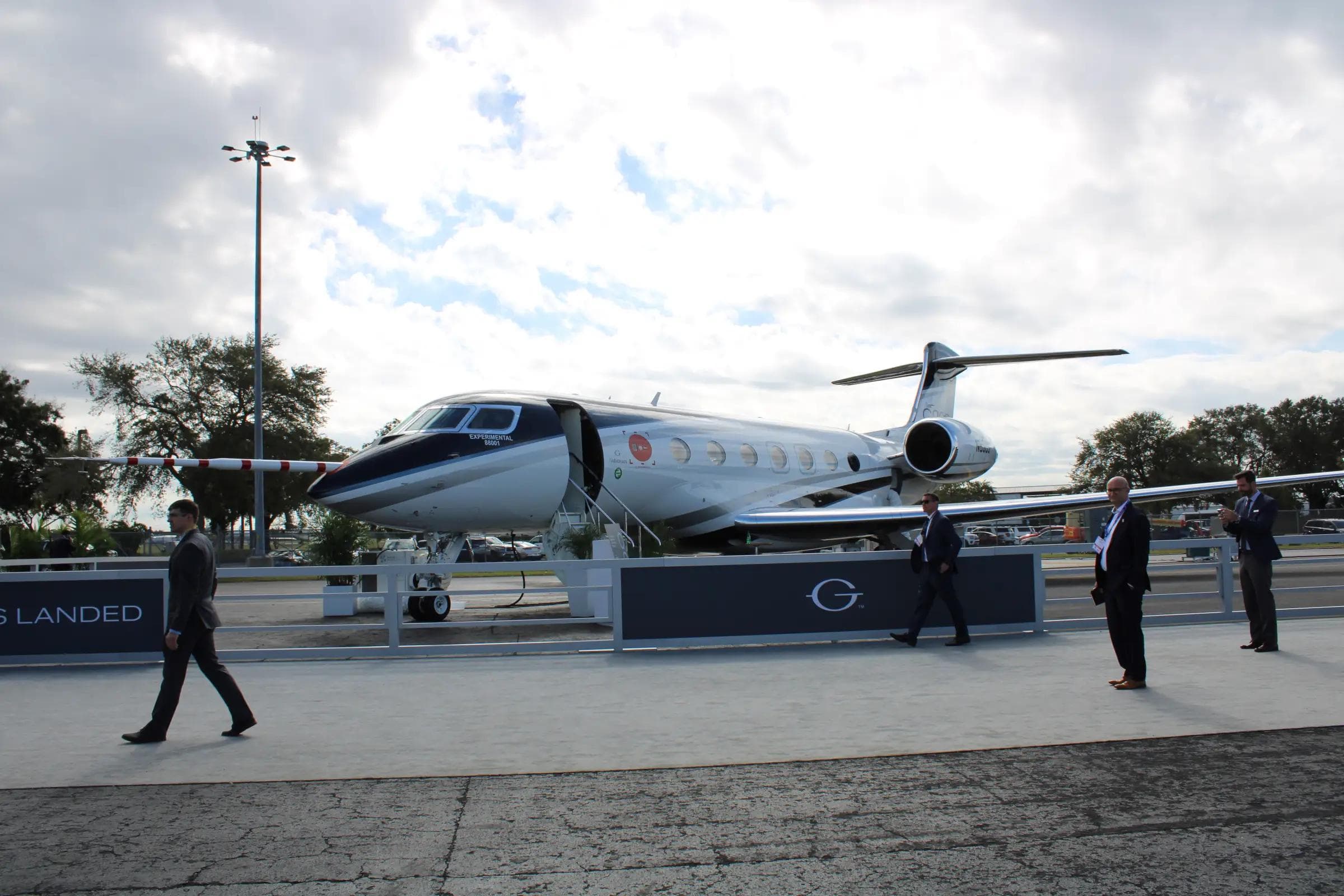
Gulfstream delivered the first G800 on August 27, 2025, four months after the aircraft earned simultaneous FAA and EASA type certification on April 16. The G800 entered service as the longest-range business aircraft in production, certified to fly 8,200 nautical miles at Mach 0.85, a figure that is 200 nautical miles above the original design target and roughly 450 nautical miles beyond what the G700, Gulfstream's other current flagship, carries on its most efficient cruise setting. By the time November arrived, the G800 had set eight city-pair speed records, ending the Dubai Airshow run from Phuket in 5 hours and 38 minutes.
General Dynamics, Gulfstream's parent, reported its aerospace segment at 13.1 billion dollars in full-year 2025 revenue, up 16.5 percent year over year, with a backlog of 21.8 billion dollars at year end. The G800's entry into service in the third quarter of 2025 was the cited driver. By the first quarter of 2026, backlog had climbed further to 22.27 billion dollars, and Gulfstream delivered a record 38 aircraft in that quarter alone, with roughly 160 total deliveries guided for the full calendar year. That backlog figure now stretches order books for both the G700 and the G800 into mid-2028.
The instinctive read is that the G800 is simply the successor to the G650, Gulfstream's prior long-range standard. That framing is too narrow. Gulfstream is running two flagships simultaneously, not one. The G700 is the volume leader, its 56-foot, 11-inch cabin and five living zones designed to win the fleet-procurement and corporate-aviation buyer who needs maximum interior space. The G800, with a 10-foot shorter cabin derived from the G650 architecture, is the range instrument, designed to fly nonstop city pairs that no competing aircraft can reach and to hold the brand's pricing floor at the very top of the market. Understanding which of the two aircraft an operator actually needs is the whole decision.
The G700 is the volume leader. The G800 is the range instrument. They are not competing products. They are two sides of the same positioning strategy.
The 8,200 nautical mile number and what it unlocks
Gulfstream's published range for the G800 is 8,200 nautical miles at its long-range cruise of Mach 0.85. At the high-speed cruise of Mach 0.90, range reduces to 7,000 nautical miles. The maximum operating speed has been raised to Mach 0.935 from the Mach 0.925 originally projected. At the long-range cruise figure, the G800 connects New York to Dubai nonstop, Los Angeles to Sydney nonstop, and Singapore to London nonstop. Those are routes the competition cannot reliably clear. The journey from London to Sydney runs approximately 9,188 nautical miles, roughly 988 more than the G800's certified maximum, which places that specific pair just out of range. But nearly every other ultra-long city pair a global principal actually operates falls inside the envelope. The Gulfstream product page carries the full city-pair table.
Range leadership translates directly to a specific kind of operational freedom that cannot be replicated by adding a fuel stop. A refueling stop on a transatlantic-plus route adds two to four hours of elapsed time, introduces a slot or permit dependency at the divert airport, and degrades the jet's primary value proposition for the passenger: uninterrupted, no-variable-calendar travel. For a family office principal whose schedule books six weeks out and whose counterparties sit on different continents, the ability to close a refueling stop from the itinerary is not a luxury specification. It is the product.
The G800's powerplant is the Rolls-Royce Pearl 700, the same engine series that powers the G700. Gulfstream pairs it with a new aerodynamic wing and winglet designed specifically for the G800. The aircraft also maintains Gulfstream's industry-noted cabin altitude figure: below 3,000 feet at 41,000 feet of cruising altitude. That is a biologically meaningful gap from the 6,000-to-8,000-foot equivalent altitude that older large-cabin jets produce. On a 16-hour flight, that differential is part of the aircraft's operational story, not an afterthought on a spec sheet. The Aviation Week coverage of the certification covers the airframe and engine combination in detail.
Two flagships, not one: the G700 role in Gulfstream's positioning
Gulfstream delivered 50 G700s in 2025, up from 27 in 2024. The G700's 56-foot, 11-inch cabin with five living areas and 20 windows is the largest purpose-built interior in the Gulfstream lineup. Gulfstream does not publish list prices, but the figure brokers and market trackers cite is near 75 million dollars, and the aircraft has become the dominant product in the ultra-large-cabin segment, the one that charter operators, flight departments, and fractional programs default to when cabin volume is the primary specification.
The G800 serves a structurally different buyer. Its cabin is derived from the G650 architecture: 10 feet shorter than the G700, four living areas, 16 windows, and a reported market price brokers place near 72 million dollars (Gulfstream does not publish a list price). That shorter cabin is not a compromise. It is the design choice that enables the range leadership. Trading cabin length for wing geometry and fuel capacity is what produces 8,200 nautical miles. A buyer choosing between the G700 and the G800 is not choosing between a better and a worse aircraft. They are choosing between a space-first and a range-first instrument, and Gulfstream's two-flagship strategy is deliberately positioned to capture both. The Bryant analysis of G700 slot market dynamics covers the G700's secondary-market position in detail.

The competitive field: where Bombardier and Dassault stand
Gulfstream held the range title without a direct challenger through most of 2025. That changed in December. Bombardier received FAA certification for the Global 8000 on December 19, 2025, and delivered the first aircraft to Canadian businessman Patrick Dovigi on December 8. The Global 8000 is positioned primarily as a speed aircraft: certified top speed of Mach 0.95, versus the G800's Mach 0.935. On range, Bombardier publishes 8,000 nautical miles for the 8000 at long-range cruise, a 200-nautical-mile gap behind the G800's 8,200 nautical miles. The Bombardier Global 8000 piece runs the speed comparison directly. The short version: Bombardier leads on top speed; Gulfstream leads on range.
The predecessor model, the Bombardier Global 7500, carries a published range of 7,700 nautical miles and remains the incumbent volume product in Bombardier's lineup, a position that mirrors the G700's role on the Gulfstream side. The pre-owned market for the Global 7500 is a useful read on where the Gulfstream G700 may trade once supply loosens. The Bryant analysis of Global 7500 pre-owned parity pricing examines that secondary market.
Dassault's Falcon 10X, the third aircraft in this tier, has not arrived. Dassault rolled out the first prototype in March 2026 after a five-year ground test program and confirmed a maiden flight target in 2026, with entry into service now targeted for late 2027. The Falcon 10X's published range target is 7,500 nautical miles, roughly 700 nautical miles less than the G800's certified maximum. Its claimed competitive advantage is cabin width: 9 feet and 1 inch, wider than either the G700 or G800. Until the aircraft completes certification and enters service, the delay is a supply-side constraint that leaves an entirely unchallenged runway for both Gulfstream flagships. The Bryant analysis of the Falcon 10X delay covers what the slip means for the competitive field.

What the backlog signals about pricing durability
Backlogs extending into mid-2028 on both the G700 and G800 do two things simultaneously. They validate demand at current price levels, and they remove near-term supply from the secondary market. A buyer today is committing to a mid-2028 delivery at a price agreed now, which means the new-aircraft market and the pre-owned market are effectively decoupled for the next two years. Pre-owned G800s, in the rare instance one trades, will carry a significant premium over a new-aircraft order, because the new-aircraft order resolves in 2028 and the pre-owned aircraft is available today.
The completions constraint that General Dynamics has cited across multiple earnings calls is the primary ceiling on near-term volume. Gulfstream guides roughly 160 aircraft for 2026, only two more than the 158 it delivered in 2025. That is not a demand problem. It is a production capacity problem. Until completions capacity expands, the backlog will continue to extend rather than clear. For the secondary market, that means buyers unwilling to wait for a new-aircraft slot will pay to access an existing aircraft, and the G800's novelty ensures that pool of available aircraft remains thin for several more years.
The range moat and its limits
Range leadership in business aviation has historically been a durable competitive position because the development cycle for a new ultra-long-range aircraft runs eight to twelve years and costs billions in capital. Gulfstream achieved FAA and EASA certification on the G800 in a single April 2025 action, a process that itself ran from the aircraft's public launch in 2021. Dassault has been in development on the Falcon 10X since the same 2021 announcement and will not deliver until late 2027 at the earliest. Bombardier reached the 8,000 nautical mile mark with the Global 8000 but at 200 nautical miles less range than the G800. The Aviation International News first-delivery report covers the certification and delivery sequence.
The limit of the range moat is also clearly visible. Bombardier is now in the 8,000-plus nautical mile tier. Dassault will be there by 2028. The moat is currently measured in months and hundreds of nautical miles, not in years and thousands. Gulfstream's durable advantage, if it extends beyond the next aircraft generation, will rest less on the raw range number and more on the completions capacity and certification track record that allow it to deliver on time while competitors slip. That is a less elegant marketing story than a single range figure, but it is the mechanism that actually compounds into a pricing position over a decade.
The bottom line for buyers
The G800 is in service now, certified and delivering, with eight speed records confirmed and a completions line in Appleton, Wisconsin, operating through a backlog that extends into mid-2028. A buyer with a range requirement above 7,700 nautical miles and a preference for Gulfstream's cabin altitude and avionics architecture has one aircraft that meets that specification today. A buyer primarily prioritizing cabin volume at comparable range should read the G700 case before committing. The full Aviation coverage carries both.