
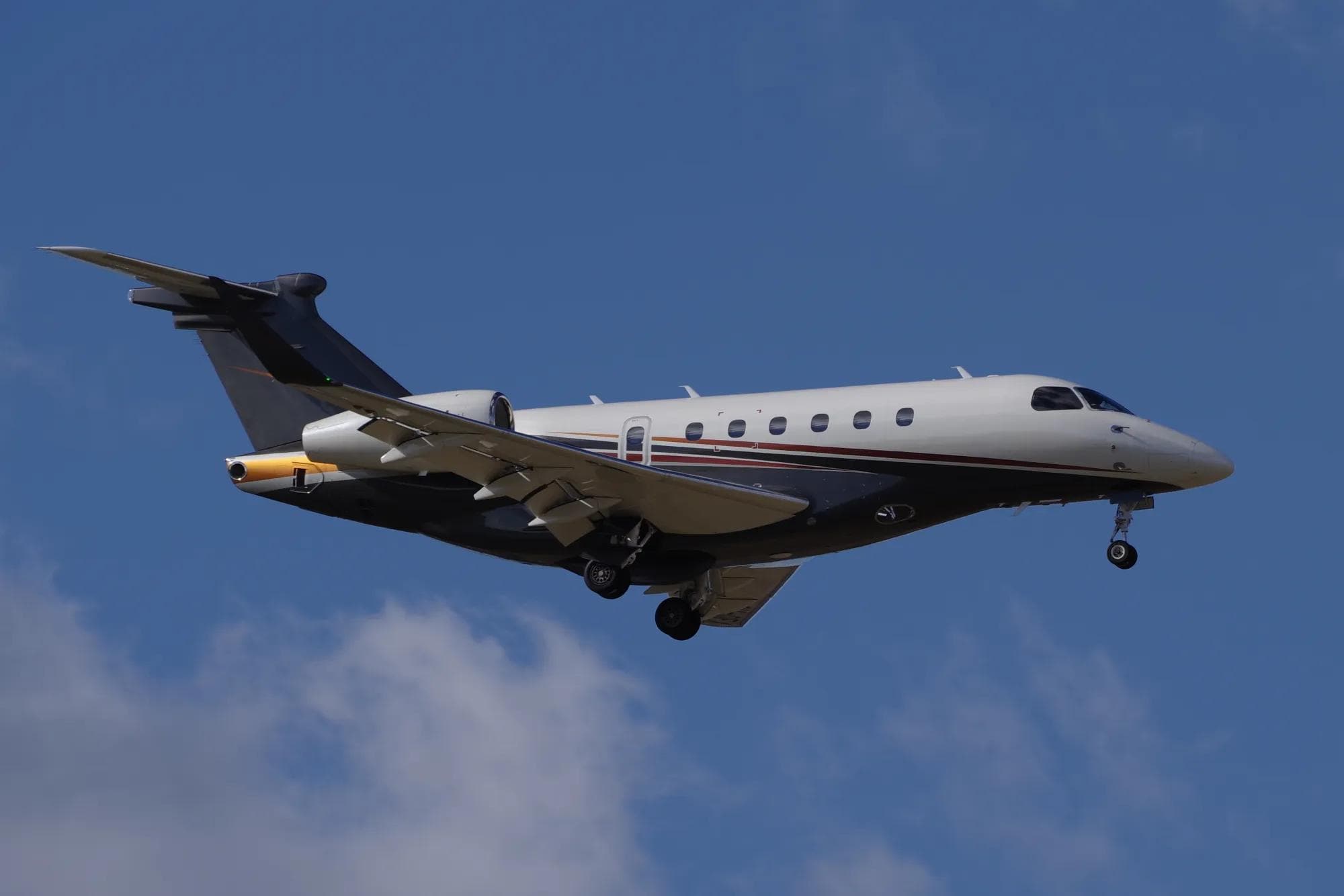
Embraer earned simultaneous certification for the Praetor 600E from Brazil's ANAC, the United States FAA and Europe's EASA on April 30, 2026, closing the regulatory path on the first redesign the Praetor family has received since the line launched in 2018. The aircraft is finished. The type certificate is signed in all three of the jurisdictions that matter most to a transatlantic buyer. And yet the company's own press materials state that for all new orders, deliveries are expected to begin in the first quarter of 2029.
That is an unusually long runway between a certified aircraft and a delivered one, and the market noticed the timing more than the technology. The 600E is not a new airplane. It retains the same airframe, the same two Honeywell HTF7500E engines, the same full fly-by-wire flight controls and the same 4,018-nautical-mile range as the Praetor 600 it replaces. What changed is the cabin: an all-new management system, re-engineered seating and an optional 42-inch 4K OLED Smart Window that streams exterior camera views and hosts video calls. Michael Amalfitano, president and chief executive of Embraer Executive Jets, framed the February launch as redefining the segment. The hardware underneath tells a more disciplined story.
A finished certificate and a 2029 delivery date is not a backlog. It is a pricing instrument.
The reflex read across the trade press has been that Embraer is managing a constrained production line and a long order queue, the same supply story that has dominated business aviation since 2022. That read is incomplete. The Praetor backlog is real, but the three-year gap is not primarily a capacity signal. It is the mechanism by which Embraer converts a mature, well-understood airframe into a fresh pricing tier, and it works precisely because the company has chosen not to flood the segment with metal.
Why certify in 2026 and deliver in 2029
The conventional explanation is supply chain. Embraer's first-quarter 2026 results carried genuine production strain, and management was candid about it. On the consolidated earnings call, chief executive Francisco Gomes Neto pointed to supplier pacers, singling out engines as the binding constraint while noting the situation was improving. Company-wide adjusted EBIT margin landed at 6.5 percent for the quarter, well under the 8.7 to 9.3 percent the company has guided for the full year. US import tariffs cost the business roughly 13 million dollars in the quarter, with more expected in the second.
Those pressures are concentrated in commercial aviation, not executive jets. The Executive Aviation division actually had its strongest first-quarter delivery performance on record. It shipped 29 aircraft, up 26 percent year-over-year, split between 16 light jets and 13 midsize. Segment revenue rose roughly 30 percent to 418 million dollars, according to Corporate Jet Investor's reading of the results. The division is not capacity-starved in the way the commercial side is. It is running hot.
So the 2029 date is not the only schedule Embraer could have offered. It is the schedule that serves the strategy. By certifying the 600E now and opening an order book that does not deliver for three years, Embraer accomplishes three things at once. It validates the aircraft to its most demanding regulators, removing certification risk as a buyer objection. It locks in 2029 deliveries at today's pricing. Aviation Week put the outgoing Praetor 600 at 23.995 million dollars base in 2025; Embraer has not separately published a 600E list price, and a 7 to 8 percent cabin-upgrade premium would put it near 25.8 million dollars. And it gives the current Praetor 600 a defined production cutoff, which is the single most reliable way to firm residual values on the airframe already flying.
What the flat backlog signals
The number that anchors this reading is one that looks, at first glance, like nothing happened. Embraer's company-wide backlog reached a record 32.1 billion dollars in the first quarter of 2026, its sixth consecutive all-time high. Executive Aviation's share of that was 7.6 billion dollars, and it was flat, broadly unchanged year-over-year and quarter-over-quarter.
A flat backlog against a 26 percent jump in deliveries is not stagnation. It is equilibrium. Order intake in the executive division roughly matched the faster delivery pace, so the queue neither lengthened nor drained. That is exactly the condition a manufacturer wants when its goal is pricing power rather than market share. A backlog that balloons signals demand the company cannot serve and eventually forces discounting to clear. A backlog that collapses signals demand falling away. A backlog held flat while output accelerates signals a book being managed to a target, with the manufacturer matching supply to the price it wants to hold.

The full first-quarter scorecard reads the same way. Company-wide backlog stood at a record 32.1 billion dollars, the sixth straight all-time high. Executive Aviation's slice held flat year-over-year and quarter-over-quarter at 7.6 billion dollars. The division delivered 29 aircraft, up 26 percent, on revenue of roughly 418 million dollars, up about 30 percent. And segment adjusted EBIT margin landed at 6.0 percent, down sharply from 11.3 percent a year earlier. Output up, backlog flat, margin compressed: a book run to a price, not to volume.
The margin line is the cost side of the same strategy. Executive Aviation's gross margin compressed from 21.8 percent to 15.1 percent year-over-year, and its segment adjusted EBIT margin fell from 11.3 percent to 6.0 percent, pressured by roughly 12 million dollars in tariff cost that eroded about 280 basis points on its own. Embraer is absorbing real margin pain on current deliveries. Holding list price on the 600E rather than discounting into that pressure is the lever it has chosen to pull, and a long order book with a 2029 floor is what makes the price defensible.
The secondary market is already doing the work
The pricing thesis only holds if the existing Praetor 600 retains value, and on that point the used market has been unusually emphatic. Aviation Week's running market analysis has described pre-owned Praetor 600s as hard to find and slow to depreciate, with inventory thinning to a handful of aircraft and, by the magazine's account, periods this year with effectively none listed. A super-midsize jet trading at roughly 5 percent of its fleet available for sale is tight by any standard, and a 2022-build holding near its original value several years on is the kind of residual performance that anchors new pricing.
This is the same structural pattern The Bryant has tracked at the top of the cabin. The Gulfstream G700 slot premium showed buyers paying millions above list simply to skip the production queue, and the Bombardier Global 7500's pre-owned parity pricing showed used examples clearing within a few percent of new. The Praetor 600 is now exhibiting a midsize version of the same scarcity, and Embraer is engineering it deliberately rather than stumbling onto it after the fact. The Falcon 10X program delay demonstrated how taking capacity off the market tightens an entire segment; Embraer's 2029 delivery window does something subtler, holding the line on a class that is not actually supply-constrained.
The light end of the portfolio reinforces the read. The Phenom 300 series closed 2025 as the best-selling light jet for the fourteenth consecutive year, with 72 delivered and a global fleet above 900 aircraft. The Praetor line added 69 deliveries in 2025 and crossed 400 aircraft in service. These are not programs fighting for relevance. They are franchises with enough installed base and brand gravity that Embraer can set a price and a calendar and expect the order book to follow.

What 2029 means for a buyer deciding now
For a principal weighing a super-midsize acquisition, the 600E announcement reframes the decision rather than simplifying it. A new 600E ordered today is a 2029 aircraft at a 2026 price, which is attractive if super-midsize list prices keep rising and unattractive if the buyer needs lift before then. The alternative is a current Praetor 600, certified, available and now operating against a known production sunset that supports its resale. Embraer has effectively created two coherent buy cases for the same cabin, one forward-dated and one immediate, and priced both to hold.
The broader signal sits alongside the fractional-ownership economics that increasingly govern this tier of the market and the wider aviation coverage The Bryant maintains. The deliberate-scarcity playbook is not unique to aircraft; the same logic governs how collectors are buying at auction in 2026, where supply discipline and provenance set the clearing price. Embraer is not behaving like a manufacturer racing to clear demand. It is behaving like one that has decided the scarcity narrative pricing the cabins above it is worth importing, on its own terms, into a segment it already leads. The 2029 delivery date is the headline buyers will react to. The flat 7.6 billion dollar backlog is the number that explains why it is there.