
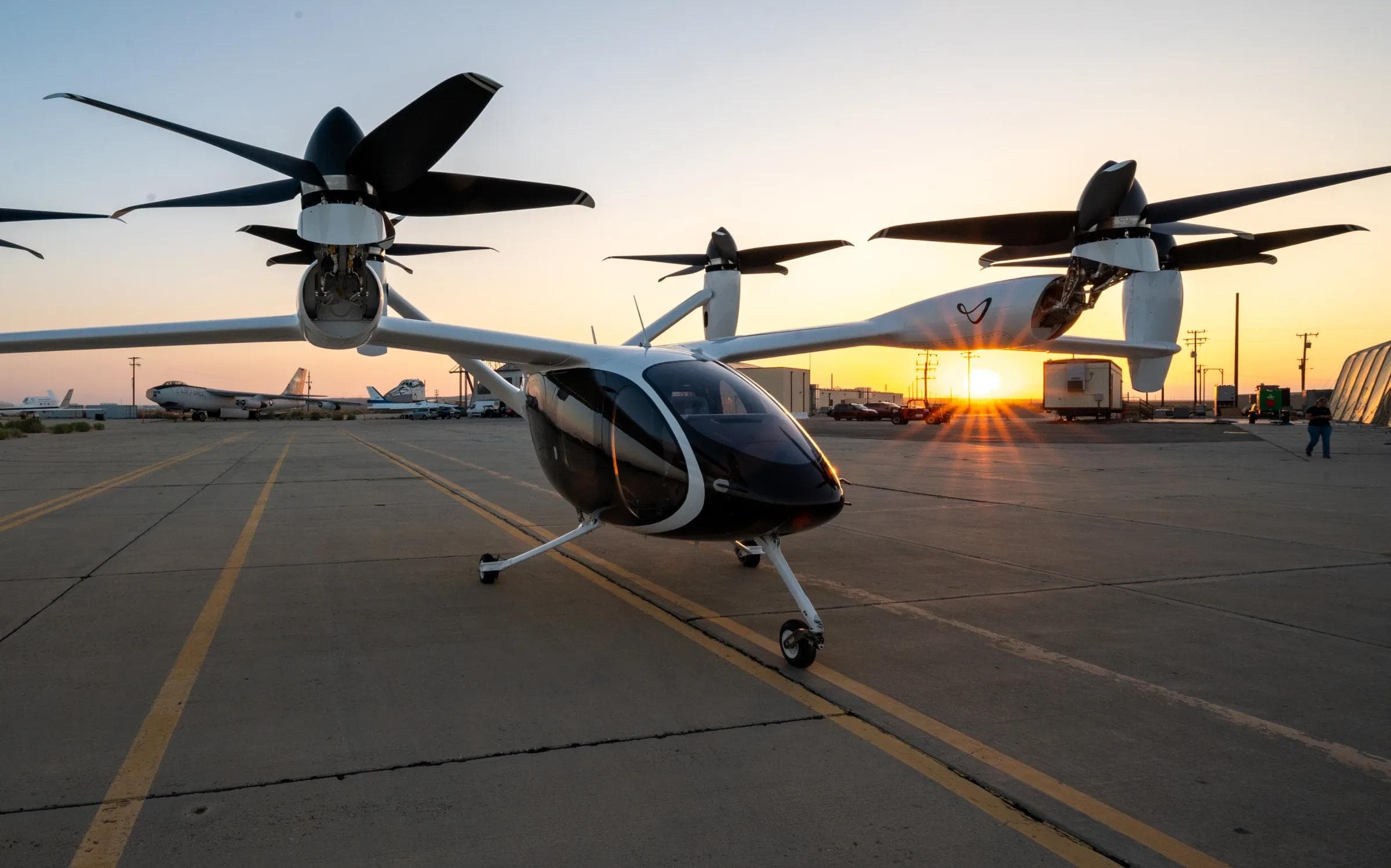
Joby Aviation flew its electric air taxi from John F. Kennedy International Airport to the East 34th Street Heliport in Midtown Manhattan in roughly seven minutes in late April 2026. The demonstration campaign used the Downtown Skyport and the West 30th Street and East 34th Street heliports, and ran as part of the FAA's eVTOL Integration Pilot Program, a White House initiative for live-airspace operations over major US cities. It was the first time an electric vertical takeoff and landing aircraft, known as an eVTOL, had flown a point-to-point route from one of New York City's major commercial airports into Manhattan. Around the same window, Archer Aviation disclosed that Abu Dhabi Aviation had begun making payments under its Launch Edition agreement to deploy Archer's Midnight aircraft in the UAE.
The market noticed. Archer's stock closed up more than 13 percent on news of the UAE regulatory clearance. Joby's shares have traded between roughly 10 and 11 dollars through the spring, reflecting the tension between real and verifiable progress and a commercial timeline that Wall Street has been extending further to the right with each passing quarter. Morgan Stanley's base-case urban air mobility forecast puts the global market at one trillion dollars by 2040. Both companies are listed, pre-revenue, and burning cash at pace. The bet is on who reaches paying passengers first and survives the ramp.
The consensus read is that eVTOL is finally arriving. The more precise read is that the technology is real, the operations are demonstrably safe, the Gulf is moving faster than the US domestic market, and the 2026 story is a race, not a finish line. For the UHNW reader, the sector presents two distinct opportunities at once: an early-access product, the ability to skip a 45-minute ground transfer and land at a vertiport next to the terminal, and a public-market allocation question in two tickers that have already moved materially on certification headlines. The honest read on both requires separating what has been certified from what has been committed to, and what the Gulf programs represent versus what American commercial service will require.
The 2026 story is a race, not a finish line. The technology is real, the Gulf is moving faster than the US domestic market, and the certification clock is the variable everything else depends on.
Joby's position: Stage 4 cleared, one stage and the type certificate left
Joby cleared Stage 4 of the FAA's five-stage type certification process in late March 2026, becoming the first eVTOL manufacturer to reach that point. Stage 4 covers the implementation phase, where the FAA verifies that the certification plans agreed in the earlier stages are being executed against the actual aircraft. One stage remains. Stage 5 is the final conformity inspection and operational demonstration that precedes issuance of the type certificate, and no competitor has cleared Stage 4 ahead of Joby. The certification progress was documented in Joby's own investor materials and reported across aviation trade press.
What Stage 4 clearance does not mean is commercial service. As of June 2026 the FAA had not provided a projected timeline for final type certificate issuance, and certification schedules depend on applicant performance and the resolution of any open compliance findings. The remaining gates before Joby can carry a paying passenger in the United States are FAA-witnessed flight testing under Type Inspection Authorization, Stage 5 conformity and operational demonstration, type certificate issuance, and a separate Air Carrier Certificate. Joby is targeting late 2026 for US commercial launch, with Delta Air Lines as its named partner for New York and Los Angeles airport connections. That is a stated target, not a confirmed date. Independent analysts at SMG Consulting, which tracks advanced air mobility progress, have projected entry into service closer to mid-to-late 2027.
The Joby S4 is a five-seat aircraft, one pilot and four passengers, with a top speed of 200 miles per hour and roughly 150 miles of range per charge. Six tilting rotors allow vertical takeoff and landing without a runway. Toyota Motor Corporation has invested a total of 894 million dollars in Joby, making it the aircraft's most visible manufacturing partner and the company's largest single external backer by disclosed dollar amount.
Archer's position: Phase 3 complete, UAE first
Archer closed Phase 3 of the FAA's four-phase type certification process for its Midnight aircraft in April 2026, becoming the first eVTOL company to do so, building on the FAA's earlier acceptance of 100 percent of the 797 means of compliance for the aircraft. The company is in Phase 4, where Midnight's compliance is demonstrated through formal testing and analysis. Full FAA type certification is a target Archer has placed in 2027 or 2028, not a date the agency has set. The Q1 2026 earnings release, filed with the SEC, stated that US and UAE pilot programs were on track for 2026 under the White House eVTOL Integration Pilot Program, a DOT and FAA initiative selecting partners for initial operational programs across Texas, Florida, and New York, with first flights targeted for the second half of 2026. Those remain targets. Archer's Q1 2026 revenue was 1.6 million dollars against a net loss of 217.7 million dollars. The company held approximately 1.8 billion dollars in liquidity at quarter end, providing runway through the certification and initial commercial ramp.
The cleaner near-term Archer story runs through Abu Dhabi, not Washington. Archer unveiled its Launch Edition commercialization program with Abu Dhabi Aviation as the named first customer, targeting passenger flights in Abu Dhabi under a Restricted Type Certificate framework administered by the UAE's General Civil Aviation Authority. Archer is the first eVTOL manufacturer admitted into the UAE's Restricted Type Certificate program. The company completed an in-country flight test campaign in Abu Dhabi demonstrating Midnight's full eVTOL envelope over UAE terrain, and Abu Dhabi Aviation has begun making payments under the deployment agreement. Archer describes the Launch Edition structure as a repeatable commercialization playbook intended to reach dozens of early-adopter markets in sequence.

The Gulf programs: why Dubai and Abu Dhabi are moving first
Both companies are moving faster in the Gulf than in their home market, and the reasons are structural. Joby has a six-year exclusive agreement with Dubai's Road and Transport Authority to establish air taxi services in the emirate, with commercial launch targeted for 2026. In November 2025, Joby completed a 17-minute piloted flight from its UAE test facility in Margham, the first by any electric air taxi company in the UAE. The initial vertiport network announced by Joby covers four sites: Dubai International Airport, Dubai Mall, Atlantis the Royal, and the American University of Dubai, built through an agreement with Skyports to design, build, and operate the network. The Dubai International site was targeted for completion in the first quarter of 2026, with the other three set to follow in 2026; as of June 2026 the network buildout remains on the published target schedule rather than confirmed in service. The full vertiport network announcement was published by Joby in November 2025.
The regulatory structure in both Dubai and Abu Dhabi allows for a Restricted Type Certificate pathway that is aligned with but faster than the full FAA type certification cycle. Neither Joby nor Archer can carry a paying passenger in the United States without a full FAA type certificate. In the Gulf, the restricted certificate framework creates a defined path to limited commercial operations that does not require waiting for Washington. That asymmetry is deliberate on both companies' part, and it is why the Gulf programs are the ones where commercial service dates are being stated rather than projected.
Archer and Joby are not the only players running this playbook. Aviation Week has reported that both companies are advancing UAE commercial launches in parallel, framing the Gulf as the global proving ground for eVTOL commercialization ahead of the US market.
The patent dispute: Archer files, Joby pushes back
The 2026 race has a complication. In March 2026, Archer filed a complaint with the US International Trade Commission alleging that Joby violated the US Tariff Act of 1930 by importing eVTOL components, some sourced from China, that infringe on Archer's patents. The ITC instituted a formal investigation in April 2026. The complaint seeks to block Joby from importing, marketing, or selling the contested products within the United States. Delta, which has invested up to 200 million dollars in Joby contingent on certification milestones, has publicly warned that an adverse ruling could shut down Joby's existing product line and undermine its plans for airport-connection services in New York and Los Angeles. An ITC investigation at this stage of the certification process is the kind of headline risk that is hard to price from the outside, and hard to dismiss.
The dispute is worth naming because it is real and because it illustrates something specific about where the US eVTOL market sits: two listed companies, both pre-revenue, are fighting over who controls the intellectual property of a category that does not yet legally exist in commercial service. Delta has framed an Archer victory as handing the competitor an effective monopoly. The ITC investigation is ongoing as of June 2026, and no ruling has been issued.

The allocation question for family offices
Joby (ticker JOBY) trades on the NYSE. As of mid-May 2026, it carried a market capitalization in the area of 10 billion dollars at a share price near 10.49 dollars on roughly 980 million shares outstanding. Archer (ticker ACHR) trades on the NYSE and carried a market capitalization in the area of 5 billion dollars over the same window, at a share price near 6.81 dollars on roughly 758 million shares outstanding. Both figures move daily on certification headlines. Both companies are pre-revenue at scale. Joby is the further along in FAA certification; Archer has the first customer contract with commercial payments already flowing. The two are direct competitors in the US market and are simultaneously litigating against each other. This is not a position either company discusses plainly in investor materials, but the ITC filing makes it a material disclosure risk. The full investor context is in Archer's SEC filings and Joby's IR press releases.
Morgan Stanley revised its urban air mobility base-case forecast in recent research, lowering the projected 2040 global TAM to one trillion dollars from 1.5 trillion previously, while extending the long-term outlook to 2050. The vertical inflection in the base case is now framed as closer to 2040 than 2030. That is the right framing for family offices thinking about the category as an allocation, not a trade: the long-term thesis is intact, the near-term timeline keeps slipping right, and the structural question is which two or three platforms survive to capture the majority of the market when it does scale. A position in Joby today is a bet that it wins the FAA race, survives the ITC dispute, and scales manufacturing fast enough to fill the Delta partnership. A position in Archer is a bet that the UAE commercialization playbook works, the US pilot program converts to real service, and the company's 1.8 billion dollar liquidity runway holds through the certification cycle. Both theses are coherent. Neither is cheap. The parallel to the space economy is not accidental. The same publicly-listed-pre-revenue-in-a-new-category dynamics that frame the SpaceX IPO allocation question apply here with a different regulatory clock and a smaller market ceiling.
The bottom line for buyers and allocators
The eVTOL category is real, flying, and closer to commercial service than it has ever been. Joby cleared the deepest FAA conformity check any manufacturer has reached. Archer has the first customer contract with cash flowing in from Abu Dhabi. Dubai is building the vertiports. The White House has a formal pilot program for US operations. None of that means commercial service is imminent in the United States. The FAA has not issued a type certificate, and it has not provided a timeline for doing so. The Gulf programs represent limited operations under a restricted certificate framework, not the full US commercial service either company has been targeting. For the reader who wants the early-access product, Dubai and Abu Dhabi are where the first vertiport hops will exist; New York and Los Angeles are targets for late 2026 or later, pending the FAA's schedule. For the reader with an allocation question, the two tickers move materially on certification headlines, the ITC dispute is a live overhang on Joby, and the category's long-term TAM is the kind of projection that moves right every time someone publishes a new base case. The Bryant Aviation desk covers both as the certification cycle closes. The full aviation coverage is the running record. The best parallel for reading the public-market bet: how the G700 slot market priced frontier access before delivery is the closest analog for how the market prices scarcity before commercial service opens.