
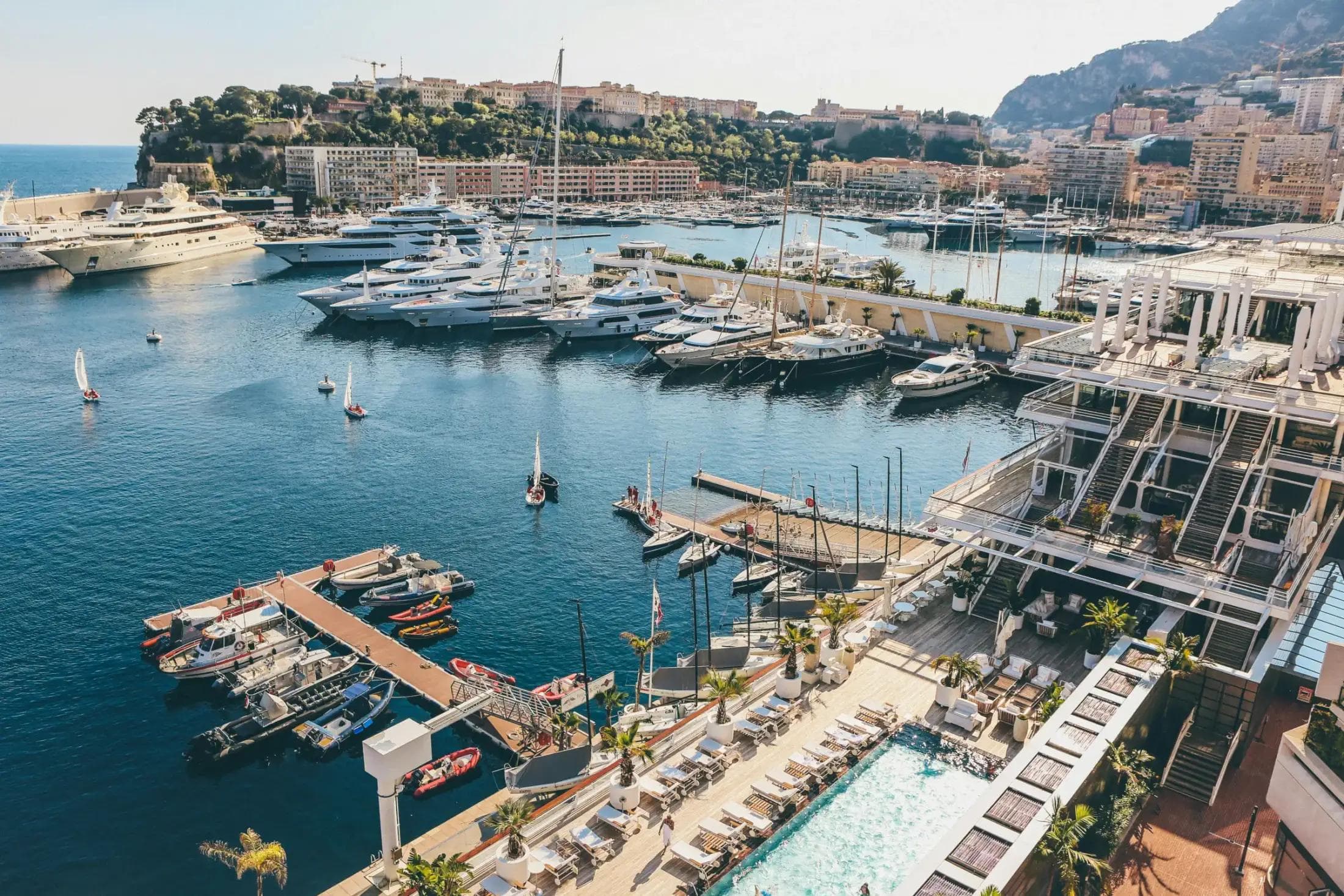
Feadship floated a 101.2-meter superyacht named Destiny out of its Makkum shed on April 1, 2026 and sent it into the North Sea on May 21 for sea trials, becoming the largest Feadship delivery of the year. The vessel was built at the Papendrecht yard from late 2022 through the hull phase, transferred to Makkum in November 2024 for outfitting, and launched with a navy hull, a white superstructure, and a glass-bottomed pool on the main aft deck that feeds light directly into the beach club below. At 3,840 gross tonnes and 15.2 meters of beam, it joins the small group of Feadships launched in the 100-meter-plus class, a tier the yard first reached only in the past decade. Destiny is scheduled for delivery in 2026, Feadship's largest flagship-class project in a year when six Feadships across the size range are set to hand over.
The same week Destiny cleared the Makkum channel, BOAT International published the 2026 Global Order Book and the top line went to Azimut|Benetti for the twenty-sixth consecutive year, 163 hulls and 5,924 meters of total length versus every other builder on earth. That juxtaposition carries the whole argument. One number measures the volume business. The other measures something different.
The reflex read is that the superyacht market has a single leader, and that leader is Italian. The data says the market has two layers with almost no overlap. The volume crown and the trophy crown are not competing for the same buyers, the same order slots, or the same capital. Destiny and the Azimut|Benetti table are both correct reads on the same moment, and the UHNW buyer who has the resources for a 100-meter-plus full-custom Feadship is not choosing between them. The choice was never on the table. At the very top, the order itself is the asset and the relationship with the yard is the moat that makes it irreplaceable.
The volume crown and the trophy crown are not competing for the same buyers, the same order slots, or the same capital.
What the Dutch order book actually measures
The BOAT International 2026 Global Order Book records the Netherlands second by gross tonnage, at 107,796 gross tonnes across 66 units. Italy leads by tonnage at 240,560 gross tonnes across 568 units. The unit counts look wildly asymmetric. They are not measuring the same thing. An Italian volume builder manufacturing 40-meter platforms at pace and a Dutch full-custom yard building three flagships a year are both in the gross tonnage column, but they are in entirely different businesses.
The Netherlands figure implies an average vessel of over 1,600 gross tonnes across those 66 hulls. That is not a volume number. That is a trophy number expressed in aggregate, produced by Feadship, Amels, Oceanco, and the cluster of Dutch custom yards whose business model starts with a blank page for each order and does not begin again from a platform.
Germany sits fourth at 78,651 gross tonnes across only 18 units, with that entire output concentrated at the top of the market, principally at Lurssen. Lurssen released its third flagship of 2026 in May, the 117-meter Boardwalk at 5,602 gross tonnes, built full-custom for an American owner who commissioned it in 2022. Between the Netherlands at 66 units and Germany at 18, the two countries account for the near-totality of the 100-meter-plus order book. Italy and Turkey are almost entirely absent from that segment.
Full custom means something specific at this scale
Feadship's policy is documented without ambiguity: every project starts from a blank page, no production-line platform, no semi-custom variant. Construction on Destiny began in late 2022 with hull work at Papendrecht and finished at Makkum across roughly three and a half years of build time. The exterior is RWD, a British studio. The naval architecture is Azure Yacht Design and Naval Architecture. The interior is a collaboration between RWD and the Parisian studio Chahan Interior Design. Three separate specialist firms, one bespoke brief, no shared geometry with any other vessel in build at the same yard.
The competitive implication is structural, not stylistic. A buyer commissioning a 100-meter-plus full-custom Feadship or Oceanco is not buying a product. They are buying a process: three to four years of engineering time in which the yard's naval architects, the owner's design team, and the classification society are building something that will not exist until it is finished. The slot itself, the guaranteed access to that process with a specific yard in a specific delivery window, is what brokers mean when they describe the relationship with the yard as the primary asset in the commission.

The 2026 delivery list and what it tells you about concentration
The ten largest superyacht deliveries expected in 2026, per the BOAT International listing, are concentrated in a way the volume table does not capture. REV Ocean at 194.9 meters leads the list. Project Tanzanite from Amels at 120 meters is the largest Dutch-built motor yacht in history. Lürssen fills four of the ten positions: Boardwalk at 117 meters, Project Cosmos at 114.2 meters, Project Shackleton at 107 meters, and Project Jassi at 103 meters. Feadship's Destiny at 101.2 meters slots in at position nine on that list. Of the ten, the German and Dutch yards account for six entries, with Italy reaching the segment only at the very bottom of the list.
That concentration is not accidental. It reflects where the engineering depth, the build cadence, and the classification-body relationships for full-custom 100-meter-plus construction currently sit. Dutch yards delivered nineteen superyachts valued at 1.3 billion euros in 2023 alone, per the Netherlands Maritime Technology trade association, with 64 projects in build at that same moment. The market has not diversified that concentration out. It has deepened it.
The cross-market read: Azimut|Benetti's volume crown measures a business built on production efficiency, dealer networks, and a broad market of buyers in the 24-to-60-meter range. Feadship and Oceanco measure a business built on scarcity of output, depth of customization, and a buyer pool that is, by definition, vanishingly small. The group that manages the most global wealth does not need both. It needs to understand which market it is already in.
Where the slot premium comes from
Feadship's order book is reported in trade press as extending to 2028 and 2029. Oceanco's DreAMBoat, the 111-meter delivery in November 2025, was completed in what the yard described as the shortest lead time in its history for that scale of project, from first discussions in November 2021 to delivery in roughly four years. Those two data points describe the same constraint: at this scale and customization level, there is a finite number of yards with the capability, the workforce, and the relationships to build a 100-meter-plus full-custom vessel, and those yards cannot rapidly expand capacity.
The slot premium is a function of that constraint. When a buyer with a long-term relationship with a yard and an established commissioning history can access a 2026 or 2027 delivery window, the access itself holds value independent of the specific vessel being built. The vessel is new and specific to its owner. The access to the yard is the durable asset that sits underneath the transaction.
That dynamic is not unique to superyachts. The G700 slot market carries a secondary premium for the same reason: constrained capacity at the top of a bespoke production line, extended order books, and a buyer pool that can pay above list to skip a wait. The mechanism is identical across the trophy-asset categories. Scarcity of the production relationship, not scarcity of the object, is what the premium prices.

What Destiny tells you that the order book does not
The BOAT International order book captures what is in build. It does not capture what the delivery represents for the buyer or for the segment. Destiny's specifications, an exterior by RWD, a Parisian interior from Chahan, a glass-bottomed pool, a certified helipad on the foredeck, and a beach club with fold-down balconies at the waterline, are not remarkable for a vessel at this scale. Those amenities are table stakes at 100-meters-plus, not differentiators. What differentiates the Feadship commission from the alternatives is the process. The vessel is a Cayman Islands-flagged teak-decked steel and aluminum displacement yacht with dimensions that place it at number 48 by length in the full superyacht registry. The process that produced it is a three-and-a-half-year engineering engagement with one of the four or five yards on earth capable of doing this at this scale.
The buyer reading that is not buying a yacht. They are buying the conclusion of a multi-year collaboration with a yard that will, after delivery, have more institutional knowledge of their preferences, their operating patterns, and their structural requirements than any other yard could accumulate from a standing start. That institutional knowledge is what repeat commissioning clients are preserving when they return to the same yard for the next vessel. It cannot be transferred. It cannot be auctioned. It depreciates at the rate of staff turnover and fades with each commission cycle that passes. The relationship, once built, is the primary asset on the balance sheet of the trophy-tier buyer who intends to commission again.
The bottom line for buyers
The 2026 delivery list confirms what the order book data has been signaling for several years: full-custom 100-meter-plus production is a Dutch and German preserve, and that concentration is not loosening. Destiny represents one of a handful of full-custom flagships the world's most capable yards will deliver in any given year. The UHNW buyer who wants access to that tier is not competing with the volume market. They are competing with one another for a constrained number of yard relationships and a delivery window that does not expand to meet demand. The Bryant Yachts desk tracks the trophy tier delivery by delivery. The full Yachts coverage holds the running record, alongside the explorer superyacht segment and the charter market read for buyers considering the economics.