
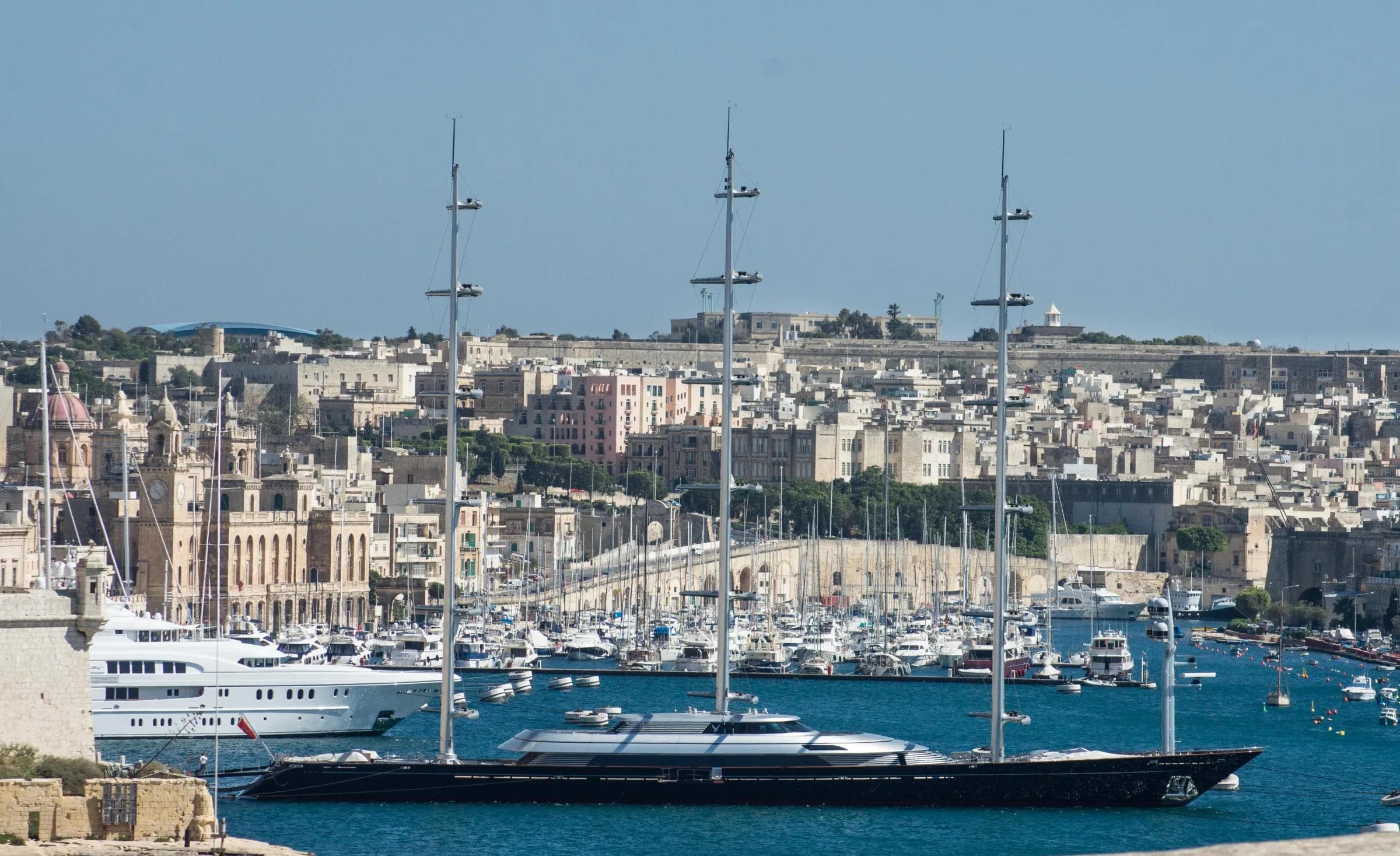
Royal Huisman turned the hull of Project 410 at its yard in Vollenhove, the Netherlands, in August 2024, timing the milestone to the shipyard's 140th anniversary. The hull is aluminium, 85 metres long, and carries a single carbon mast and boom built by Rondal, Royal Huisman's sister company. When Project 410 delivers in 2026, it will be the world's largest sloop, a classification that refers to a sailing yacht with exactly one mast, and it will be the longest yacht Royal Huisman has built since the 90-metre schooner Athena left the yard in 2004. The owner, whose identity has not been disclosed, commissioned the design from German Frers for naval architecture and exterior, and Wetzels Brown for interiors.
Project 410 is not the most powerful signal. It is the most specific one. Across the same twelve months that saw the hull turned in Vollenhove, Perini Navi delivered the 60-metre ketch Katana in July 2025, and Katana won the Judges' Special Award at the World Superyacht Awards in May 2026 and Best Interior at the Kitzbühel Superyacht Design Festival. Sanlorenzo, whose revenue reached 960.4 million euros in 2025, acquired Nautor Swan in August 2024 for 81 million euros and has since committed a 35-million-euro investment programme to expand Swan's production through 2027. Southern Wind's order book runs through 2028. A 7-percent share of the in-build pipeline is not a revival in unit terms. In the largest and most demanding tier of the market, the signals are pointing the same direction.
The reflex read is that sailing yachts are a niche and a declining one. The Monaco Yacht Show Market Report 2025 puts it plainly: sailing yachts are 15 percent of the operating fleet but only 7 percent of the yachts currently in build, which means the motor yacht fleet is compounding its share advantage with each delivery cycle. That read is correct on the aggregate and incomplete on the margin. What it misses is the character of the sailboats getting built. The yards currently delivering or nearing delivery of large sailing superyachts are not filling a quiet corner of the market. They are building the hardest yachts in the world to design, engineer, and crew, for a buyer who is choosing sail when the same budget could buy a substantially larger, faster, and lower-maintenance motor superyacht. That choice is an editorial statement, and the statement is attracting the most demanding constructors in the industry.
Sailing yachts are 15 percent of the operating fleet but only 7 percent of the yachts in build. What the aggregate misses is the character of the sailboats getting built.
What the world's largest sloop actually is
A sloop, to gloss the term once, is a single-masted sailing yacht. It is the simplest rig, and at large scale the hardest one to make work. More mast length means more moment arm on every sail load; a single mast at 85 metres must handle forces that would normally be distributed across two or three spars. Project 410's carbon mast is paired with a 2-megawatt battery bank that qualifies the vessel for Lloyd's new Hybrid Power certificate, allowing the engines to run in a fumeless, silent mode under power. The hybrid integration is structural, not optional: Frers built the naval architecture around the regeneration capability, so the yacht produces usable electricity while sailing rather than running gensets. That combination, a record-scale rig on a hybrid electric backbone, is what moves Project 410 past a statement build into a credible operational argument for why large sail is relevant in 2026.Royal Huisman's press release confirms the Rondal rig and the Hybrid Power qualification. BOAT International's superyacht directory entry for Project 410 lists the 2026 delivery date and the 1,310 gross tonne displacement.
The prior holder of the world's largest sloop record was Mirabella V, 75 metres, launched in 2003. Between Mirabella V and Project 410 there was more than two decades without a serious challenger. Four of the ten largest sailing yachts currently on the water are either built by or under construction at Royal Huisman. The concentration matters: a yard that can build the top four entries in the length table is a yard whose capacity is not replicable at short notice, and the owner commissioning Project 410 knows that.

The Perini Navi case: a brand that survived bankruptcy by delivering
Perini Navi went into administration in 2021. The Italian Sea Group acquired the brand and its shipyard in Marina di Carrara and, in 2022, restarted the hull that would become Katana, the fourth delivery in Perini Navi's 60-metre ketch series. The other three sisterships, Seahawk, Perseus 3, and Seven, were delivered under the original ownership. Katana was delivered under The Italian Sea Group on July 1, 2025, eight years after the build began. Her naval architecture is by Ron Holland. Her interiors are by Rémi Tessier. The carbon fibre masts, booms, and rigging are by Southern Spars. She carries twin MTU engines for a top speed of 15.5 knots and a cruising range of 3,500 nautical miles at 10 knots.Katana was nominated and won at both the World Superyacht Awards and the Kitzbühel Superyacht Design Festival in 2026, the first major award recognition for a Perini Navi hull under The Italian Sea Group's ownership. The read across the industry was straightforward: the brand's delivery integrity is restored.
The market significance is structural, not sentimental. Perini Navi's 60-metre series is a platform, not a bespoke order. Each hull uses a proven set of design parameters and a construction system that The Italian Sea Group can repeat with more predictability than a fully custom one-off. The awards did not recognise a custom commission. They recognised a production-class sailing superyacht that the new owners finished, commissioned, and successfully handed over after a build process that had been interrupted by a corporate bankruptcy. That is a more difficult achievement than building a new hull from scratch, and it was the harder argument to make to future buyers.
Sanlorenzo buys Swan: the builder's read on sail
Sanlorenzo acquired a controlling stake in Nautor Swan in August 2024 for 81 million euros. The deal put the Finnish yard, which has been building performance sailing yachts since 1966, inside the group that posted 960.4 million euros in 2025 revenue and holds a backlog of 1.96 billion euros. Sanlorenzo's strategic rationale, stated publicly at the 2024 Cannes Yachting Festival, is a sail portfolio that reaches from Swan's offshore racing pedigree through a new series of larger custom sailing superyachts. The first large model under joint development is a 43-metre alloy sailing yacht targeted for a 2028 launch. A year after closing, Sanlorenzo reported that Nautor Swan's segment was profitable, with strong fourth-quarter 2025 performance. The group committed a 35-million-euro investment programme running through 2027 for new production sites in Brescia and Viareggio and a new headquarters in Milan.The superyacht peer on Sanlorenzo's methanol strategy covers the group's propulsion technology bets in detail. The Swan acquisition is a different kind of bet: conviction that a large segment of the coming buyer class wants to sail.

The ownership argument: why sail is not a compromise
A buyer at the 85-metre level who commissions a sloop is not choosing sail because the motor alternative is unaffordable. A motor superyacht of comparable overall length would be faster, carry more volume, require less crew expertise, and cost materially less to maintain. The choice is active. Two things drive it. First, the operational experience: a sailing superyacht run by a capable captain and crew in twenty-plus knots of trade wind is a categorically different vessel from a motor yacht in the same conditions, and owners who have done that crossover report the motor boat as the lesser experience at sea. Second, the emissions argument has become a real factor in berth access and European regulation. Project 410's hybrid electric certification is not a green-marketing position. The yacht.de coverage of the build notes that the regenerative sailing system produces usable electricity; the Lloyd's certificate formalises what that means for port access under incoming EU maritime emissions rules. For an owner who plans to spend serious time in the Mediterranean, that certification is an operational asset, not a gesture.The explorer superyacht boom covers the parallel argument in motor yachts: the shift toward usage over venue that is reshaping the top of the market. The large sailing superyacht is the same thesis, with the additional constraint that the owner has to want to actually sail.
That last constraint is the filter. Most UHNW buyers at the 80-metre level do not want to crew or manage a large sailing programme. The minority who do are concentrated in a few owner networks, tend to be returning clients at yards like Royal Huisman and Southern Wind, and commission with a specificity that motor-yacht buyers rarely match. Project 410 was commissioned by a returning Royal Huisman owner. Katana was sold a year into a speculative hull build to the owner of a Monaco-based shipyard, a buyer whose professional context is the industry itself. These are not first-time superyacht buyers finding their way to sail. They are owners who have already made the choice and are scaling up.
The yards building at this level, and the ones that cannot
Three yards deliver large custom sailing superyachts above 50 metres with any regularity: Royal Huisman, Southern Wind, and Perini Navi under The Italian Sea Group. A fourth, Baltic Yachts in Finland, operates in the 30-to-60-metre performance range and has its own committed order book. No other yard currently has the engineering depth, the rig integration capability, and the delivery track record to build at this standard and this size. That scarcity is not accidental. A large aluminium sailing superyacht requires a fundamentally different construction sequence from a large motor yacht. The structural loads from the rig must be engineered into the hull from the keel up. The mast deck fitting, the structural chainplates, the keel geometry, and the ballast distribution are all interdependent in a way that motor construction is not. Royal Huisman's 140-year history, its Rondal rig subsidiary, and itsrecord of four of the ten largest sailing yachts in the active fleet are not marketing copy. They are evidence that the tooling, the institutional knowledge, and the supplier relationships are in place and cannot be assembled quickly by a competing yard.
The same constraint works in the buyer's favour. An owner who wants a 70-metre custom sloop has a short list of capable yards and almost no time pressure to decide, because the yards are full. Southern Wind's order book runs through 2028. Royal Huisman has Project 410, Project 411 (the 81-metre Sky, targeted for 2030), and Project 412 (an 81-metre schooner under construction) on its active build programme simultaneously. The argument for acting now on a large custom sailing superyacht commission is not that the market is moving. It is that the yards are not, and wait times are extending. A buyer weighingthe aviation fractional market against a full superyacht programme will find that the sailing option has the longer lead time, the most demanding crew requirement, and the most defensible scarcity argument.
Bottom line for buyers
Project 410 delivering in 2026 is not the start of a large-scale sailing revival. The aggregate numbers, 7 percent of new builds, do not support that framing. It is a data point in a narrow but strengthening case: the buyers commissioning large sailing superyachts in 2026 are more technically specific, more likely to be repeat clients at capable yards, and more insulated from the soft secondary market than the motor superyacht cohort directly below them in the size table. The three capable yards are full. The hybrid certification is becoming operationally material in Europe. Sanlorenzo's 81-million-euro commitment to Nautor Swan is a corporate bet that the sail buyer class is growing, not shrinking. For an owner with the right experience, the right crew, and a preference for a vessel that works as hard as it looks, the large sailing superyacht is a different instrument from the motor market that surrounds it. The Bryant Yachts desk tracks the top of both segments transaction by transaction.