
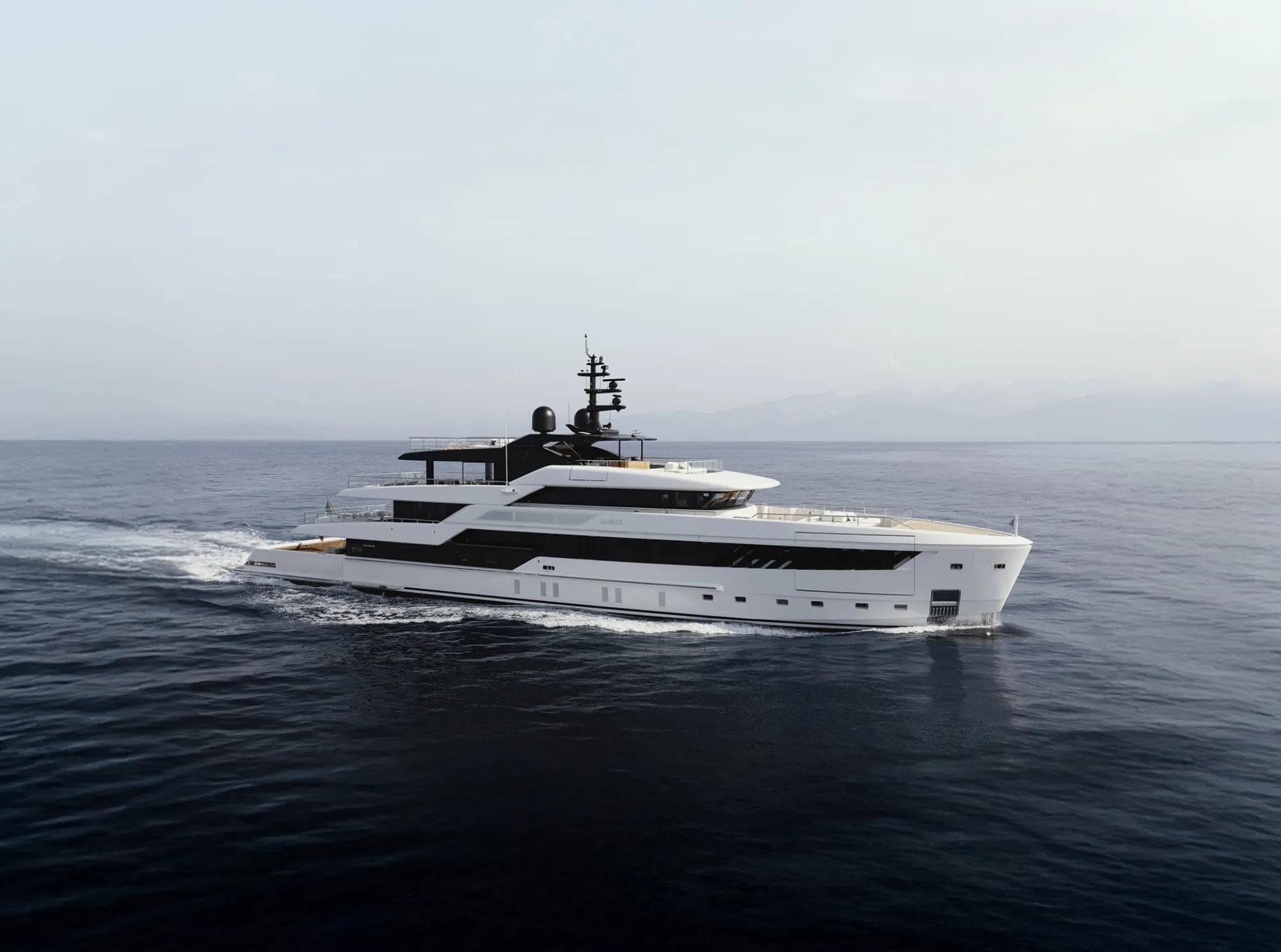
On May 8, Sanlorenzo presented its 2026-2028 business plan and first-quarter results in the same session, and the two halves of that presentation told different stories about the same company. The financials were the picture of a yard running hot: new-yacht revenue of 222.1 million euros for the quarter, order intake up about 25 percent year on year to roughly 223 million euros, and an order backlog of 1.23 billion euros with 90 percent already sold to final clients, figures reported by BOAT International from the company's release. The strategy half was quieter and stranger. Sanlorenzo, a builder whose shares trade on a scarcity premise, used the same morning to recommit capital to a green-methanol fuel-cell program that began with a single yacht delivered in 2024 and that almost no client walked in asking for.
The market read the financial half and liked it. Sanlorenzo shares rose on the print, extending what is now a seventh consecutive quarter of order-intake growth, and the company guided to full-year new-yacht revenue of 980 million to 1.02 billion euros with an EBITDA margin in the 18.4 to 18.8 percent band. Sell-side coverage framed the result as continuity: demand visibility, disciplined margins, a backlog that covers most of the year. Executive chairman Massimo Perotti, who has run the company since acquiring it in the mid-2000s and took it public on the Milan exchange in December 2019 at 16 euros a share, described the strategy as disciplined and built around preserving the exclusivity of its brands.
The methanol bet only makes sense once scarcity, not volume, is understood as the asset Sanlorenzo is actually selling.
The reflex read is that the fuel cell is a marketing flourish, a green halo bolted onto a luxury product to please a regulator and a press cycle. That read is too cheap. The methanol program is the more revealing half of the May 8 presentation, because it exposes the structural tension underneath the order book. Sanlorenzo is a public company that has to grow, and it is a luxury house whose pricing depends on not growing too much. The fuel cell is how it is trying to resolve that contradiction, by competing on engineering scarcity rather than unit scarcity. Whether that works is the real question, and the order book is what makes it hard.
What did Sanlorenzo actually report on May 8?
Start with the numbers, because they frame everything that follows. New-yacht revenue for the first quarter was 222.1 million euros, up roughly 4 percent on the same period in 2025. That is modest top-line growth, and it is deliberately so: Sanlorenzo's revenue in any quarter is gated by build slots, not by demand. The more telling figure is order intake, which rose about 25 percent year on year to roughly 223 million euros, the seventh straight quarter of growth. When a builder takes in more orders than it books as revenue, the backlog deepens, and Sanlorenzo's did, to 1.23 billion euros at quarter-end.
The composition of that backlog is the part that should interest a principal. Ninety percent of it is already sold to final clients rather than held as dealer or speculative stock, and the slice tied to 2026 deliveries was reported at about 725 million euros, covering roughly 72 percent of the midpoint of full-year guidance. Net profit for the quarter came in around 22 to 23 million euros depending on the line item, up in the mid-single digits, with EBITDA margin holding above 17 percent for the period. These are not the numbers of a company straining for volume. They are the numbers of a company managing a waiting list.

The geographic split reinforces the point. Europe accounted for 58.6 percent of quarterly revenue at 130.3 million euros, the Americas for 23.5 percent at 52.3 million and growing nearly 19 percent year on year, and the superyacht division specifically generated 74.2 million euros, about a third of the total and up roughly 14 percent. The Americas growth matters because it tracks a broader shift in the buyer base that we have covered in the American move toward fractional and syndicated yacht ownership. The demand is real, it is increasingly American, and it is running ahead of the yard's capacity to deliver. That is the enviable problem, and it is also the constraint.
Why does a full order book limit a builder rather than free it?
A 1.23 billion euro backlog that is 90 percent pre-sold looks like pure strength, and in cash-flow terms it is. It also quietly removes options. When most near-term production is spoken for by clients who placed deposits against specific hulls, the yard cannot easily flex volume up to fund a new initiative, and it cannot flood the market without diluting the exclusivity that justifies its prices in the first place. The backlog is revenue visibility and a straitjacket at the same time.
This is where the methanol program stops looking like a press release and starts looking like a strategy. Sanlorenzo cannot grow its way to a bigger valuation by simply building more boats, because more boats is precisely what a luxury yacht buyer does not want the brand to do. The same logic governs the rest of the top end of the market, and it is why allocation, not availability, is the currency at the highest tiers, a dynamic Bryant has traced from Gulfstream's G700 delivery-slot market to Patek Philippe's allocation politics. Scarcity is the product. So the growth has to come from somewhere other than unit count, and Sanlorenzo's answer is to move the competition onto a different field: be the yard that solves problems the others have not, and charge for the engineering rather than the volume.
The fuel cell is the clearest expression of that answer, which is why it survived into the 2026-2028 plan rather than being quietly retired after the first hull.
Does the methanol fuel cell actually work, or is it theatre?
It works, within carefully defined limits, and the limits are the point. Sanlorenzo's 50Steel, the 50-metre platform that carries the technology, was launched in May 2024 and the first hull, named Almax, was delivered in July 2024 to Perotti himself. That detail is not vanity. Putting the founder on the prototype is a credibility signal to a buyer base that does not want to be the beta tester for a six-figure-per-year asset. By early 2026 a second 50Steel was in the water and four units in the line had been sold, which is a meaningful order count for a vessel of this size and price.
The system itself, developed with Siemens Energy, converts green methanol into hydrogen and then into electricity on board, without storing hydrogen in tanks, a design that sidesteps the single biggest safety and regulatory objection to hydrogen at sea. It produces up to 100kW and, per the builder, covers roughly 90 percent of a superyacht's typical onboard energy use during the stationary periods when these vessels spend most of their lives at anchor, running lighting and climate off generators. It does not propel the yacht. That distinction is often blurred in coverage: the fuel cell is a hotel-load solution, not a powertrain, which is exactly why it is deployable now rather than in a decade.

The same engineering logic is visible one division over, where Sanlorenzo's Bluegame unit built the hydrogen-powered foiling chase boats for the 37th America's Cup, vessels required by the event protocol to hit 50 knots on hydrogen fuel cells. That program is a different application of the same institutional bet: that the firms which master alternative marine propulsion early will own the top of the category when regulation and buyer expectation eventually catch up. The chase boats are a laboratory the public never sees on the order book, and they are part of why the methanol story is more durable than a single yacht line.
Comparing the bet: volume scale versus engineering scarcity
The strategic fork is easier to see laid out directly, because two builders can post similar revenue and pursue opposite paths to a higher valuation. A volume-scale builder grows by adding hulls, dealers, and model range; a Sanlorenzo-style scarcity builder grows by raising the value per hull and owning proprietary technology. The volume path risks the brand by diluting exclusivity and pressuring pricing; the scarcity path carries the risk of funding research and development against current cash flow instead. For the volume builder the order book is a buffer that fills capacity, whereas for Sanlorenzo it is pre-sold scarcity, 90 percent committed to final clients. The volume builder's margin comes from operating leverage on units; the scarcity builder's comes from the pricing power that differentiation and engineering confer. And what the buyer is ultimately paying for diverges completely: availability and price on one side, allocation and a yard solving hard problems on the other.
Sanlorenzo has chosen the second column, and the May 8 numbers show it can afford to. An EBITDA margin guided toward the high teens and rising toward 19 percent by 2028, against a backlog already three-quarters sold for the current year, is the financial profile that funds long-cycle research without a capital raise. The methanol program is expensive and slow and serves a small number of hulls. A volume builder could not justify it. A scarcity builder uses it as the moat.
Where this leaves a buyer, and a watcher
For a principal weighing a build slot, the read-through is concrete. A yard pre-sold to 90 percent of capacity is a yard with pricing power and a waiting list, which means the negotiation is over allocation and specification, not discount. The methanol option, where it is offered, is not a green gesture to feel good about; it is a hedge against the operating-cost and regulatory trajectory of owning a large yacht into the 2030s, when emissions rules at anchor in Mediterranean and Caribbean ports are likelier to tighten than loosen. That last point is the author's read of the regulatory direction, not disclosed company guidance, but the buyer is paying, in part, for optionality on a future that has not arrived.
For anyone watching the category as an asset class, Sanlorenzo is the cleanest public proxy available, because most of its peers are private and disclose nothing. The seven-quarter order streak, the Americas mix, and the willingness to fund propulsion research out of cash flow are all readable signals about where the top of the market is heading, in a way that the privately held yards do not provide. The same question, scale versus scarcity, runs through every corner of the luxury-asset world Bryant covers, including the branded-residence boom and the broader yachts desk, where Mediterranean charter economics and ownership models keep colliding. Sanlorenzo's answer is to bet that the builder who controls the hardest engineering, not the largest fleet, wins the decade. The order book says the bet is, so far, paying for itself.
The Bryant Yachts desk tracks where allocation, engineering, and scarcity collide at the top of the market, transaction by transaction. The Society membership is where that running coverage lives.