
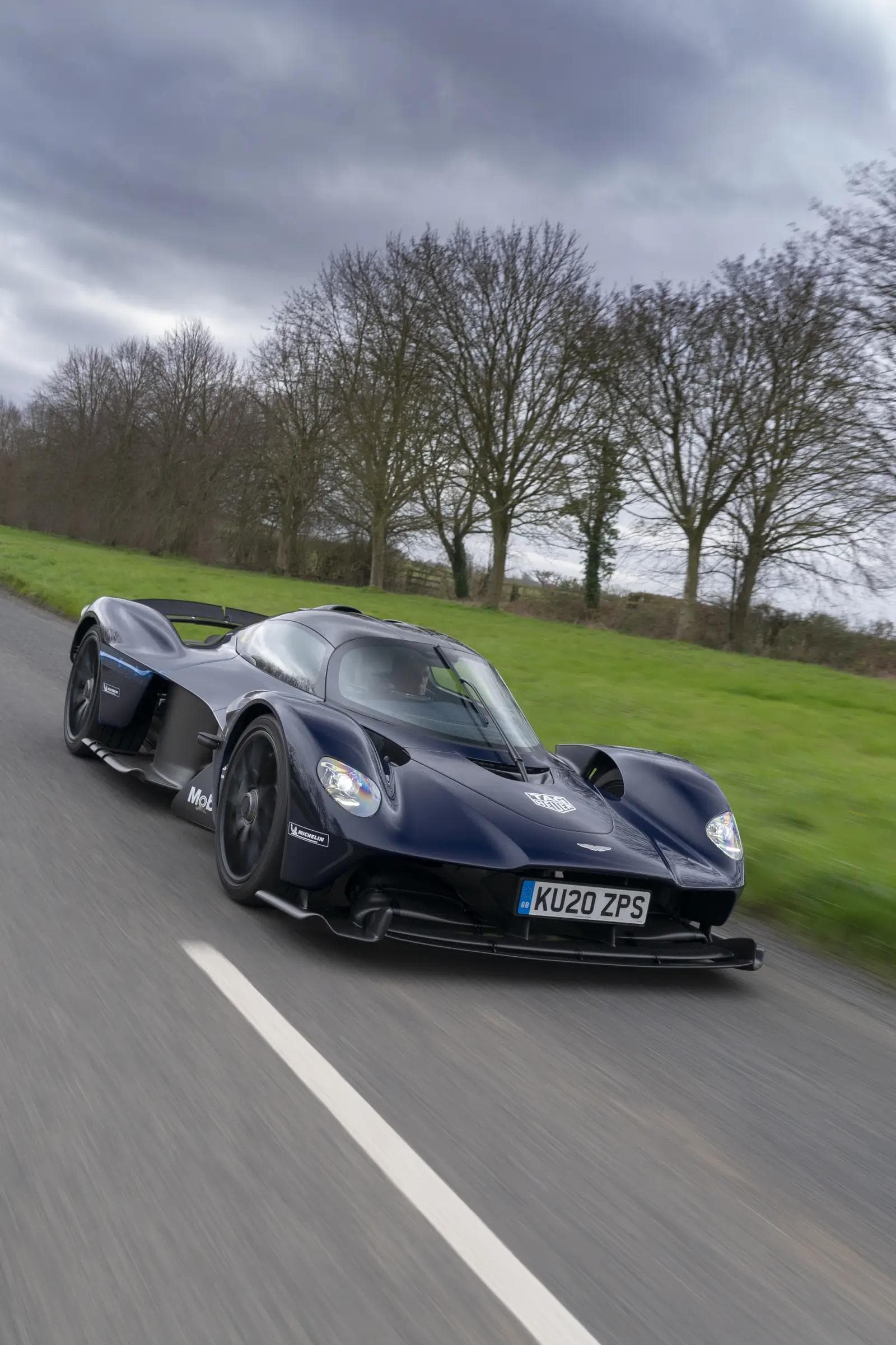
The Aston Martin Valkyrie is one of those cars that looks faster standing still than most cars look at speed. A 1,160 horsepower car on a carbon-fibre monocoque, 6.5-litre naturally aspirated Cosworth V12 redlining at 11,100 rpm, an aerodynamic floor designed by Adrian Newey as a single ground-effect venturi, and a body that exposes its engineering rather than concealing it. 150 road cars built. Aston Martin's own positioning, on the model page: as close as possible to being a Formula One car without being restricted to the track. Most modern hypercars dress their engineering. The Valkyrie wears it. In a segment that currently includes the Mercedes-AMG One (F1-derived powertrain, conventional supercar styling), the Ferrari F80 (twin-turbo V6 hybrid, Centro Stile-led, deliberately disruptive lines), the Pagani Utopia (hand-built artisanal sculpture, the antithesis of the Valkyrie's brief), and the McLaren W1 (P1 successor, more restrained form), the Valkyrie is the one that looks the most like what it is.
Across the Aston Martin Pressroom record on the Valkyrie (the December 2018 Cosworth V12 announcement, the March 2019 hybrid powertrain release, the August 2021 Spider reveal, the 2026 Valkyrie LM model page), the FIA WEC race results from the 6 Hours of Spa-Francorchamps on 9 May 2026, the Red Bull Advanced Technologies AM-RB 001 project record, RM Sotheby's Abu Dhabi 2025 and Monterey 2025 transaction archives, Hagerty's 2026 Bull Market List, and the Classic.com market data on six reference hypercars, this is the design analysis on the Aston Martin Valkyrie and the case for where it sits in the modern hypercar comp set.
Three threads run through it. First, the Valkyrie's form is dictated by Adrian Newey's aerodynamic brief, with Marek Reichman's Aston Martin design language carrying the upper-body surfaces on top of an engineering structure they did not author. Second, the cars that have shared this form-follows-function design DNA (the McLaren F1, the Ferrari F50, the Porsche Carrera GT) have aged into the collector market materially. The F1 currently clears roughly thirty times its as-launched price across confirmed 2024 to 2025 transactions; the F50 roughly nineteen times; the Carrera GT three-to-four times against a $448,000 MSRP. Third, designer pedigree carries weight in this segment; Gordon Murray's solo follow-up to the F1, the GMA T.50, hit $8,035,000 at Broad Arrow California Mille in April 2026, against an approximately $3,000,000 list price.
The road program and the racing variant
The Valkyrie is several cars under one badge. The road program is a 1,160 brake horsepower car built on a carbon-fibre monocoque, powered by a 6.5-litre naturally aspirated Cosworth V12 that produces 1,000 brake horsepower at 10,500 rpm with a redline at 11,100 rpm. A Rimac and Integral Powertrain hybrid system adds 160 brake horsepower. Combined peak torque is 900 newton metres at 6,000 rpm. Aston Martin has not officially disclosed the 0 to 100 kilometres per hour time, top speed, kerb weight, or peak downforce on its primary press surfaces; the motoring press reliably cites 2.5 seconds, 400 kilometres per hour, 1,030 kilograms, and 1,816 kilograms of peak downforce. Aston Martin has not put those figures on the record.
The road production split into four variants, all capped: 150 road cars (production complete December 2024), 85 Spiders (deliveries from H2 2022), 40 AMR Pro track-only cars plus two prototypes (production complete December 2024), and 10 Valkyrie LM track-only hypercars (deliveries from Q2 2026, customer track days Q3 and Q4 2026). The racing program is a separate variant, the Valkyrie AMR-LMH, derived from the LM hypercar and homologated to the Le Mans Hypercar regulations. Two chassis are running the 2026 FIA WEC season for Aston Martin THOR Team: #007 with Tincknell and Gamble, #009 with Riberas and Sorensen.
The Cosworth V12 was specified to Newey's engineering brief: low rotational mass for response, exposed to the chassis as a stressed member, 206 kilograms in mass, no turbochargers. The body around it is a venturi. Most of the chassis floor is the downforce surface; the upper bodywork is shaped to clear airflow rather than to generate aero of its own. The Aston Martin Pressroom December 2018 release is the primary source on the engine spec; the Red Bull Advanced Technologies project record is the primary source on Newey's authorship of the aerodynamic package.

Like an ant or exo-skeleton. Certainly not everyone's cup of tea.
Marek Reichman, Aston Martin Chief Creative Officer, on the Valkyrie design language
Newey and Reichman, the pedigree calculation
The two designer names attached to the Valkyrie are not equivalent in the collector market. Adrian Newey carries the heavier weight by a wide margin.
Newey's Formula 1 record from 1992 forward includes twelve Constructors' Championships designed across Williams, McLaren, and Red Bull, fourteen Drivers' Championships, and 223 Grand Prix wins. That is more wins than any racing-car designer in history. He held the Chief Technical Officer role at Red Bull Racing when the AM-RB 001 project began in 2016, and Aston Martin worked with him through Red Bull Advanced Technologies on the Valkyrie's aerodynamics until the road car reached production in November 2021. Newey moved to Aston Martin in March 2025 as Managing Technical Partner. The November 2025 announcement that he becomes Team Principal of the Aston Martin Aramco Formula One Team from 2026 reinforced the connection between his work and the marque, with implications that extend beyond the F1 program.
Marek Reichman has been Aston Martin's Chief Creative Officer since 2005. The Aston Martin Pressroom names him as the design partner to Newey on AM-RB 001 specifically; he authored the upper-body surfacing that carries the Aston design DNA into the Valkyrie's form. His framing of the car as like an ant or exo-skeleton, certainly not everyone's cup of tea, is doing the same work Pininfarina once did when defending the Testarossa: positioning the car as ahead of mainstream taste rather than against it.

The Gordon Murray pattern is the cleanest test of designer-pedigree-as-asset. Murray designed the McLaren F1. The F1 is now the most valuable production car of the modern era, with a 1994 example clearing $25,317,500 at RM Sotheby's Abu Dhabi in December 2025. Murray's solo follow-up, the GMA T.50 (100 units, deliveries from 2022, list price approximately three million dollars), was first publicly auctioned in December 2025 at $5,630,000 in Abu Dhabi; a 30-mile example then realized $8,035,000 at the Broad Arrow California Mille sale in April 2026. That is approximately 168 percent above MSRP for a car still in its first ownership cycle. The market is pricing Murray's signature, not just the rarity.
If Newey's pedigree transfers on the same basis, the implication for the Valkyrie's secondary market is meaningful. The Red Bull RB17 (50 units, approximately five million pounds list, production starting 2025) is the cleaner future test of that thesis because it is Newey's first solo signature work. The Valkyrie is the first Newey-authored car branded as something other than Red Bull, and the first to enter the collector market in volume.
The form-follows-function thread
Three cars span thirty years of evidence on what predicts hypercar appreciation, and they share one trait. The body was shaped by the engineering brief, not by stylists chasing aesthetic novelty.
The McLaren F1 was Gordon Murray's engineering manifesto. Central driving position dictated by sightline and weight distribution. BMW V12 chosen because Honda would not supply the engine Murray wanted. No power steering, no anti-lock brakes, no power windows. The cabin and the bodywork were the consequences of those decisions, not the drivers of them. Chassis #014 cleared $25,317,500 at RM Sotheby's Abu Dhabi in December 2025, the marque record. Earlier in 2025, a time-capsule example traded at $20,465,000 at Gooding Pebble Beach.
The Ferrari F50 had a 4.7-litre F1-derived V12 bolted directly to the carbon tub as a stressed member. Exposed engineering throughout, manual gearbox, no power steering. Ralph Lauren's Giallo Modena example sold for $9,245,000 at RM Sotheby's Monterey in August 2025. Class average across confirmed 2024 to 2025 trades is approximately $5,690,000.
The Porsche Carrera GT carried a 5.7-litre V10 derived from a discontinued Le Mans program, a wood-shift manual gearbox, and exposed carbon. The model was named to Hagerty's 2026 Bull Market List in November 2025. Hagerty's price guide places the band at $1,400,000 to $1,750,000 for #1 to #2 condition cars against an as-launched MSRP of approximately $448,000. Multiple 2024 to 2025 sales cleared $3,000,000.

The Bugatti EB110 (carbon monocoque, quad-turbo V12, 1991 to 1995 production) has run an approximately ten-times appreciation curve over the last decade, with the SS variant trading near $2,900,000 in 2026 against sub-$300,000 a decade ago. The Jaguar XJR-15 (Tom Walkinshaw-led, race-derived, 53 road cars) sits at $1,200,000 to $1,900,000 for the strongest examples. The Classic.com market data on the Valkyrie currently shows an average secondary trade of $2,587,375.
The common thread is engineering integrity. Visible carbon, exposed engineering, restrained surfaces that follow the chassis brief rather than dressing it. The cars that have appreciated did not photograph as pretty when they launched. They photographed as inevitable.
The peer-set design comparison
| Car | Production cap | As-launched price (per primary source) | Recent secondary read | Bryant flag |
|---|---|---|---|---|
| Aston Martin Valkyrie (road) | 150 | not officially disclosed by Aston Martin (press-reported approximately $3,500,000 at launch) | $2,587,375 average secondary (Classic.com, accessed 2026-05-19) | first Newey-authored road car in volume collector market |
| Aston Martin Valkyrie Spider | 85 | not officially disclosed | limited public secondary trades on record | |
| Aston Martin Valkyrie AMR Pro | 40 (plus 2 prototypes) | not officially disclosed | track-only, no public secondary trades on record | |
| Aston Martin Valkyrie LM | 10 | not officially disclosed (press-reported $4,500,000 to $6,500,000) | deliveries Q2 2026, all allocated | newly-shipped track-only LMH derivative |
| Ferrari LaFerrari | 499 | not officially disclosed by Ferrari (press-reported approximately $1,400,000 at launch) | approximately $3,500,000 average (Classic.com) | Manzoni-era restraint, appreciating slower than F50 |
| Ferrari F80 | 799 | $3,900,000 (Ferrari press, October 2024) | all allocated; one build slot listed at $6,300,000 (Carscoops, 2024) | Manzoni-led, form-follows-function positioning |
| Pagani Utopia | 99 cars | $2,190,000 (Pagani press, September 2022) | $4,075,000 RM Sotheby's transaction; $3,500,000-plus asking on LUSSO listings | hand-built auteur model, 85 percent premium realized |
| McLaren W1 | 399 | $2,100,000 (McLaren press, October 2024) | all allocated, no secondary trades on record | P1 successor |
| McLaren Senna | 500 | approximately $1,050,000 (McLaren press) | $1,300,000 average, range $556,000 to $3,020,000 (Classic.com) | open verdict on long-term design read |
| Bugatti W16 Mistral | 99 | EUR 5,000,000 (Bugatti press, August 2022) | one example listed at $10,500,000 (Autoblog) | Anscheidt-era, appreciation realized |
| Mercedes-AMG One | 275 | $2,700,000 (Automotive News, primary at launch) | $3,200,000 to $4,000,000 USD secondary listings; EUR 3,750,000 to 4,400,000 Europe | F1-derived; thin liquidity, thesis unproven |
| Koenigsegg Jesko | 125 | $3,000,000 starting (Koenigsegg / Motor Authority) | $3,500,000 to $4,000,000 secondary, 25 to 35 percent above MSRP | engineering-led, smaller cultural footprint |
| McLaren F1 (historical comp) | 106 total / 64 road | press-reported approximately $815,000 at launch | $25,317,500 (RM Sotheby's Abu Dhabi, December 2025) | form-follows-function reference |
| Gordon Murray T.50 | 100 | approximately $3,000,000 (press chain) | $8,035,000 (Broad Arrow California Mille, April 2026); $5,630,000 (Abu Dhabi, December 2025) | designer-pedigree premium realized in three years |
Two patterns run through it. Realized auction premiums above as-launched price cluster in two categories: form-follows-function engineering with the right designer pedigree (McLaren F1, T.50, Carrera GT) and hand-built auteur builds (Pagani Utopia, Bugatti Mistral). The Valkyrie sits in the first category. The current Classic.com discount against the press-reported $3.5M launch price is partly first-owner flippers exiting after one track day, not a verdict on the design.
Read of the table
Two patterns run through it. The cars with realized auction premiums above as-launched price cluster in two categories: form-follows-function engineering with the right designer pedigree (McLaren F1, T.50, Carrera GT) and hand-built auteur builds (Pagani Utopia, Bugatti Mistral). The Valkyrie sits in the first category, currently trading at an average $2,587,375 on Classic.com against a press-reported $3,500,000 launch price. The current discount is partly a function of who is selling now (first-owner flippers exiting after one track day) rather than a verdict on the design.
The Mercedes-AMG One is the genuinely contested case in the set. Engineering-led, F1-derived, sold out at $2,700,000 MSRP, secondary listings now running $3,200,000 to $4,000,000 in the United States and EUR 3,750,000 to 4,400,000 in Europe. The premium is real, but with fewer than ten confirmed public transactions across the entire 275-unit run, liquidity is thin enough that one bad sale could reset the band. The thesis is unproven in either direction.
The McLaren Senna is the open verdict. Engineering-led but without the headline-designer name attached, average secondary $1,300,000 against an approximate $1,050,000 MSRP. Roughly flat. The buyer base is still digesting whether Robert Melville's surfacing will age the way Murray's has.
The investment read for the next twelve months is straightforward and worth stating clearly. The Valkyrie's design language and Newey's individual pedigree place it in the same cluster as the McLaren F1, the F50, and the Carrera GT. Lower confidence than the F1 or T.50, which have realised track records; higher confidence than the AMG One, which has thin liquidity and open questions on F1-derived powertrain longevity. Current Valkyrie owners hold the configuration. Prospective Valkyrie LM buyers (ten units, all allocated, deliveries from Q2 2026) hold to first delivery and let the WEC racer establish the band. The Le Mans race weekend 13 to 14 June will be the next major data point. The Newey-Murray pedigree pattern, if it transfers, would put the Valkyrie's secondary band at 150 to 200 percent of as-launched price within three to five years. That is pattern matching, not a forecast.
Further reading
For Bryant's adjacent Automotive read on a heritage marque using a halo car to name a segment, Vision BMW Alpina: The Line for Alpina's Next Decade is the same-batch companion. For the institutional read on auction-versus-dealer flow inside seven-figure collector capital, Why collectors are buying at auction instead of dealers in 2026 carries the framework. Bryant's broader Automotive coverage is the vertical landing.
For the primary technical record on the Valkyrie engine package, the Aston Martin Pressroom V12 announcement is the source. For the modern hypercar collector-market signal, Hagerty's 2026 Bull Market List names Carrera GT as the headline hypercar entry, and the RM Sotheby's 1995 Ferrari F50 Monterey 2025 lot record carries the cleanest auction primary on a form-follows-function reference comp.