
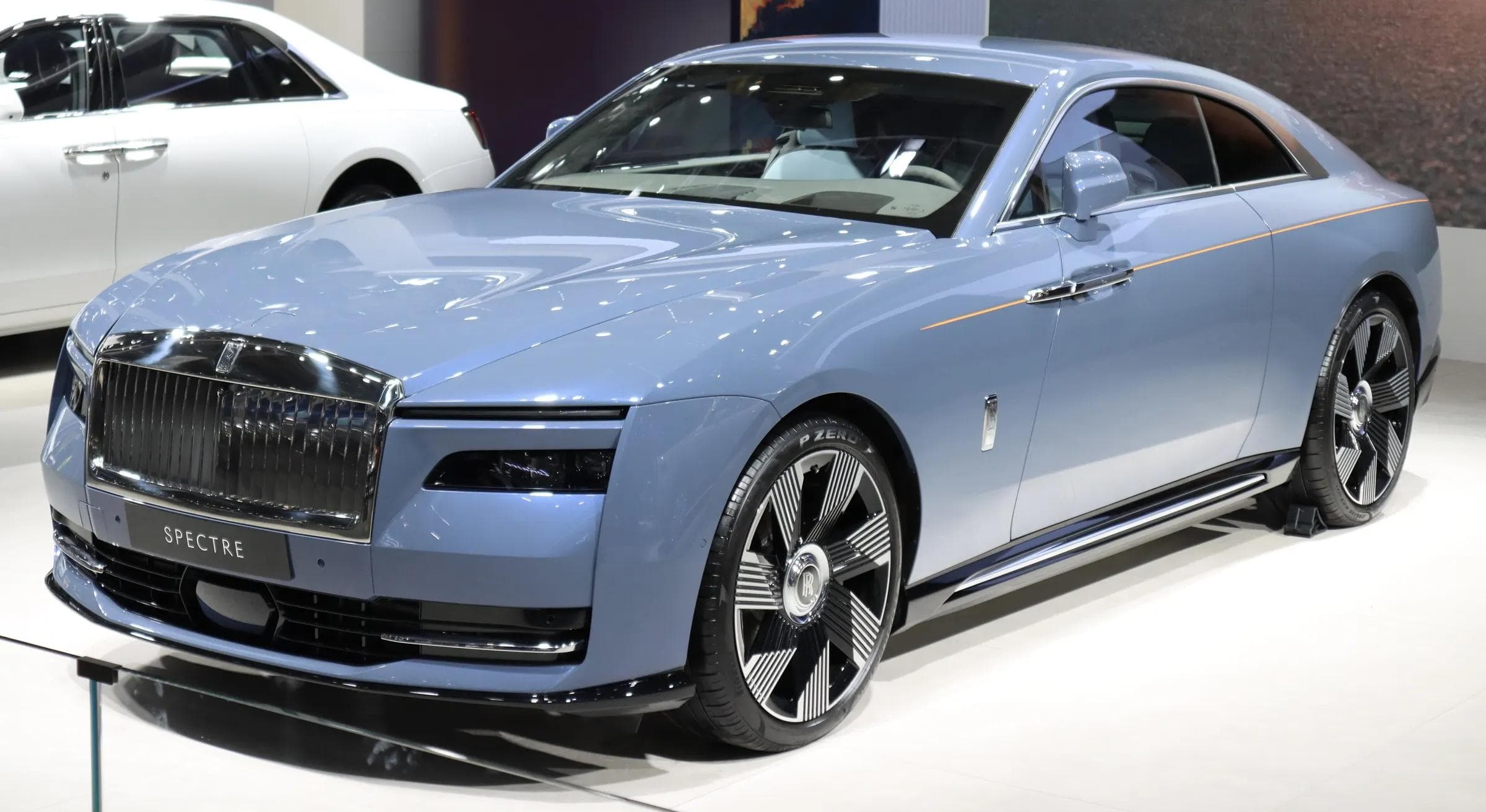
Rolls-Royce sold 1,002 Spectres in 2025, down 47 percent from the 1,890 it delivered in 2024, and in March 2026 it quietly retired the pledge the car was built to honor. The Spectre was launched in 2022 as the first fully electric car in the company's history and the cornerstone of a commitment, made under former chief executive Torsten Müller-Ötvös, that every Rolls-Royce would be battery-powered by 2030. BMW Group's annual report logged the collapse. Current chief executive Chris Brownridge confirmed the strategy reversal to the Guardian on March 18, 2026.
The Spectre's share of the Rolls-Royce lineup fell from 33 percent in 2024 to 17.7 percent in 2025. Brownridge did not set a new electrification date. "For every client that loves an electric vehicle, there is one who does not," he said, adding that the V12 is part of the company's history and will continue for the foreseeable future. The reversal lands hardest because of who said it. Rolls-Royce was, on paper, the one luxury maker with every structural reason to win at the top of the electric market: its founder, Charles Rolls, drove an early electric car in April 1900 and called it "perfectly noiseless and clean," which is the exact register a Rolls-Royce trades on.
The reflex read across automotive press has been that the apex buyer rejected the electric car, that EVs do not work at the very top, and that Rolls-Royce read the room and walked it back. That read is mostly wrong. The Spectre did not fail. It sold exactly as a Rolls-Royce sells, and it failed only against a forecast that mistook a regulatory bet for a demand signal. The number that matters is not the 47 percent drop. It is what the same buyers did with their money in the same year, and that data points the opposite way from the headline.
The Spectre did not fail. It failed against a forecast that mistook a regulatory bet for a demand signal.
Did the apex buyer actually reject the electric car
Start with what the Spectre is. The standard car makes 584 horsepower and 664 pound-feet from a dual-motor layout, with an official range of 329 miles on the European cycle and a 10 to 80 percent charge in 34 minutes on a 195kW supply, per Car and Driver. It starts around 330,000 pounds in the United Kingdom and roughly 420,000 dollars in the United States. It is, by the reviewers who have driven it, the car a Rolls-Royce was always trying to be: silent, vibration-free, effortless. Electric propulsion suits the brand's century-old thesis better than the V12 ever did.
So the demand question is sharper than the headline allows. The Spectre still outsold the Ghost in 2025, finishing 1,002 to 993, and it did so at more than double the Ghost's price. A car selling a thousand units a year at a 420,000-dollar entry point, in its second full year, against an internal-combustion sedan it beats on volume, is not a rejected product. It is a successful one measured against any sane baseline. It looks like a failure only against the 2024 figure, and the 2024 figure was inflated.
The 2024 number carried the launch surge: the order bank that Rolls-Royce itself said had exceeded its most ambitious expectations, plus the early-adopter cohort that buys the first of anything. When that bank cleared, the run rate normalized. A 1,890-to-1,002 step down reads as a collapse only if the 1,890 was the floor. It was the ceiling. The honest framing is that the Spectre found its level, and its level is a strong single product line, not the spearhead of a full-portfolio transition.
Where the same money actually went in 2025
The decisive evidence is in the rest of the lineup. Total Rolls-Royce deliveries in 2025 were 5,664, down only 0.8 percent, or 48 cars, on the year. The V12-powered Cullinan rose 27.1 percent to 3,291 units, roughly 58 percent of everything the company sold. The Ghost rose 22.9 percent. Per the BMW Group sales breakdown, the combustion cars did not soften while the EV fell. They grew, and they grew enough to hold total volume nearly flat against a halved Spectre.
That pattern only resolves one way. The Rolls-Royce buyer did not leave the brand when the electric car underperformed expectations. They moved across the showroom to the V12. The money stayed inside Goodwood. What changed was not appetite for Rolls-Royce. It was appetite for being early on a powertrain, and that was always the most fragile part of the 2030 thesis.
The commission data closes the argument. Rolls-Royce reported that it doubled its Private Office commissions worldwide in 2025, from Dubai and Seoul to Shanghai and New York, the most heavily personalized and highest-margin work the company does. Brownridge described the year as "defined by thematic richness, global collaboration and artistic evolution," and the company committed more than 300 million pounds to expanding the Goodwood site, with the new structure weathertight by November, explicitly to build out Coachbuild capacity. In the year the EV halved, the company invested at its highest-value, most powertrain-agnostic end.
Why powertrain is not the product at this price
The structural point sits underneath all of it. At 420,000 dollars and up, and far higher into Coachbuild, the buyer is not purchasing propulsion. The Coachbuild program, the Boat Tail and Droptail commissions that run into the millions and the eight-figures, is the purest expression of what the marque sells: a name, a craft, a one-of-one object. None of that depends on whether the motor burns fuel or draws current. The Spectre proved the brand can deliver electric power beautifully. The 2030 pledge asked the buyer to value the powertrain itself, on a deadline, and the buyer declined to.
This is the cleanest read on the apex EV question, and it is nearly the inverse of what played out at Ferrari. When Ferrari unveiled its first electric car, the Luce, the market punished the product, the design and the powertrain choice, on the day. Rolls-Royce's Spectre was not punished as a product. It draws acclaim from the reviewers who have driven it. What softened was the volume forecast attached to it. Ferrari took a product risk. Rolls-Royce took a timing risk. Different bets, both repriced in 2026.

What the Black Badge Spectre reveals about the strategy
The most telling product move of the cycle was the Black Badge Spectre, revealed in 2024 and run up the hill at the 2025 Goodwood Festival of Speed. It produces 485 kW, which Rolls-Royce states as 659 PS, and 1,075 Newton-meters of torque, making it "the most powerful Rolls-Royce in history," per the company's own announcement. It reaches 60 miles per hour in 4.1 seconds and starts around 490,000 dollars, roughly 70,000 dollars above the standard car, with a quoted range of 306 to 329 miles on the WLTP cycle.
Read the Black Badge as a tell. The fact that the most powerful car the company has ever built is the electric one is the strongest possible argument that Rolls-Royce believes in the platform. A company walking away from EVs does not crown its electric car as its performance flagship. So the 2030 reversal is not a verdict on the Spectre. It is a verdict on a calendar. The company is keeping the V12 because demand for it persists, not because the electric car disappointed at the bench.

What the residual-value problem actually prices
There is a real economic friction underneath the demand softness, and it is worth naming honestly rather than overstating. The deterrent at the top of the EV market is not range or charging. It is residual value. A buyer spending half a million dollars on a car wants to know what it is worth in five years, and the used-EV market has not yet produced a stable answer at this tier because the cars are too new and too few to set a floor. Bryant reads the Spectre softness as substantially a residual-value question, not a product one. That is an inference from the demand pattern, not a sourced survey figure, and it should be held as such.
The combustion Rolls-Royce, by contrast, has a century of resale data and a known depreciation curve. Faced with two cars from the same maker, one with a legible residual story and one without, the buyer who is not ideologically committed to electric power takes the known curve. That is not an EV problem in the engineering sense. It is a market-maturity problem, and it resolves on its own timeline, not on a 2030 mandate.
How this reframes the apex EV question
The pattern is not unique to Rolls-Royce. Across the top of the car market, the maker's strongest equity sits in the marque and the scarcity, not the drivetrain, which is the same logic that lets a watch house build the second-largest position in Swiss watchmaking on the strength of its name, rather than on movement complication. It is also the read running through BMW's revival of the Alpina coachbuilding line at Villa d'Este, where the value is the hand-finished object and the badge, not the powertrain underneath. Apex demand prices the name first. Everything else, including the choice of motor, is downstream of it.
The contrast with the volume-performance segment is instructive. When Porsche's profit collapsed in 2026 on a mix of EV-transition cost and softening Chinese demand, the pain ran through a brand that sells on performance and engineering rather than on a name and a commission. The further up the price ladder a maker sits, the more insulated its core demand is from powertrain risk, because the powertrain is a smaller share of what the buyer is paying for. Rolls-Royce sits at the very top, which is exactly why its EV softness reads as a timing miss rather than a structural one.
The bottom line for the apex EV thesis
The electric trophy car has been built, and it works. What has not arrived, on the timeline Rolls-Royce projected, is the buyer who chooses it for being electric. The Spectre sells as a strong product. The lineup around it grew. The commission business doubled. The reversal of the 2030 pledge says less about the apex appetite for electric cars than about the folly of attaching a volume forecast to a regulatory deadline. The right way to read the Spectre is as the most successful electric car the ultra-luxury segment has produced, judged against a target it was never going to hit on schedule. The Bryant Automotive desk tracks the trophy-car market through the cycle. The full Automotive coverage holds the running record.