
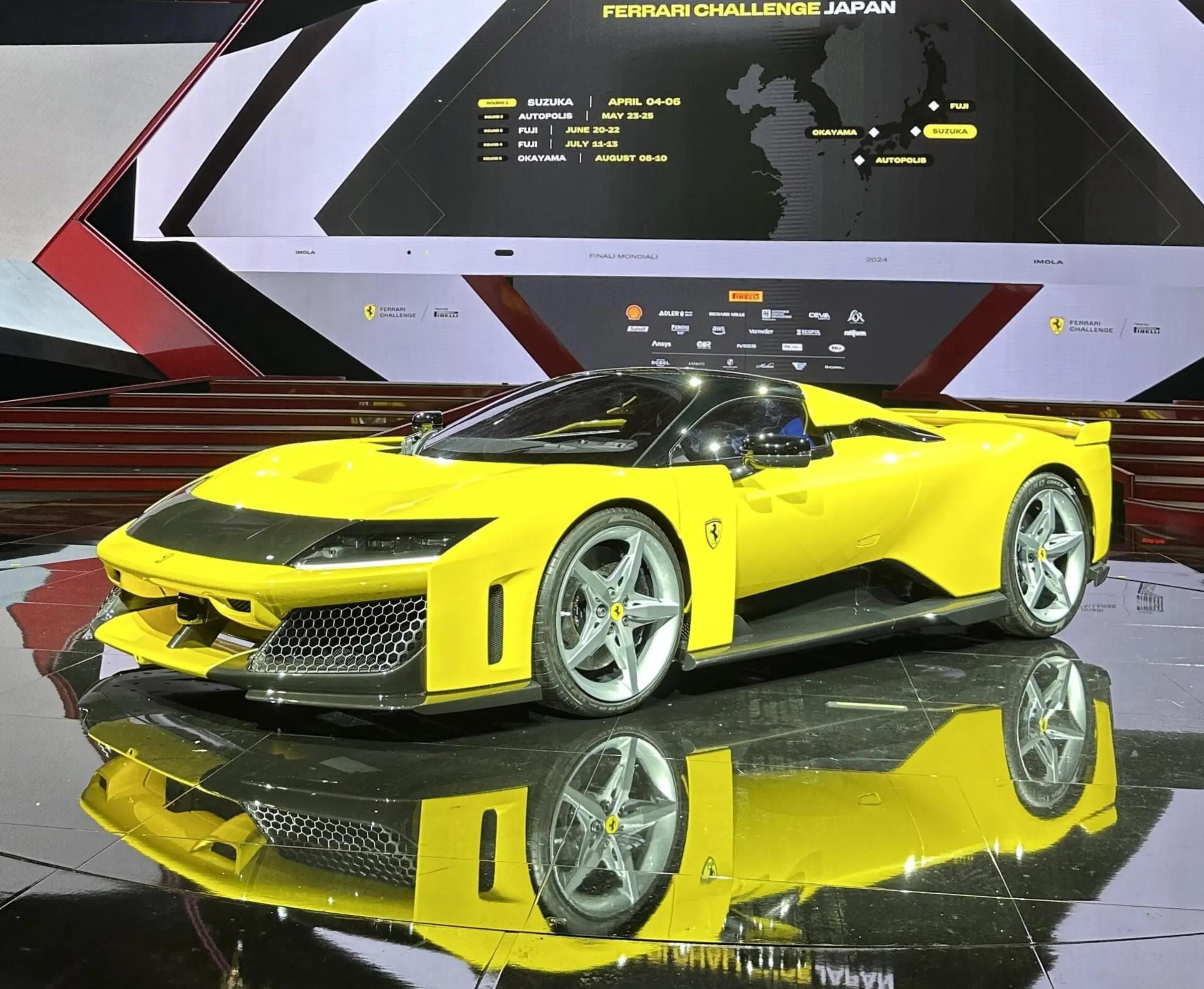
Inside eighteen months, five carmakers committed their next-generation flagships to the road, and four of them arrive carrying batteries. Ferrari revealed the F80 in Maranello on October 17, 2024. McLaren had presented the W1 eleven days earlier, on October 6. Bugatti had shown the Tourbillon that June. Aston Martin began building the Valhalla, and Pagani is still hand-finishing the last Utopia cars. Each car is the most powerful road machine its maker has ever built. Each is capped at a number the manufacturer set deliberately, and in almost every case the entire run sold before the public saw the car.
The horsepower figures read like a typo. The Bugatti Tourbillon makes 1,800 PS, or roughly 1,775 horsepower, from a naturally aspirated 8.4-liter V16 built by Cosworth and three electric motors, per Bugatti's published specification. The Ferrari F80 makes 1,184 horsepower from a twin-turbo V6 and three motors. The McLaren W1 makes 1,258. The Aston Martin Valhalla makes 1,064. Numbers that belonged to Formula 1 a decade ago are now the entry ticket to a road-car flagship. Pagani is the one holdout, and the exception is the tell.
The reflex read is that this is a horsepower race, the natural endpoint of an arms contest between marques. That read is shallow. The simultaneity is the story, not the power. Five flagships landing in the same window, all hybrid except one, all volume-capped, all pre-sold, is what a class transition looks like when it happens at the top of the market. What the 2026 class actually prices is the end of the combustion-only flagship and a scarcity discipline that has quietly become the most valuable thing these companies own.
The simultaneity is the story, not the power.
Why did the hybrid flagship arrive all at once
Start with the engineering reason the cars cluster. The hybrid hypercar is not new. The reference class is the 2013 to 2015 trio of the Ferrari LaFerrari, the McLaren P1, and the Porsche 918 Spyder, the cars the enthusiast press still calls the Holy Trinity. Those three proved that an electric motor bolted to a combustion engine was not a compromise at the top of the market but a performance multiplier, filling the torque hole turbochargers leave and sharpening throttle response below the power band. A decade of that lesson, plus a decade of battery and power-electronics progress, is what made 1,800 horsepower street-legal. The F80's V6 is derived from Ferrari's 499P Le Mans car, which is the clearest signal of where the architecture came from. The race program is now the road-car R&D budget.
The second reason is regulatory, and it is the one the marketing rarely says out loud. A combustion-only flagship is a harder car to certify and a harder car to defend through a transition that every one of these companies has publicly committed to. Folding a battery into the flagship now lets each maker book the halo car as a technology proof point for the electrified lineup beneath it, rather than as a last hurrah for an engine on its way out. The hybrid flagship is the bridge product. That four of the five chose to build that bridge in the same eighteen-month window is not coincidence. It is the same calendar pressure acting on five companies that read the same rulebook.
Pagani declined the bridge. The Utopia runs a 6.0-liter twin-turbo Mercedes-AMG V12, 852 horsepower, no hybrid system, and a seven-speed manual gearbox on the options list. Horacio Pagani bet that his buyer wants the analog experience precisely because the rest of the class abandoned it. With 99 cars, all assigned, he did not need to win the horsepower argument. He needed to be the only one not having it. That is a positioning decision, not an engineering shortfall, and it is the cleanest evidence that the class split is real.
What does the production cap actually price
The numbers each company chose are not round by accident. Ferrari capped the F80 at 799 units. McLaren capped the W1 at 399. Bugatti set the Tourbillon at 250. Aston Martin will build 999 Valhallas. Pagani will finish 99 Utopia cars. Read the caps against the price ladder and the logic resolves.
The Tourbillon sits at the top on price and the bottom on volume, at roughly 3.8 million euros, about 4.1 million dollars, for 250 cars, per Bugatti and the duPont Registry's reporting. The Ferrari F80 lists near 3.9 million dollars for 799 cars. The McLaren W1 starts around 2.1 million dollars for 399, per HiConsumption's launch coverage confirming all 399 are spoken for. The Valhalla, at a previously indicated figure near 800,000 dollars for 999 cars, is the volume play of the group and the most attainable. The cap and the price move together: the rarer the car, the higher the number, and the line is close to straight.
What the cap prices is allocation, and allocation is the asset. A 799-unit run that sells out before reveal tells a prospective buyer two things at once. First, the car is liquid the moment it is delivered, because demand exceeded supply at the primary price. Second, the only way into the car at launch was an existing relationship with the marque. Both facts are worth money. The cap converts a manufactured object into a positional good, and the buyer is underwriting the position as much as the machine.

Where does the collector value concentrate
The predecessor class is the only honest guide to where 2026 value lands, and the public secondary-market record is directional rather than precise. Excellent LaFerrari examples trade in a band that runs roughly 1.5 million dollars to north of 2 million for cars with provenance, the McLaren P1 sits a little below it, and the Porsche 918 Spyder has shown the strongest percentage appreciation off an original price near 845,000 dollars, per Magneto's Holy Trinity market read. The pattern the prior generation set is the one to extrapolate, carefully. Three forces drive the spread.
The first force is rarity, and it is not linear. The Pagani Utopia at 99 cars and the Bugatti Tourbillon at 250 are structurally scarcer than the Ferrari F80 at 799 or the Valhalla at 999. Below a few hundred units, every car that comes to market moves the whole curve, because the float is tiny relative to the pool of buyers who can write the check. Above 799, the car is still rare in absolute terms but common enough within the class that supply can meet a soft patch in demand. Scarcity compounds fastest at the bottom of the volume range.
The second force is the powertrain that is going away. Pagani's non-hybrid V12 and Aston Martin's twin-turbo V8 with a combustion character are, on current trajectory, among the last of their kind to launch in a flagship. The hybrid V6 and V16 are the future of the segment, which makes the engines that are not the future the ones likeliest to carry a nostalgia premium later. The same logic that lifted air-cooled Porsche values after water cooling arrived applies here. The car the market will miss is not always the most powerful one. It is the one that closed a chapter, which is the dynamic playing out in the broader collector shift toward buying the rarest cars at auction.
The third force is brand, and it does not split evenly. Ferrari's flagship carries the deepest collector base and the most disciplined allocation machine in the business, which is the same machine that priced the Luce launch the way it did. A Ferrari halo car with a confirmed sold-out run starts from a stronger residual floor than a peer with equal specs and a thinner collector history. Bugatti's brand sits in a category close to art rather than transport, which supports the price but narrows the buyer pool. McLaren has the engineering credibility and a smaller halo, the same gap that has historically left the P1 trading a step below the LaFerrari despite comparable hardware.

How should a buyer read the 2026 class
For a buyer choosing among these cars, the spec sheet is the least useful page. All five will outrun any road the owner can legally use them on. The decision is about which scarcity story holds. Three questions separate the cars.
First, is the allocation real or aspirational. A run that sold out before reveal, as the Tourbillon, the W1, and the Utopia reportedly did, is a different instrument from one still taking orders. The pre-sold car is liquid at delivery; the still-open car is not yet proven. Second, is the engine a closing chapter or an opening one. The non-hybrid V12 and the combustion-character V8 carry the nostalgia option that the hybrid V6 and V16, for all their performance, do not yet own. Third, does the brand have a collector base deep enough to defend the residual through a soft market. Ferrari and Pagani clear that bar most cleanly. The others are a closer call.
The same separation between a scarce, brand-defended trophy and the broad market beneath it is not unique to cars. It is the structural pattern across the trophy economy, the same dynamic visible in how Rolex raised prices into a record year while the secondary market stopped following. Scarcity at the very top decouples from the market beneath it, and the decoupling is the entire case for the asset.
What the wave signals about the next cycle
The 2026 class is the high-water mark of the combustion-hybrid flagship, and it is worth naming that plainly while the cars are still arriving. The architecture that defines this generation, a downsized engine wrapped in electric assistance, is a transitional one. The pure-electric flagship is coming, and when it does, these cars become the last combustion-engined halo machines a generation of marques built. That is precisely the condition that has historically minted collector value: a car that closes an era, built in a number small enough that the float never satisfies demand.
Aston Martin's own naming convention says it without subtlety. The Valhalla was developed under the internal project name Son of Valkyrie, the firm's 1,160 horsepower naturally aspirated V12 flagship limited to 150 cars. The lineage runs from the analog extreme toward the hybrid usable, which is the same arc the whole class is tracing. The Valkyrie is the predecessor in spirit even where it overlaps in showroom, and the comparison frames the trajectory: the segment is moving from the loudest possible statement toward the most defensible one.
Read the 2026 class as a portfolio rather than a beauty contest and the conclusion is unglamorous. The cars likeliest to hold value are not the most powerful. They are the rarest, with the engines that are ending, wearing the badges with the deepest collector bench. On those terms the Pagani Utopia and the top-allocation Ferrari F80 sit at the front, the Bugatti Tourbillon carries the highest absolute price and the narrowest buyer pool, and the Valhalla is the broadest, most usable, and most exposed to the size of its own run. The horsepower is the headline. The cap, the engine, and the badge are the trade.
The Bryant Automotive desk tracks the hypercar class transaction by transaction and cap by cap. The full Automotive coverage holds the running record, from the Valkyrie's design case to where the scarcest cars are actually clearing.
Methodology: this read is a synthesis of publicly available data. Specifications, prices, production caps, and delivery timing for the Ferrari F80, Bugatti Tourbillon, McLaren W1, Aston Martin Valhalla, and Pagani Utopia are drawn from each car's manufacturer-press and Wikipedia specification entries, cross-checked against Motor1, HiConsumption, and the duPont Registry launch coverage. Predecessor secondary-market values for the LaFerrari, McLaren P1, and Porsche 918 Spyder are framed as public market ranges per Magneto, not as precise transaction prints. Prices are approximate launch figures and vary by market and specification. No private dealer, broker, or owner conversation informs any claim.