
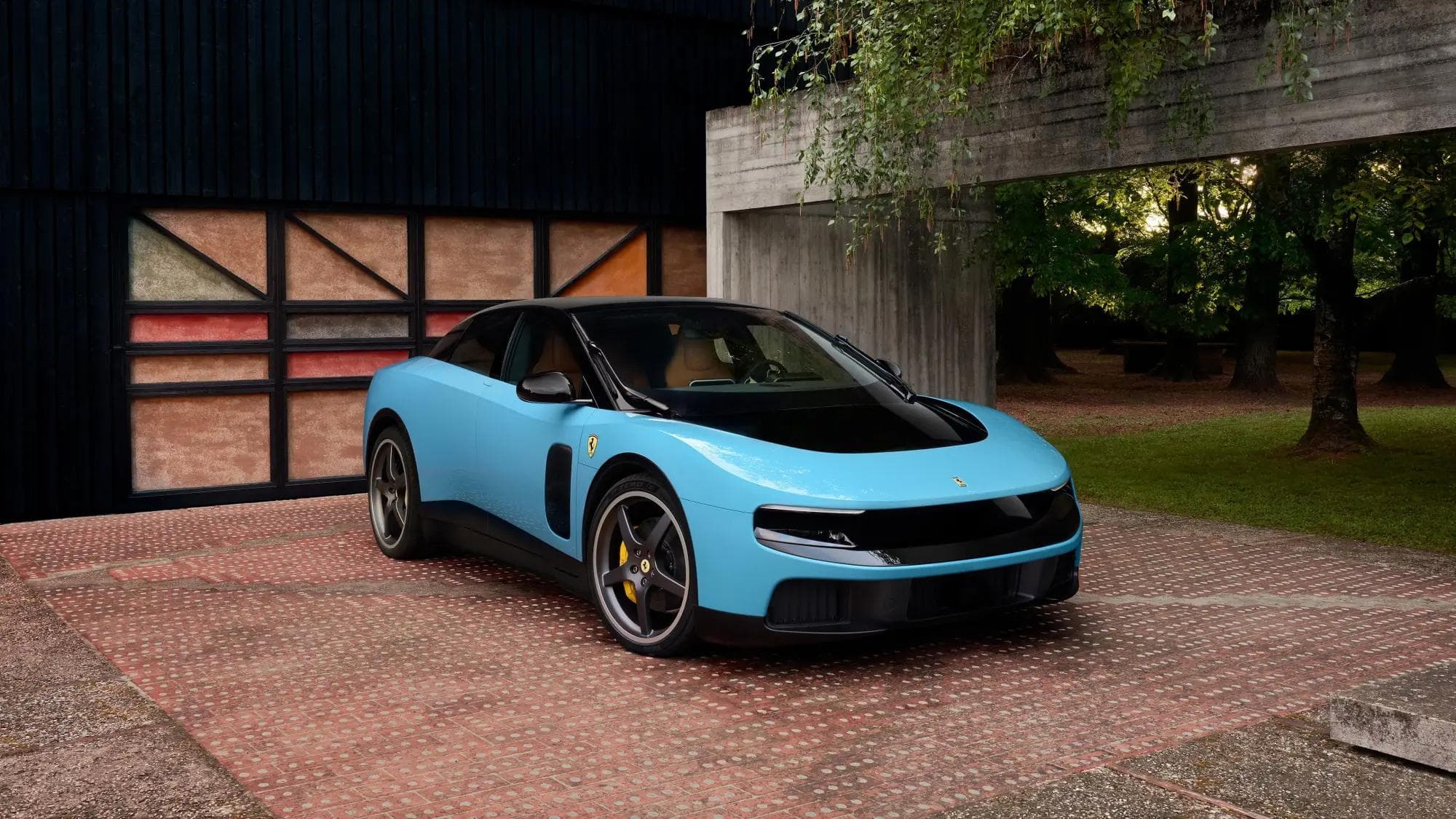
Ferrari unveiled the Luce in Rome on Monday, May 25, the first Ferrari ever shown to the world away from Maranello and the first fully electric car in the company's seventy-eight-year production history. The €550,000 four-door, five-seat grand tourer is the most ambitious commercial bet Maranello has placed since the Purosangue, designed jointly with LoveFrom, the firm Jony Ive set up after leaving Apple in 2019, and signposted to investors since the company's 2024 capital markets day as the cornerstone of Ferrari's EV transition.
The market did not love it. By Tuesday morning RACE was down 7.8% in Milan and 4.6% in New York, the steepest single-day move on a Ferrari product day in recent memory. Car and Driver called the Luce the company's "most controversial model ever." Design critics openly compared the silhouette to a Honda Accord and the rear three-quarter view to a Nissan Leaf. Former chairman Luca di Montezemolo, who built Ferrari's allocation system between 1991 and 2014 and is arguably the most influential living voice in the industry's modern history, told Italian press he hopes Ferrari takes the Prancing Horse off the car.
The reflex read across automotive press has been that the design failed and the market punished it. That read is mostly wrong. The 7.8% drop is real, but it is not pricing the styling. It is pricing three structural questions that the Luce launch surfaced, all at once, about a company whose entire equity story is built on the premise that scarcity beats scale.
The Ferrari Luce, on paper
The Luce was presented at the Vela di Calatrava in Rome's Città dello Sport, a Santiago Calatrava-designed venue better known for hosting World Aquatics championships than supercar reveals. Maranello chose it deliberately. The first Ferrari launched outside Italy's Motor Valley needed a setting that signaled something other than red-paint Italian-supercar heritage.
Headline specs: €550,000 base price (≈ $640,000 at launch-day FX). Four permanent-magnet synchronous motors with a combined 1,035 horsepower (282 front, 831 rear). 0-100 km/h in 2.5 seconds. Top speed above 310 km/h. A 122 kWh structural battery pack on an 800V architecture that takes 350 kW DC fast charge. WLTP range above 500 kilometres. Five seats — a Ferrari first — across four doors. Customer deliveries begin Q4 2026. The most important phrase from launch-day analyst commentary was Maranello's framing of the second EV: "at least 2028," pushing EV-2 out from a previously implied 2027 cadence.

Why the 7.8% drop is about more than design taste
Three things sit underneath the move that the styling commentary misses.
One: the Luce stretches Ferrari's volume thesis. Ferrari trades at a premium multiple because the market believes the company will sell fewer cars at higher prices forever. A five-seat EV at €550,000 in a four-door grand-touring format opens a question about whether Maranello is reaching for volume (which would dilute the scarcity premium that justifies the multiple) or whether the Luce is a deliberately constrained halo (which limits its financial contribution). Ferrari has not disclosed Luce production volume targets. Until the H1 results call on July 30, the multiple is harder to defend in either direction.
Two: pushing EV-2 to 2028 is a confession, not a delay. Ferrari's previous EV transition deck, presented to investors in late 2024, implied a faster second-EV cadence. Pushing it out says one of two things. Either Maranello does not yet have an architecture that gets ICE-loyal collectors to spend more than a million dollars on an electric flagship, or it has the architecture and has chosen to slow-walk the migration to protect the allocation system. Either way, the "Ferrari is becoming an EV company" framing got materially harder to argue overnight.
Three: the Jony Ive credit cuts both ways. Inside Ferrari, the LoveFrom collaboration was framed as the lifestyle-EV proof point. The post-launch coverage has been the opposite. Ars Technica called the result "amazing interior, controversial exterior." When the design credit on a Ferrari can be traced to a Cupertino-adjacent firm, Maranello is signaling that Ferrari design language has been redefined. That redefinition is a feature, not a bug, only if the future buyer profile is closer to Apple-money than the existing collector base. The audit on that thesis is open.
What the Luce launch actually does for allocation
The buyer pool for the F80, the Daytona SP3, the 12Cilindri, and the Purosangue does not overlap with the buyer pool for a five-seat, four-door electric grand tourer. A family-office principal who has been on the Purosangue waiting list for two years is not the same person who walks into Maranello's order book with a Tesla Model X in the family garage and asks for the EV. Bryant has tracked the same designer-pedigree-as-asset thesis on the Aston Martin Valkyrie.
That separation is the strategic point. Read the Luce as Ferrari's regulatory hedge: a real EV product with real fleet emissions math that lets the rest of the lineup remain V12 and V8 for another full product cycle. If you are sitting on a Daytona SP3 allocation or a Purosangue waiting list and you have been nervous that EVs would dilute the ICE program, the Luce is what tells you that worry is misplaced. The opposite is true. The Luce existing protects everything you already own.
The 599 GTB Fiorano analog applies. Maranello has done this before. Build the product that satisfies the market the analysts care about (in 2006, a 599 that would actually do laps; in 2026, an EV that registers as compliance) so that the products that matter to the collectors remain unbothered. The same logic that drove the 599 launch is driving the Luce launch. The market correctly priced the implication on Tuesday morning, even if the trade press misread the cause.

For the pre-owned ICE allocation market the Luce launch is largely a non-event. The 296 GTB, the Roma, and the 12Cilindri trade on a different buyer profile and a different scarcity dynamic than the Luce. The next two quarters of Hagerty Price Guide and Bring a Trailer running averages will either confirm or refute that read. Bryant's read across the broader collector automotive market, including the shift toward auction-driven price discovery for trophy cars, suggests the structural separation will hold.
What Luca di Montezemolo's pushback actually signals
The instinct on the "remove the Prancing Horse" quote is to take it as a sincere editorial on the design. It almost certainly is not. Montezemolo built Ferrari's allocation system between 1991 and 2014. He invented the modern scarcity architecture. He understands, better than anyone alive, that the worst thing Ferrari could do is launch an EV that genuinely competes with the ICE flagships for allocation share. The Luce launching as a polarising product, panned by the brand's own former chairman, is approximately the best possible outcome for the existing allocation system.
Read the comment as a defense of allocation politics, not an aesthetic complaint. Owning an F80 still means what it meant six months ago.
He is signaling to the collector base that the Luce is not a Ferrari in the sense that the F80 is a Ferrari, which means owning an F80 still means what it meant six months ago. That is the message a brand whose entire moat is scarcity needs to deliver. If that read is right, Tuesday's 7.8% move was Ferrari executing the launch exactly as designed. The drop is the cost of the hedge.
What changes on the desks over the next 90 days
Three things to watch.
The pre-owned ICE Ferrari book. If the allocation-politics theory holds, secondary pricing on the 296 GTB, the Roma, and the 12Cilindri firms between now and Q3. If the Luce is actually drawing collector attention away from the ICE program, those segments soften.
The Luce production volume disclosure. Ferrari has not published a target. The H1 results call on July 30 is the first scheduled window. A higher production number means Maranello is genuinely chasing volume and the multiple has further to fall. A lower number confirms the halo-product framing and the sell-side reverses some of the May 26 move.
The 2028 EV-2 architecture announcement. When a product gets pushed from a public timeline, Maranello tells the analyst base what is replacing it. Expect that disclosure between Q3 and Q4 results. The architecture spec on EV-2 will tell you whether Ferrari is building a Luce successor (volume EV) or a true ICE-collector EV (low-volume, V12-equivalent allocation positioning).
The Luce will sell. Ferrari knows how to sell €550,000 cars to family offices in Riyadh and Como. That was never the question. The question was whether the launch would force the rest of the brand to behave differently. The early read from Maranello's launch-day commentary is no. The 7.8% drop is what happens when the analyst base prices in the absence of a Ferrari EV transition, not the arrival of one. The same dynamic is playing out across legacy automakers reaching for EV credibility without diluting their core franchise. Bryant has tracked the same pattern at BMW Alpina, where the brand-split decision protected the heritage product line. The mechanic is structurally identical. The Luce protects what was already protected. The market reads it that way too. More in Automotive.