
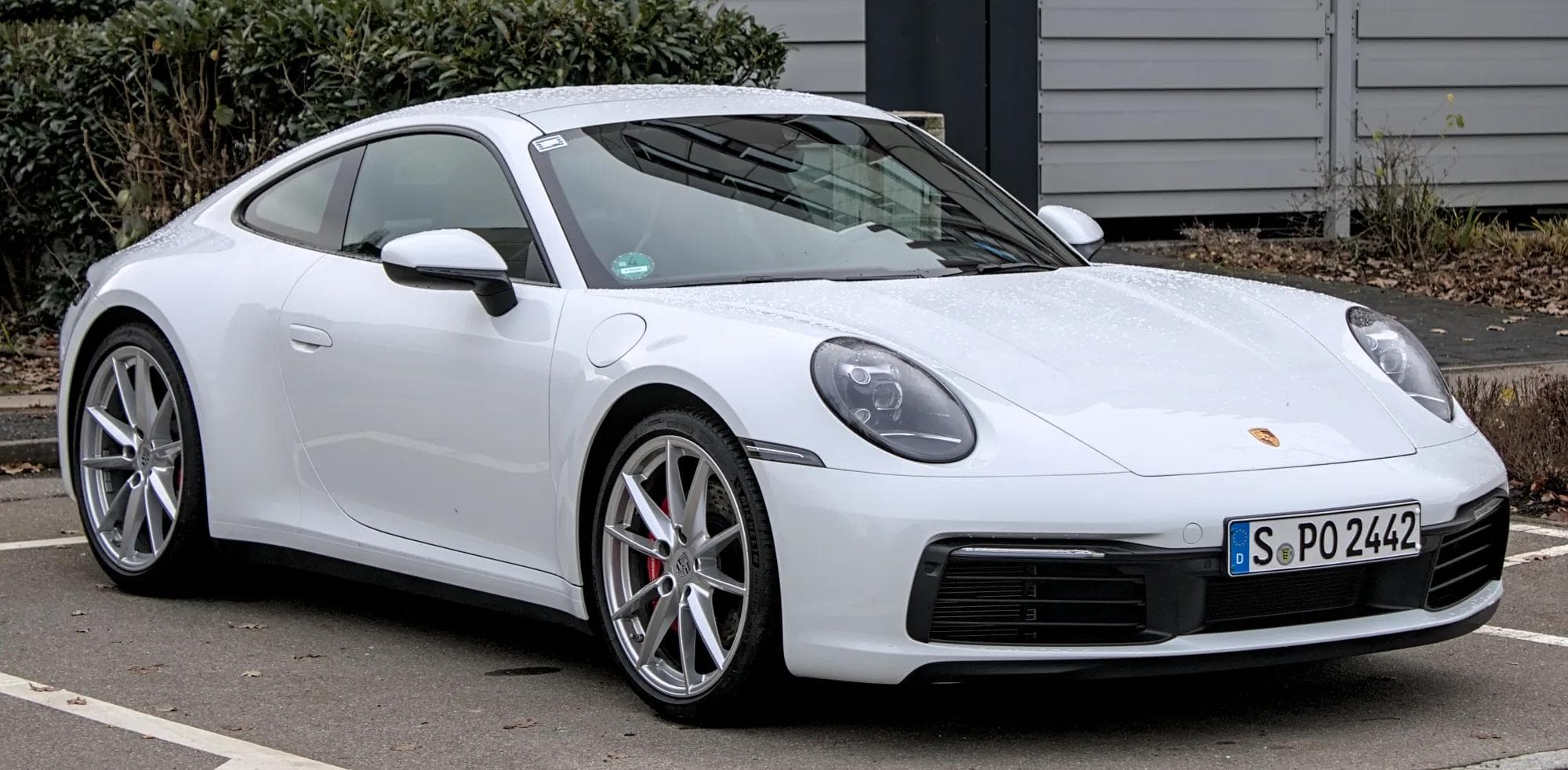
Porsche reported its first-quarter 2026 deliveries on April 10, and the headline number was bleak: 60,991 cars worldwide, down 15 percent from the 71,470 it delivered a year earlier. China fell 21 percent. Overseas and emerging markets fell 20 percent. The Panamera fell 42 percent and the 718 sports-car line, now winding down, fell 60 percent. It was the kind of quarter that follows a full-year result in which Porsche's automotive operating profit had fallen 98.3 percent to 90 million euros, dragged down by roughly 3.9 billion euros in charges tied to its retreat from an all-electric future.
One line went the other way. Deliveries of the 911, the rear-engined sports car that has anchored the brand since 1963, rose 22 percent to 13,889 units. It was the only model line in the range to grow, and it grew while everything around it contracted. That single divergence is the most important data point Porsche has published in two years, and it explains the strategy the company is now betting its recovery on.
Value over volume is not a slogan at Porsche. It is the price of admission for a 911.
The reflex read across the financial press has been that Porsche is a luxury franchise in distress, caught between a collapsing China, a botched electric-vehicle transition, and a reported group operating margin that fell from 14.5 percent in 2024 to 0.3 percent in 2025. All of that is true. But the 911's 22 percent gain inside a 15 percent decline is not a contradiction to be explained away. It is the thesis. Porsche is not failing at being a volume manufacturer. It is being reminded, expensively, that it was never supposed to be one.
Why did the 911 grow while everything else fell?
The honest answer is that the 911 is the part of Porsche that behaves most like a scarce asset and least like a mass-market car. The 718 decline reflects a model at the end of its combustion life. The Macan's 23 percent fall reflects the awkward ramp of an electric replacement against a discontinued petrol original. The Panamera's 42 percent drop reflects a sedan segment in structural retreat. The 911 has none of these problems. It is supply-constrained, allocation-managed, and priced into a customer base that does not flinch at list increases.
The pricing tells the story. The entry 911 Carrera now lists at 135,500 dollars in the United States before a 2,350-dollar destination charge, an increase of roughly 8,000 dollars inside a single model year, according to CarBuzz's 2026 price tracking. The Drive notes the 911 now starts about 40,000 dollars higher than it did five years ago. At the top of the range, autoevolution reported only 31 examples of the 2026 911 Turbo S available across the United States, with asking prices between 285,000 and 344,000 dollars and an average of seven days on dealer lots. A car that sells in a week at a six-figure premium is not suffering from weak demand. It is being rationed.

This is the same market structure that drives the auction economy The Bryant has tracked in its read on why collectors are buying at auction instead of dealers, where the scarcest examples set the price and the price sets the brand. Porsche's problem in 2026 is not that its best product is weak. It is that its best product is a small share of its volume, and the rest of the volume got built around an EV thesis that the market has not yet rewarded, much as the design risk in the Aston Martin Valkyrie sits in a different part of the value stack than the engineering.
What actually broke in 2025?
The damage was concentrated, accounting-driven, and largely self-inflicted by a strategy reversal. For the full year 2025, Porsche AG's group operating profit fell 92.7 percent to 413 million euros, and the automotive division's operating profit fell 98.3 percent to 90 million euros, per Euronews. Roughly 3.9 billion euros in extraordinary charges drove the collapse: about 2.4 billion euros tied to strategic and product-strategy realignment, 700 million euros in battery-related charges, and 700 million euros in US tariff costs. Revenue fell 11.7 percent to 32.2 billion euros and deliveries fell 10.1 percent to 279,449 vehicles.
The scale of the reset is clearest in the year-over-year comparison. Deliveries fell from 310,718 cars in 2024 to 279,449 in 2025, down 10.1 percent. Revenue fell from 36.1 billion euros to 32.2 billion, down 11.7 percent. Group operating profit fell from 5.6 billion euros to 413 million, a 92.7 percent drop, and the reported group operating margin collapsed from 14.5 percent to 0.3 percent, a swing of 14.2 points. Those 2024 figures are the prior-year bases stated in the same full-year 2025 results, as reported by Euronews and Automotive News in March 2026.
The write-downs are the consequence of a decision, not an operating failure. Porsche had committed to an aggressive battery-electric roadmap and an 80 percent EV sales ambition by 2030. As demand for electric performance cars failed to materialize at the pace planned, particularly in China and after the United States ended consumer EV tax incentives, the company wrote down the deflated value of those plans and reset. CFO Jochen Breckner framed 2025 as the trough that precedes a noticeable improvement from 2026 onwards, language that tells you management views the pain as a one-time reset rather than a structural decline.
Is Value over Volume a real strategy or a face-saving phrase?
It is real, and the China decision is the proof. Faced with a 21 percent delivery drop to 7,519 vehicles in its single most important growth market, Porsche has declined to discount. CEO Michael Leiters has made Value over Volume the organizing principle of the reset, prioritizing margin per car and pricing integrity over unit recovery. The company has said explicitly that it sees clear buyer hesitation in China and is deliberately avoiding the heavy discounting that local competitors are using to move metal.
That is a counterintuitive move for a manufacturer staring at a 15 percent volume decline, and it is the single clearest signal of where Porsche thinks its value lives. A brand that discounts into a soft market protects this quarter's units and erodes the next decade's pricing power. A brand that holds price accepts the volume hit and protects the scarcity premium that lets a 911 Carrera absorb an 8,000-dollar increase without losing a buyer. Porsche is choosing the second path, which is the only path consistent with a 22 percent gain on its most rationed product.
The forward product plan reinforces the logic rather than contradicting it. Porsche has not abandoned electrification. In Beijing on April 24, it unveiled the new Cayenne Electric, with up to 1,156 PS of overboost power in Turbo specification and as much as 669 km of WLTP range, across three drive variants. The difference from the old plan is that the electric Cayenne now sits alongside combustion and plug-in hybrid Cayennes indefinitely, rather than replacing them. Porsche is extending the life of the engines it had planned to retire and rescheduling the EV platform it had planned for the 2030s. The bet is no longer that customers will follow Porsche into an all-electric future on a fixed timeline. The bet is that Porsche will sell them whatever powertrain they want, at a price that protects the margin.

What the 911 number means for the rest of the luxury field
Porsche is not the only performance brand reporting in 2026, and the contrast is instructive. In the same window, Automobili Lamborghini delivered 2,620 cars in the first quarter on revenue of 863 million euros and a 23.1 percent operating margin, with a fully hybridized lineup and no all-electric exposure to write down. Lamborghini never made the all-electric commitment Porsche did, never took the impairment, and is compounding margin while Porsche resets. The lesson is not that hybrids beat EVs. It is that the brands which kept their powertrain bets proportional to actual demand avoided the charge that just erased 98 percent of Porsche's automotive profit.
For the ultra-high-net-worth buyer, the takeaway is narrower and more useful. The 911 is doing in the new-car market what the best examples do in the collectible market: appreciating in price, rationed in supply, and indifferent to the macro softness hitting the rest of the category. The watch market is watching the same dynamic play out in allocation-managed steel sports references, a pattern The Bryant documented in its read on the Patek Cubitus allocation game, and the logic rhymes across categories: scarcity, held discipline on the part of the maker, and a buyer pool that treats access as the product. Porsche spent 3.9 billion euros learning that the scarce part of its franchise was the part worth protecting. The 22 percent number is the receipt.
The question for the next four quarters is whether Porsche can extend that discipline across a range where most of the volume is not, and may never be, as scarce as the 911. The reset buys time and protects the crown jewel. It does not solve the structural problem that a 911-only Porsche is a much smaller company. But for a principal weighing where pricing power actually sits in this brand, the first quarter of 2026 answered the question with unusual clarity. The crisis is in the volume. The value is in the scarcity. They were never the same business. For buyers tracking how access-managed assets behave when the wider market softens, the full Automotive coverage carries the related analysis on where pricing power is concentrating across the performance category.