
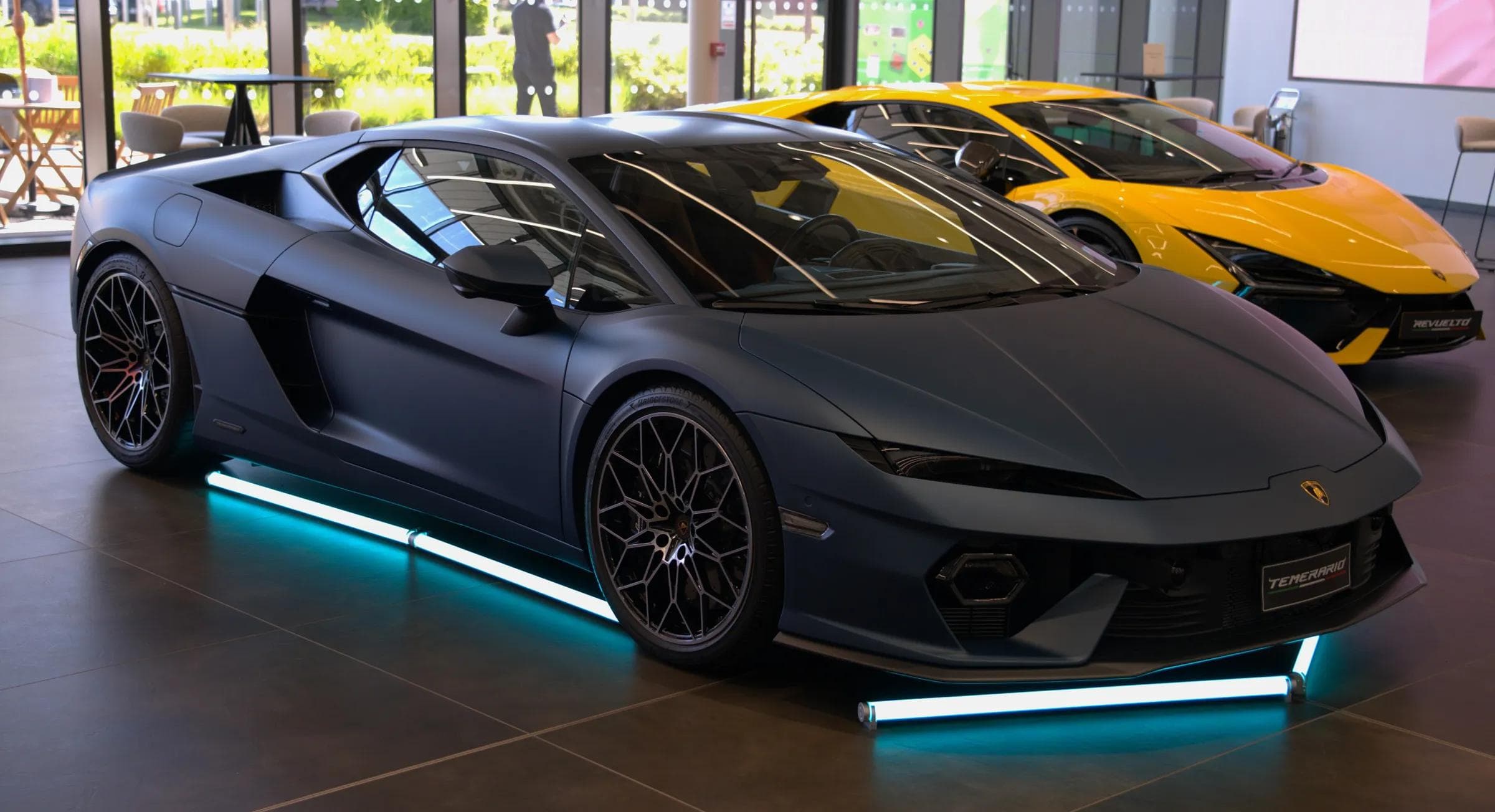
Lamborghini unveiled the Temerario at Monterey Car Week in August 2024 and then did something quietly radical with it. The car that replaces the Huracan, the best selling product in the marque's history, arrives with no naturally aspirated option at all. In its place sits a 4.0 liter twin turbo V8 paired with three electric motors, a flat plane crankshaft, and a 10,000 rpm redline that Lamborghini calls the only production super sports car able to reach that figure. Customer deliveries began in January 2026.
The headline that ran almost everywhere framed this as Lamborghini going hybrid, another marque bowing to emissions rules. That framing is half the story and the less interesting half. The same week the Temerario started reaching customers, Lamborghini was finalizing the decision to cancel its first fully electric car, the Lanzador, with chief executive Stephan Winkelmann telling reporters that customer interest in a Lamborghini without a V8 or V12 was close to zero. The company that just killed the naturally aspirated V10 also just killed its own EV.
Read together, the two decisions are not a contradiction. They are a single strategy stated twice. Lamborghini is not electrifying. It is using a battery to defend the combustion engine, buying the regulatory headroom to keep building cars that rev to 10,000 rpm for as long as the rules and the buyers allow. The Temerario is the clearest expression of that bet, and the end of the V10 is the cost of placing it.
The company that just killed the naturally aspirated V10 also just killed its own EV. The two decisions are a single strategy stated twice.
What the Temerario actually replaces
The Huracan ran from 2014 to August 2024 on a 5.2 liter naturally aspirated V10 making between 602 and 640 PS depending on variant. It was the most commercially successful car Lamborghini had ever built. By late 2019 it had already matched the lifetime production of its predecessor the Gallardo at 14,022 units in roughly half the time, a figure Lamborghini confirmed at the time. Lamborghini has not published a final cumulative total, so the honest number to anchor on is that 2019 milestone and the model's full decade in production. The Huracan was succeeded by the Temerario, announced in 2024, and the marque had signaled the direction two years earlier: in November 2022 it confirmed the Huracan Sterrato would be the last non hybrid model it launched.
The Temerario's powertrain is a different machine entirely. Lamborghini's own technical brief puts the V8 at 800 PS from 9,000 to 9,750 rpm and 730 Nm of torque, with a central electric motor and two front axle motors lifting the combined output to 920 PS, roughly 907 hp. The car runs 0 to 100 km/h in 2.7 seconds and tops out at 340 km/h. It is the first mid engine V8 Lamborghini since the Jalpa went out of production in 1988, which means the marque did not simply swap one engine for another. It reached back four decades for a configuration it had abandoned.
Why kill the V10 and the EV in the same breath
The Lanzador cancellation is the part of the story that reframes everything. Lamborghini showed the Lanzador as a concept in 2023, slated a production version first for 2028 and then 2029, and at the end of 2025 scrapped the fully electric car outright. Winkelmann's language was unusually direct. Investing heavily in full EV development when the market and customer base are not ready, he said, would be an expensive hobby, and financially irresponsible toward shareholders, customers, employees and their families. Lamborghini still intends to launch a plug in hybrid sports car by the end of the decade, with a combustion engine rather than a battery at its core.
That is the context the Temerario lives in. The hybrid V8 is not a stepping stone toward an electric Lamborghini. There is no electric Lamborghini coming. The battery exists to do two jobs: fill the torque gap below the V8's high power band, and lower the fleet's emissions enough to keep the combustion engine legal in the markets that matter. Strip the green framing away and the strategy is the opposite of what the hybrid badge implies. Lamborghini is spending electrification money to protect internal combustion, not to retire it.

What the hybrid pivot is doing to residuals
For anyone holding a late Huracan or a final special edition, the V10's retirement is the part that matters, and the early signals are mixed in an instructive way. The Temerario starts at 357,621 dollars in the United States per Lamborghini's configurator at launch, against 249,865 dollars for the Huracan Tecnica it effectively succeeds. That is a step of more than 100,000 dollars on the base car, a derived gap from the two published figures, before a single option. Options run hard: paint to 32,700 dollars, carbon wheels at 26,200 dollars, an Alleggerita lightweighting package up to 78,600 dollars. A loaded Temerario clears half a million.
And yet the new car is not commanding a premium on the street. Within months of deliveries starting, a Beverly Hills dealer was reported to be offering new Temerarios at under sticker, with one near delivery mileage example listed at 449,000 dollars after a discount. A new Lamborghini selling below MSRP in its first year is not a crisis, supercar launch markups soften routinely once initial allocation clears, but it is a data point worth holding next to the residual question. The scarcity premium in the modern Lamborghini lineup is increasingly attaching to what is ending, the naturally aspirated engine, rather than to what is launching.
That is the structural case for the late V10 cars. The Huracan was the last Lamborghini built around an engine that breathes on its own, in an era when every successor will carry a turbo and a battery by regulatory necessity. Final naturally aspirated examples from a marque that has publicly committed to never building another are the kind of asset that tends to find its floor and hold it. The public data sources to watch are the auction houses and valuation trackers, not a forecast invented here. What is verifiable today is the supply side: the configuration is gone, and Lamborghini has said it is not coming back.
Is the bet actually working
The most striking number in Lamborghini's recent results is that the company set an all time sales record in 2025 without delivering a single Temerario. Per Lamborghini's own 2025 delivery report, the marque delivered 10,747 cars, a new record, split 4,650 in EMEA, 3,347 in the Americas, and 2,750 in Asia Pacific. The Temerario contributed nothing to that figure; its first customer deliveries fell in January 2026. Carscoops noted the oddity directly: the record was carried by the Revuelto, the Urus SE, and the last Huracan deliveries, with the Americas down 11 percent on the year even as the global total rose.
The order book makes the same point forward. Lamborghini says the Temerario already carries roughly twelve months of orders, which means the combustion plus battery formula is selling out the production slots before the cars exist. On the demand side, the strategy is intact. The buyers who told Winkelmann they had close to zero interest in an electric Lamborghini are evidently happy to pay 357,621 dollars and up for a V8 hybrid that sounds and revs like the engine it replaced.

Where the strategy gets expensive
The cost shows up on the margin line, not the volume line. Per Reuters coverage of the 2025 results, revenue rose 3.3 percent to 3.2 billion euros, but operating income fell to 768 million euros from 835 million in 2024, and the operating margin slipped to 24 percent from 27 percent. Three things did the damage: United States tariffs in Lamborghini's single largest market, currency moves, and charges tied to scrapping the electric Lanzador. Winkelmann said the company raised prices last year but not enough to offset the tariff rates, and that it does not plan further increases in 2026 because higher prices are not helping the market.
Read that against the strategy and it resolves cleanly. The EV reversal protected the brand's pricing power and its relationship with a buyer base that does not want batteries, but it carried a one time write down. The tariffs are an external tax on selling combustion supercars into America. The combination compressed margin by three points in a single year while volume hit a record. Lamborghini is paying, in profit, to keep building the kind of car the Temerario represents. The 24 percent margin is still the envy of most of the industry, but the direction of travel is the tell: the combustion bet is getting more expensive to run, not less.
The bottom line for buyers
The Temerario is the most capable Huracan successor Lamborghini could have built and the clearest statement of where the marque is going, which is not toward electric power. For a buyer choosing between the new car and a late V10, the decision is no longer just about specification. The Temerario is the future of the lineup and already trades at or below sticker in its first year. The naturally aspirated Huracan is the end of a configuration the manufacturer has confirmed it will never build again. The same separation between what is scarce and what is merely new runs through the wider collector market, where the rarest cars are clearing at auction while the broad market softens. It is visible in Porsche's profit collapse and in the market's cool reception to Ferrari's first electric car. The pattern is consistent: at the top of the market, scarcity is doing the pricing, and an electrification badge is not scarcity.
The same volume versus scarcity tension is playing out one industry over in the water, where the largest yards are chasing order book volume even as the rarest hulls hold their value independently. Lamborghini's answer, for now, is to take the margin hit and keep the engine. The Bryant Automotive desk tracks how that bet ages, model by model.